The key points are temporarily unavailable. You can still read the full Story below.
Main Points
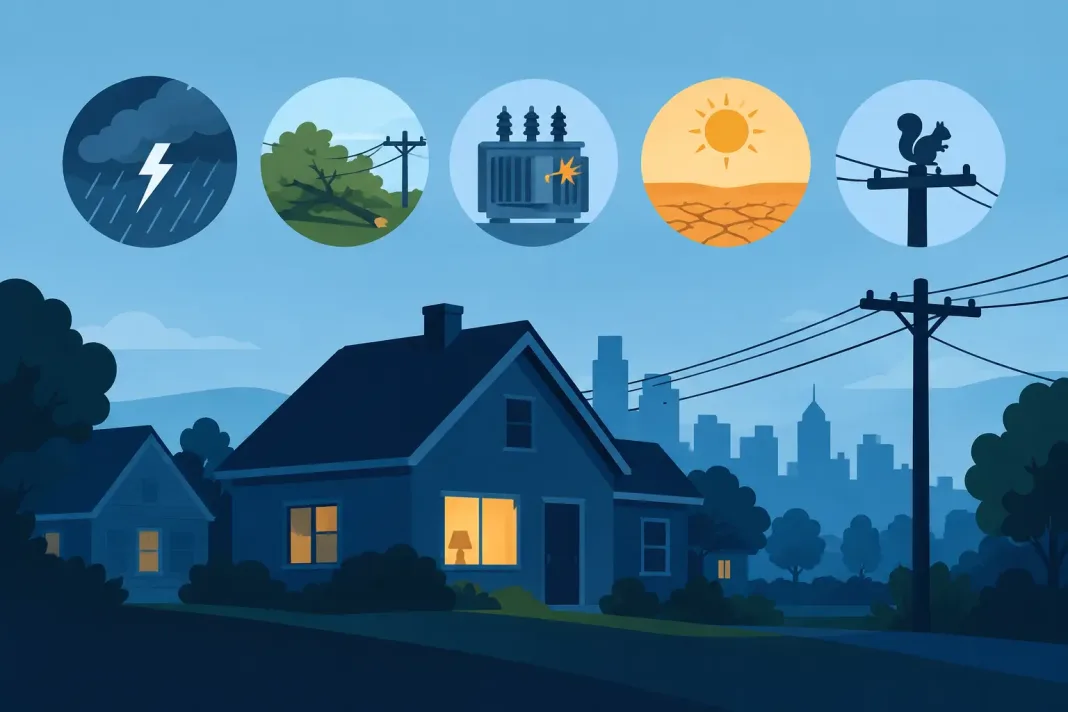
A neighbourhood can go from ordinary evening noise to sudden darkness in seconds. Fans stop, Wi-Fi drops, traffic lights may go out, and families start checking whether the problem is only inside the house or affecting the whole area. For anyone asking what causes electricity outages, the answer is rarely just “bad weather”. Power cuts can begin at a generating plant, along a transmission line, at a local transformer, or even at one damaged connection serving a single street.
The difference matters. It helps residents understand why some outages are restored quickly while others last longer, and why updates from electricity providers can sometimes change as crews assess damage on the ground.
What causes electricity outages across a power network?
Electricity reaches homes and businesses through a chain. Power must be generated, moved over high-voltage transmission lines, stepped down at substations, then distributed through poles, wires, transformers and service lines to individual properties. A fault at any point can interrupt supply.
A major failure close to generation or transmission can affect wide areas at once. A problem on a local distribution line may leave one community without power while nearby districts remain unaffected. In a single-property outage, the cause could be a tripped breaker, damaged internal wiring or an issue with the service connection rather than the wider grid.
This is why a power cut in one village may have a completely different explanation from an outage reported elsewhere on the same day.
Severe weather and lightning
Storms are among the most visible causes of outages in Trinidad and Tobago and across the Caribbean. High winds can bring down branches, poles and wires. Heavy rain can flood equipment or make access difficult for repair crews. Lightning can strike lines, transformers and substations, causing protective systems to disconnect part of the network to prevent more serious damage.
Even where a hurricane does not make landfall, rough weather can still affect the grid. Saturated ground may cause trees to topple days after a storm, while salt spray and coastal conditions can speed up wear on equipment over time.
Weather-related outages are not always a sign that a system has failed. Safety devices are designed to cut power when they detect a fault. The immediate blackout is frustrating, but leaving a damaged line energised could put residents and crews in danger.
Fallen trees, vegetation and accidents
A tree branch touching a power line can trigger an outage without bringing down an entire pole. Vegetation management is therefore a major part of keeping electricity reliable, particularly in communities with dense trees, narrow roads or lots of overhead wiring.
Road accidents can cause sudden and localised outages when a vehicle hits a utility pole, transformer or roadside cabinet. Construction work can also damage underground cables. In these cases, restoration may take longer if crews need to replace poles, secure the area, coordinate with police or road authorities, and make the site safe before repairs begin.
Residents should treat every downed wire as live. Keep away, keep others away, and report it to the relevant electricity provider or emergency authorities. Do not attempt to move a wire with a stick, rope or vehicle, even if it appears harmless.
Equipment failure and ageing infrastructure
Transformers, switches, cables, insulators and circuit breakers work under constant electrical and environmental stress. Like any equipment, they can fail. Heat, moisture, corrosion, repeated power surges and normal wear can all shorten the life of critical components.
A transformer failure is often dramatic – residents may hear a loud bang or see a flash – but the cause is not always immediately clear. Crews must inspect the equipment, isolate the fault and determine whether a repair is possible or whether a replacement is needed.
Ageing infrastructure can increase the risk of faults, especially where demand has grown faster than upgrades. But age alone does not tell the full story. A newer piece of equipment can fail after a lightning strike, while older infrastructure can continue operating safely if it has been properly maintained and upgraded where necessary.
Demand spikes can put pressure on the system
Electricity demand rises when many people use power-hungry appliances at the same time. Hot periods are a familiar example, as air-conditioning units run for longer across homes, offices, schools and businesses. Large industrial users can also affect overall demand patterns.
Grid operators plan for peaks, but unusually high demand can put pressure on generation and distribution equipment. If supply cannot meet demand, controlled load shedding may be used to prevent a wider collapse of the system. This is different from an unexpected fault: it is a deliberate, temporary interruption intended to protect the wider grid.
Households can reduce strain during peak periods by setting air conditioners sensibly, switching off unused appliances and avoiding unnecessary heavy loads where possible. Individual action will not solve a system-wide shortage, but widespread conservation can help at the margins.
Problems at generation plants or transmission lines
Not every outage begins near a home. Generating units can trip offline because of mechanical faults, fuel supply issues, maintenance problems or protective shutdowns. If enough generation is lost quickly, frequency on the grid can become unstable and automatic protection systems may disconnect customers.
Transmission lines carry large volumes of electricity across long distances. A fault on one line may be manageable if the network has alternative routes. If multiple lines or a major substation are affected, the result can be a broad outage. Restoring supply in those situations is a careful process. Operators cannot simply switch everything back on at once without risking another failure.
For the public, the key question is scale. Are several regions affected? Has the provider identified a generation, transmission or substation issue? Those details offer a clearer picture than rumours shared in group chats.
Planned outages are disruptive, but often prevent bigger failures
Some power cuts are scheduled for maintenance, upgrades, tree trimming or the safe replacement of equipment. These planned outages are inconvenient, particularly for people working from home, small businesses, medical needs and households with young children or elderly relatives.
Still, planned work can prevent more serious unplanned failures. Replacing a weakening pole, servicing a substation or clearing vegetation near lines usually requires electricity to be shut off in a controlled way. The trade-off is short-term disruption against lower risk of a longer, more dangerous breakdown later.
Where notice is provided, residents can prepare by charging mobile phones and power banks, storing water, protecting refrigerated medication where advised, and making arrangements for work or school. Businesses should also consider surge protection and backup plans for point-of-sale systems, internet equipment and perishable stock.
Why restoration times vary
The first crew on site may need to investigate before anyone can give a credible restoration estimate. A blown fuse may be resolved quickly. Replacing damaged poles, restringing lines, clearing fallen trees or repairing a substation can take far longer, especially in poor weather or after widespread damage.
Restoration also follows safety and network priorities. Hospitals, water systems, emergency services and major public infrastructure may require urgent attention, while crews work outward to reconnect the largest number of customers safely. That does not mean smaller communities should be forgotten. It means electricity providers need clear communication about where crews are working, what is known and what remains uncertain.
For residents, reporting an outage with an accurate address, landmark and details such as sparks, fallen trees or a damaged pole can help crews locate hazards faster. Avoid reporting faults through social media alone if there is an official emergency or outage channel available.
When the outage may be inside your home
If neighbours still have electricity, check your circuit breaker or fuse box first. A tripped breaker may point to an overloaded circuit or faulty appliance. Switch off and unplug appliances before resetting it. If it trips again, do not keep forcing it on – contact a qualified electrician.
Never handle electrical panels with wet hands, and never use candles where they could start a fire. Torches and battery-powered lights are safer. Keep refrigerators and freezers closed as much as possible to preserve their temperature, and use generators only outdoors, well away from windows and doors, because carbon monoxide can be deadly.
A power outage is more than an inconvenience when it interrupts water, communication, traffic systems, businesses and medical care. Understanding the likely cause does not make the lights return faster, but it helps communities separate facts from speculation, respond safely and press for the reliable service they depend on. When the next outage hits, check verified updates, look out for vulnerable neighbours and report hazards quickly.