The key points are temporarily unavailable. You can still read the full Story below.
Main Points
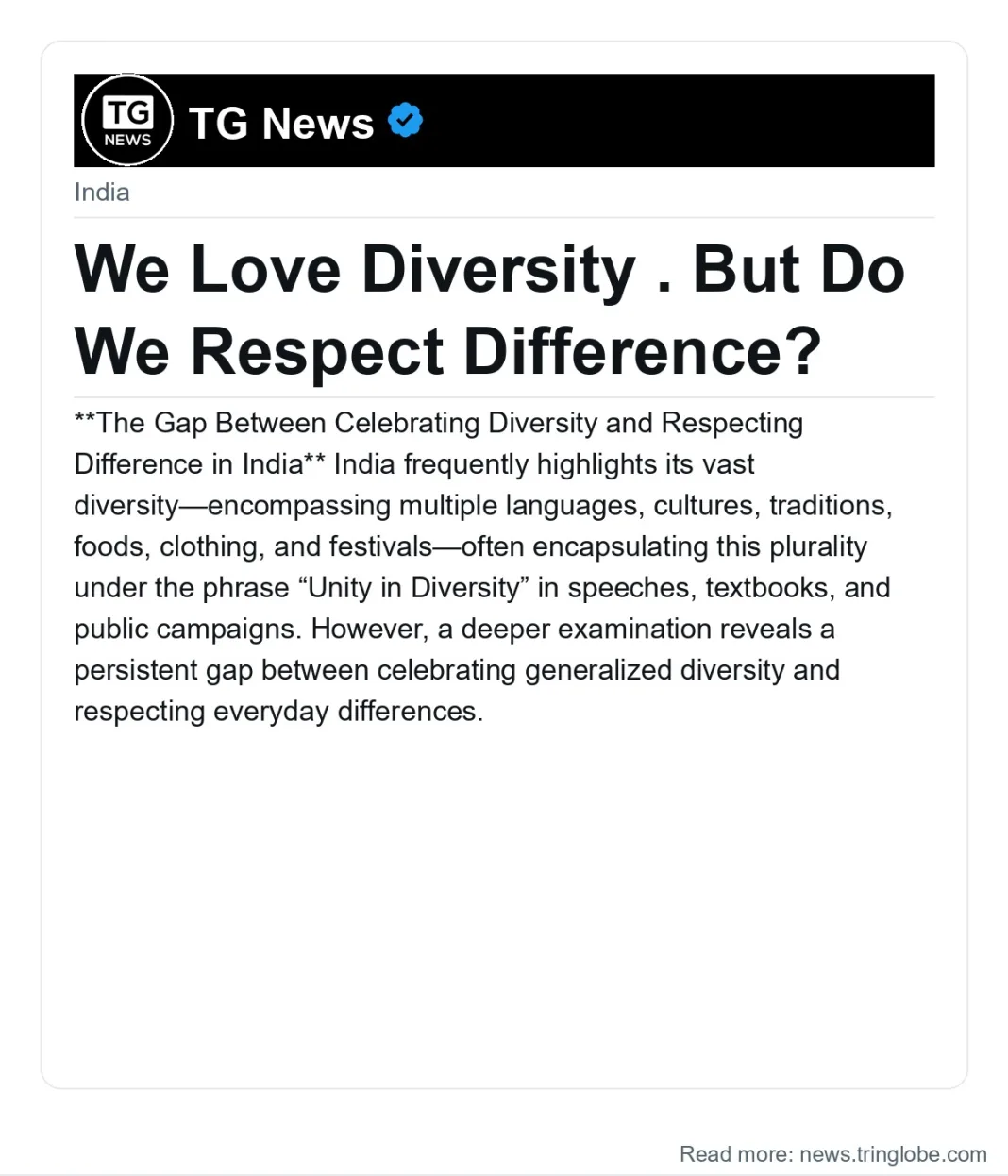
**The Gap Between Celebrating Diversity and Respecting Difference in India** India frequently highlights its vast diversity—encompassing multiple languages, cultures, traditions, foods, clothing, and festivals—often encapsulating this plurality under the phrase “Unity in Diversity” in speeches, textbooks, and public campaigns. However, a deeper examination reveals a persistent gap between celebrating generalized diversity and respecting everyday differences. While cultural diversity is often appreciated from a distance during festivals, through music, or via photographs, real diversity manifests in daily life through unfamiliar accents, surnames, dietary habits, traditional attire, and migration from different parts of the country. Observers note that these everyday encounters serve as the true test of respect. Prejudice and discrimination do not always manifest as overt acts of hatred. Often, they appear as subtle microaggressions: mocking an accent, assuming someone is less educated based on how they speak, ridiculing an appearance or culture, or demanding that someone “speak properly” when the expectation is simply to conform to a dominant linguistic norm. While these occurrences may seem minor to onlookers, they accumulate for those who experience them repeatedly. Research on regional accents within Indian workplaces indicates that "non-mainstream" accents can influence perceptions of professional competence and career growth. The core issue arises when societal differences are converted into hierarchies. Linguistic diversity remains a prominent feature of the country, with multilingualism actively promoted through programs like the Bharatiya Bhasha Summer Camp. Nevertheless, language continues to be a source of insecurity. Students may hesitate to speak out of fear of mockery, individuals may suppress their accents to avoid being perceived as "strange," and people may feel embarrassed about their native tongues because other languages carry higher social prestige. Advocates emphasize that a language is not inferior simply because it has fewer speakers, an accent is not an indicator of intelligence, and linguistic variation should not determine a person's sense of belonging. Article and image source: youthkiawaaz.com
**The Gap Between Celebrating Diversity and Respecting Difference in India**
India frequently highlights its vast diversity—encompassing multiple languages, cultures, traditions, foods, clothing, and festivals—often encapsulating this plurality under the phrase “Unity in Diversity” in speeches, textbooks, and public campaigns. However, a deeper examination reveals a persistent gap between celebrating generalized diversity and respecting everyday differences.
While cultural diversity is often appreciated from a distance during festivals, through music, or via photographs, real diversity manifests in daily life through unfamiliar accents, surnames, dietary habits, traditional attire, and migration from different parts of the country. Observers note that these everyday encounters serve as the true test of respect.
Prejudice and discrimination do not always manifest as overt acts of hatred. Often, they appear as subtle microaggressions: mocking an accent, assuming someone is less educated based on how they speak, ridiculing an appearance or culture, or demanding that someone “speak properly” when the expectation is simply to conform to a dominant linguistic norm. While these occurrences may seem minor to onlookers, they accumulate for those who experience them repeatedly. Research on regional accents within Indian workplaces indicates that “non-mainstream” accents can influence perceptions of professional competence and career growth. The core issue arises when societal differences are converted into hierarchies.
Linguistic diversity remains a prominent feature of the country, with multilingualism actively promoted through programs like the Bharatiya Bhasha Summer Camp. Nevertheless, language continues to be a source of insecurity. Students may hesitate to speak out of fear of mockery, individuals may suppress their accents to avoid being perceived as “strange,” and people may feel embarrassed about their native tongues because other languages carry higher social prestige. Advocates emphasize that a language is not inferior simply because it has fewer speakers, an accent is not an indicator of intelligence, and linguistic variation should not determine a person’s sense of belonging.
News Desk is the editorial publishing account for Tringlobe Media News, covering breaking news, public affairs, entertainment, community developments and regional stories across Trinidad and Tobago, the Caribbean and internationally.