The key points are temporarily unavailable. You can still read the full Story below.
Main Points
**China Accelerates Modernisation of Logistics Network** *Beijing, 27 August 2026* – China is intensifying efforts to make its logistics system more efficient and digitally integrated, employing data analytics, automation and enhanced multimodal connections to reduce transport time and costs across its extensive manufacturing sector. **Pinglu Canal to Shorten Waterway Routes** The newly constructed Pinglu Canal in the Guangxi Zhuang Autonomous Region is slated to open in September. The 134.2‑kilometre waterway links the Xijiang River with the Beibu Gulf and is designed for vessels up to 5,000 tonnes. Compared with the existing route via Guangzhou Port, the canal will cut the inland waterway distance to the sea by roughly 560 kilometres, potentially lowering logistics costs by 18‑30 percent. The project, estimated at 72.7 billion yuan (about US$10.7 billion), is the first river‑to‑sea canal in China coordinated at the national level since 1949. Vessel trials began on 12 August, using the BeiDou Navigation Satellite System, drones and sensors to gather data on ship movements, water currents and safe distances. The canal is also equipped with approximately 262 km of high‑speed fiber‑optic cable, a dedicated 5G network and edge‑computing capabilities, allowing real‑time vessel recognition and video analysis with millisecond‑level response times. Pinglu Canal is a key component of the New International Land‑Sea Trade Corridor, aimed at improving southwest China’s access to maritime routes. China’s trade with the Association of Southeast Asian Nations (ASEAN) reached 5.14 trillion yuan in the first seven months of 2026, a 20 percent increase year on year. **National Logistics Strategy** The logistics network is one of six “integrated networks” highlighted in China’s 15th Five‑Year Plan (2026‑2030). The other five networks are water, new‑type power grids, computing power, next‑generation communications, and urban underground pipelines. The National Development and Reform Commission (NDRC) describes these networks as mutually reinforcing and interlinked. Preliminary estimates place total investment in the six networks and related key areas at over 7 trillion yuan for the current year. MUFG Research noted that the logistics upgrades could bolster demand, employment and industrial activity in the near term while enhancing productivity over the medium to long term. **Digital Platforms and Data Sharing** China’s logistics backbone already supports the world’s largest manufacturing sector by value added, which has held the top global position for 16 consecutive years and accounted for more than 28 percent of global manufacturing value added during the 14th Five‑Year Plan (2021‑2025). In 2025, the country handled 198.95 billion parcels, ranking first in express‑delivery volume for a 12th straight year, and its ports recorded 18.3 billion tonnes of cargo and 354 million twenty‑foot equivalent units (TEUs). The focus is shifting from “hard construction” of hubs, parks and corridors to “soft connections” enabled by digital platforms, intelligent equipment and data sharing. In 2025, the NDRC and seven other agencies launched logistics‑data interconnection pilots in 16 cities, including Wuhan, to link customs, ports, railways, roads, waterways, aviation, freight forwarders and vehicle fleets. In Wuhan, a multimodal platform that integrates customs, port and transport data has helped at least one importer reduce average logistics costs by 15‑20 percent. At Yangluo Port, vessel berth waiting times have fallen from about six hours to roughly two hours, and regulatory data sharing between Wuhan Customs and Shanghai authorities now permits a single declaration, inspection and release for imports moving to Wuhan. YTO Express, which processed 31.1 billion parcels in 2025, has deployed automation at a smart logistics centre in Yongqing County, Hebei Province. Daily parcel throughput at the centre rose from 2 million in 2020 to 6.5 million, and AI‑enabled sorting now achieves 99.99 percent accuracy. Transport cost per parcel fell 10.35 percent in 2025 to 0.37 yuan. **Cost and Volume Trends** The ratio of total social logistics costs to gross domestic product (GDP) was 13.9 percent in the first half of 2026, a slight decline of 0.1 percentage points from both the previous quarter and the same period a year Article and image source: beijingbulletin.com
**China Accelerates Modernisation of Logistics Network**
*Beijing, 27 August 2026* – China is intensifying efforts to make its logistics system more efficient and digitally integrated, employing data analytics, automation and enhanced multimodal connections to reduce transport time and costs across its extensive manufacturing sector.
**Pinglu Canal to Shorten Waterway Routes**
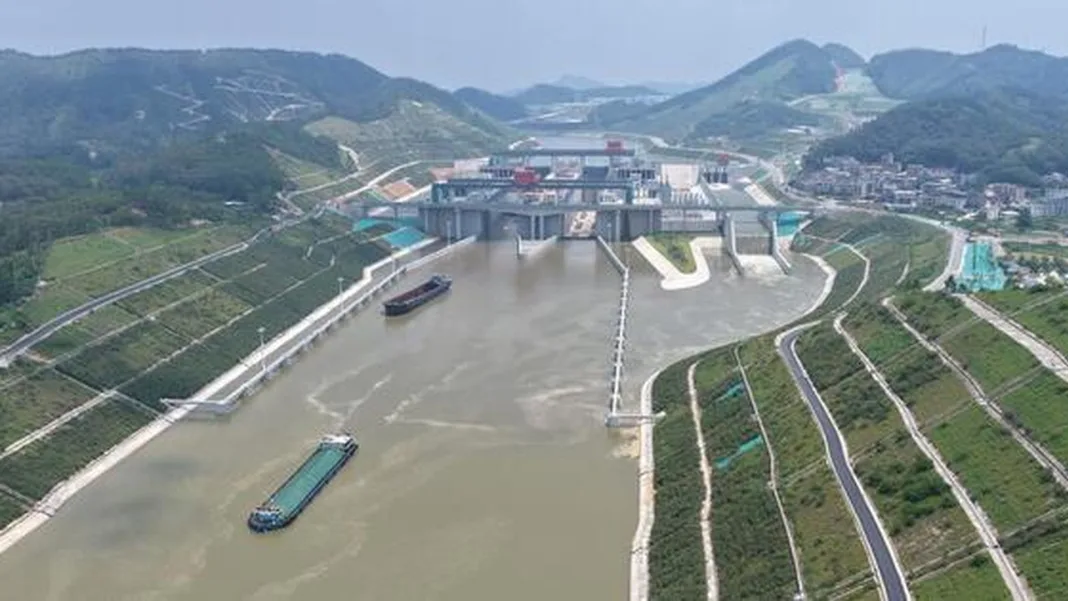
The newly constructed Pinglu Canal in the Guangxi Zhuang Autonomous Region is slated to open in September. The 134.2‑kilometre waterway links the Xijiang River with the Beibu Gulf and is designed for vessels up to 5,000 tonnes. Compared with the existing route via Guangzhou Port, the canal will cut the inland waterway distance to the sea by roughly 560 kilometres, potentially lowering logistics costs by 18‑30 percent.
The project, estimated at 72.7 billion yuan (about US$10.7 billion), is the first river‑to‑sea canal in China coordinated at the national level since 1949. Vessel trials began on 12 August, using the BeiDou Navigation Satellite System, drones and sensors to gather data on ship movements, water currents and safe distances. The canal is also equipped with approximately 262 km of high‑speed fiber‑optic cable, a dedicated 5G network and edge‑computing capabilities, allowing real‑time vessel recognition and video analysis with millisecond‑level response times.
Pinglu Canal is a key component of the New International Land‑Sea Trade Corridor, aimed at improving southwest China’s access to maritime routes. China’s trade with the Association of Southeast Asian Nations (ASEAN) reached 5.14 trillion yuan in the first seven months of 2026, a 20 percent increase year on year.
**National Logistics Strategy**
The logistics network is one of six “integrated networks” highlighted in China’s 15th Five‑Year Plan (2026‑2030). The other five networks are water, new‑type power grids, computing power, next‑generation communications, and urban underground pipelines. The National Development and Reform Commission (NDRC) describes these networks as mutually reinforcing and interlinked. Preliminary estimates place total investment in the six networks and related key areas at over 7 trillion yuan for the current year.
MUFG Research noted that the logistics upgrades could bolster demand, employment and industrial activity in the near term while enhancing productivity over the medium to long term.
**Digital Platforms and Data Sharing**
China’s logistics backbone already supports the world’s largest manufacturing sector by value added, which has held the top global position for 16 consecutive years and accounted for more than 28 percent of global manufacturing value added during the 14th Five‑Year Plan (2021‑2025). In 2025, the country handled 198.95 billion parcels, ranking first in express‑delivery volume for a 12th straight year, and its ports recorded 18.3 billion tonnes of cargo and 354 million twenty‑foot equivalent units (TEUs).
The focus is shifting from “hard construction” of hubs, parks and corridors to “soft connections” enabled by digital platforms, intelligent equipment and data sharing. In 2025, the NDRC and seven other agencies launched logistics‑data interconnection pilots in 16 cities, including Wuhan, to link customs, ports, railways, roads, waterways, aviation, freight forwarders and vehicle fleets.
In Wuhan, a multimodal platform that integrates customs, port and transport data has helped at least one importer reduce average logistics costs by 15‑20 percent. At Yangluo Port, vessel berth waiting times have fallen from about six hours to roughly two hours, and regulatory data sharing between Wuhan Customs and Shanghai authorities now permits a single declaration, inspection and release for imports moving to Wuhan.
YTO Express, which processed 31.1 billion parcels in 2025, has deployed automation at a smart logistics centre in Yongqing County, Hebei Province. Daily parcel throughput at the centre rose from 2 million in 2020 to 6.5 million, and AI‑enabled sorting now achieves 99.99 percent accuracy. Transport cost per parcel fell 10.35 percent in 2025 to 0.37 yuan.
**Cost and Volume Trends**
The ratio of total social logistics costs to gross domestic product (GDP) was 13.9 percent in the first half of 2026, a slight decline of 0.1 percentage points from both the previous quarter and the same period a year
News Desk is the editorial publishing account for Tringlobe Media News, covering breaking news, public affairs, entertainment, community developments and regional stories across Trinidad and Tobago, the Caribbean and internationally.