The key points are temporarily unavailable. You can still read the full Story below.
Main Points
Authorities in Bhutan are conducting assessments following a reported glacial lake outburst flood (GLOF) at Sintaphu Lake in the northern Gasa district. The incident, which occurred on the evening of October 29, 2026, has caused significant infrastructure damage and prompted downstream flood warnings in both Bhutan and neighboring India. As of the morning of October 30, 2026, no deaths or injuries have been reported. However, the floodwaters have caused extensive damage to local infrastructure. A section of the Punakha-Gasa Secondary National Highway near the 31.85-kilometre point has been completely washed away, resulting in the closure of the road to all traffic. Additionally, the Gasa Tshachu, a well-known hot spring complex located along the Mo Chhu, has been destroyed by the surge. The outburst was first detected when floodwaters reached the Taktsemakhang area at approximately 8:15 p.m. on October 29. The event disrupted access to Laya, one of Bhutan’s remote highland communities, and forced the evacuation of residents in potentially exposed areas. Warning sirens were activated to alert downstream populations. Sintaphu Lake, situated near Wakila Mountain in Lungo, Laya Gewog, is officially classified by the Bhutanese government as one of the country’s 17 potentially dangerous glacial lakes. This designation necessitates ongoing monitoring due to the lake's physical characteristics and the potential impact of a sudden water release. Specialists conducted field assessments of the lake between May and June 2023, which included surveys of the moraine barriers and the installation of monitoring equipment. The floodwaters from the lake enter the Mo Chhu, which flows south through Gasa and Punakha before merging with the Pho Chhu to form the Punatsangchhu. As the river system eventually flows into India as the Sankosh, authorities in the Indian states of West Bengal and Assam issued precautionary warnings, advising communities near the riverbanks to remain alert. The exact cause of the release, the volume of water involved, and the stability of the lake remain under investigation. Officials are currently utilizing field observations, monitoring data, and satellite imagery to determine whether the event was a complete or partial breach. As of October 30, the full extent of the damage to property, livestock, and infrastructure is still being assessed. Authorities continue to monitor the situation and have advised travelers to postpone non-essential journeys to the region until further notice. Article source: Daily Bhutan | Image credit: Daily Bhutan
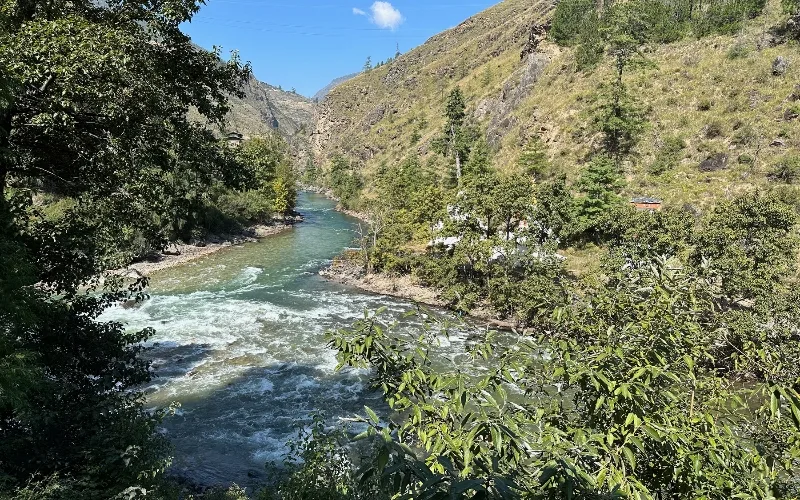
Authorities in Bhutan are conducting assessments following a reported glacial lake outburst flood (GLOF) at Sintaphu Lake in the northern Gasa district. The incident, which occurred on the evening of October 29, 2026, has caused significant infrastructure damage and prompted downstream flood warnings in both Bhutan and neighboring India. As of the morning of October 30, 2026, no deaths or injuries have been reported. However, the floodwaters have caused extensive damage to local infrastructure. A section of the Punakha-Gasa Secondary National Highway near the 31.85-kilometre point has been completely washed away, resulting in the closure of the road to all traffic. Additionally, the Gasa Tshachu, a well-known hot spring complex located along the Mo Chhu, has been destroyed by the surge. The outburst was first detected when floodwaters reached the Taktsemakhang area at approximately 8:15 p.m. on October 29. The event disrupted access to Laya, one of Bhutan’s remote highland communities, and forced the evacuation of residents in potentially exposed areas. Warning sirens were activated to alert downstream populations. Sintaphu Lake, situated near Wakila Mountain in Lungo, Laya Gewog, is officially classified by the Bhutanese government as one of the country’s 17 potentially dangerous glacial lakes. This designation necessitates ongoing monitoring due to the lake’s physical characteristics and the potential impact of a sudden water release. Specialists conducted field assessments of the lake between May and June 2023, which included surveys of the moraine barriers and the installation of monitoring equipment. The floodwaters from the lake enter the Mo Chhu, which flows south through Gasa and Punakha before merging with the Pho Chhu to form the Punatsangchhu. As the river system eventually flows into India as the Sankosh, authorities in the Indian states of West Bengal and Assam issued precautionary warnings, advising communities near the riverbanks to remain alert. The exact cause of the release, the volume of water involved, and the stability of the lake remain under investigation. Officials are currently utilizing field observations, monitoring data, and satellite imagery to determine whether the event was a complete or partial breach. As of October 30, the full extent of the damage to property, livestock, and infrastructure is still being assessed. Authorities continue to monitor the situation and have advised travelers to postpone non-essential journeys to the region until further notice.
News Desk is the editorial publishing account for Tringlobe Media News, covering breaking news, public affairs, entertainment, community developments and regional stories across Trinidad and Tobago, the Caribbean and internationally.