The key points are temporarily unavailable. You can still read the full Story below.
Main Points
Following the September 11, 2001, terrorist attacks in the United States, Armenian leadership expressed readiness to support international efforts against terrorism. In a meeting with U.S. Ambassador Michael Lemon shortly after the attacks, then-President Robert Kocharyan stated that the international community needed to cooperate to address the threat. In an interview with the Russian newspaper Kommersant, Kocharyan noted that a new global situation had emerged, requiring coordinated action.
During the 10th anniversary of Armenia’s independence on September 21, 2001, Kocharyan described terrorism as an ideology and stated that Armenia had experienced its consequences. Around the same time, Nagorno-Karabakh Republic Foreign Minister Naira Melkumian told the CNA agency that Osama bin Laden and his followers had previously identified Nagorno-Karabakh as a target for the establishment of Islamic radicalism.
Reports from the Washington ProFile news center in June 2002 alleged that Al-Qaeda maintained an office in Baku in the late 1980s and subsequently supported Azerbaijan during the conflict over Nagorno-Karabakh. According to U.S. sources cited in the report, approximately 1,500 Afghan mujahedeen arrived in Azerbaijan in September 1993 to participate in the war, with that number reportedly increasing to 2,500 by the summer of 1994.
Gerard Libaridian, a former senior advisor to Armenia’s first president, Levon Ter-Petrosyan, stated in 2015 that Azerbaijan had signed an agreement with Afghanistan to engage mujahedeen in the conflict. Libaridian recounted a secret visit to Afghanistan to meet with Prime Minister Gulbuddin Hekmatyar, which he claimed helped prevent the recruitment of additional fighters.
In January 2002, Armenian Defense Minister Serzh Sargsyan addressed a NATO ministerial meeting in Brussels, alleging that Azerbaijan had supported international terrorists. Sargsyan claimed that Afghan and Chechen mujahedeen formed special forces for Azerbaijan during the war and that some remained in the country after the 1994 ceasefire. He further alleged that the Azerbaijani branch of Islamic Jihad, which later merged with Al-Qaeda, coordinated the 1998 U.S. embassy bombings in Kenya and Tanzania.
In the years following the 9/11 attacks, the U.S. Department of State’s annual “Patterns of Global Terrorism” reports noted that, in previous years, transportation routes for mujahedeen connected to international terrorist organizations had passed through Azerbaijan.
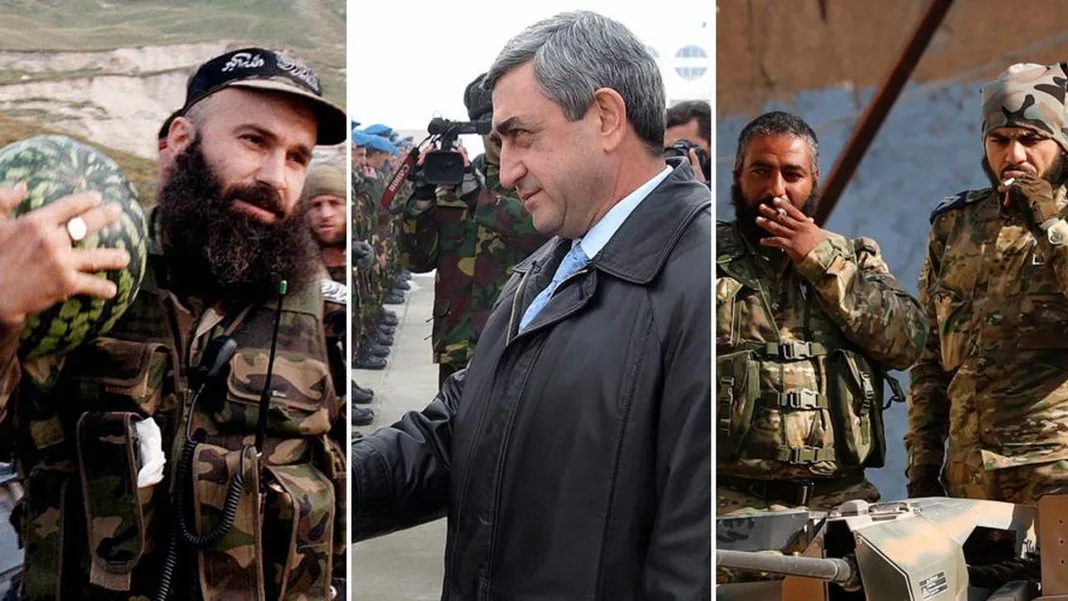
The conflict also involved Chechen militants. In a 1999 interview, Movladi Udugov, a chief ideologist for Chechen militants, described Nagorno-Karabakh as Muslim territory and claimed that Chechen mujahedeen were hostile toward Armenian policy. However, Shamil Basayev, a prominent Chechen commander, later admitted in a 2000 interview with Azerbaijani media that he had withdrawn his forces from the region in 1993, citing ineffective leadership and a lack of discipline within the Azerbaijani military.
In 2020, reports emerged regarding the involvement of foreign mercenaries in the Nagorno-Karabakh conflict. Independent journalist Lindsey Snell reported on the transfer of Syrian mercenaries to Azerbaijan. These reports were corroborated by officials, including Sergey Naryshkin, Director of Russia’s Foreign Intelligence Service, who stated that militants from organizations such as Jabhat al-Nusra were entering the conflict zone. In November 2020, the presidents of Russia and France expressed concern over the involvement of extremists from Syria and Libya.
In April 2021, Armenian Prime Minister Nikol Pashinyan accused Turkey of providing military support to Azerbaijan, including the deployment of foreign mercenaries. In January 2026, two Syrian citizens who had been sentenced to life imprisonment in Armenia for their roles in the conflict were transferred to Syrian authorities via Turkey.
Article and image source: mediamax.am