The key points are temporarily unavailable. You can still read the full Story below.
Main Points
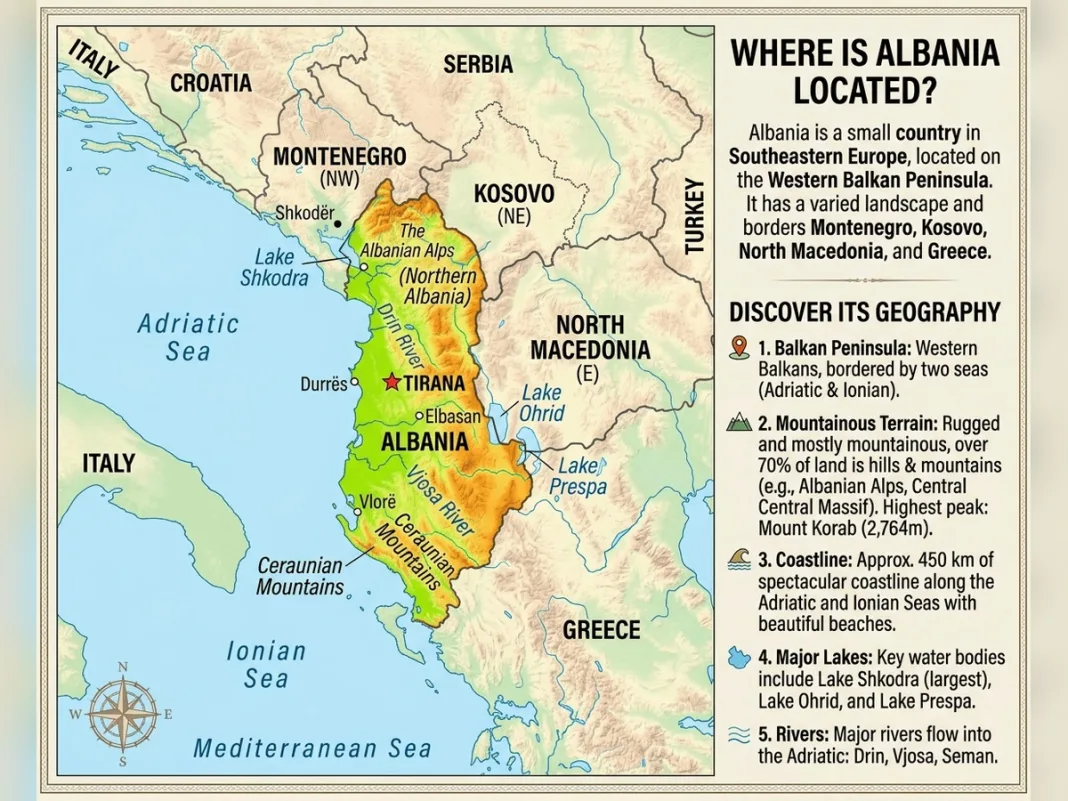
Why did Albania's major towns develop where they did? The answer begins with a country whose landscape changes markedly over short distances, from rugged mountains to fertile lowland plains and an Adriatic and Ionian coastline. Geography creates opportunities for settlement, but it does not determine urban growth by itself. Transport links, political decisions, economic change and migration also influence which places become major centres. A 2022 introduction to the geography of Albania by geographer Doka, published by Springer Nature, describes the country's varied physical environment and examines its geographical position alongside its history, resources and development. The chapter also places Albania's prolonged self-isolation between 1945 and 1990 in the context of its relationship with Europe and the wider world. Following the country's opening after 1990, international connections expanded significantly. These broad patterns help explain why settlement geography must be considered alongside political history rather than as a purely physical question. The contrast between mountains and lowlands offers a starting point. Fertile plains can support agriculture and denser settlement, while mountainous terrain can make travel and the provision of infrastructure more difficult. Coastal locations, meanwhile, offer potential access to maritime routes and connections with other regions. These are geographical mechanisms, not proof that every Albanian town developed for the same reason. Establishing why a particular settlement grew would require evidence about its own history, transport connections and economic role. Transport infrastructure can change the importance of places over time. Albania's transport overview records that the country developed a railway network after 1947, linking major urban and industrial centres. Before that investment, the country had lacked standard rail service, according to the same account. Railways created new connections between places, while roads also shaped movement between settlements and access to more remote areas. Infrastructure can make a town easier to reach, but the presence of a road or railway alone does not establish how much it contributed to population growth. Political choices can also influence where people live and work. A government that concentrates administrative functions or industrial activity in particular places can change the demand for housing, services and transport there. Albania's history of political and economic transformation makes this an important factor to investigate. Yet the available excerpts do not provide detailed evidence tracing individual government decisions to the growth of specific towns, so it would be misleading to assign a single policy as the explanation for a settlement's rise. Migration adds another layer. Movement from rural areas to urban centres can alter a town's population and expand demand for housing, schools and other services. The supplied sources describe Albania's major political and economic changes after 1990, but they do not provide a town-by-town migration dataset or establish which destinations gained the most residents from particular regions. The scale and direction of those changes therefore need to be verified through population censuses and historical records before firm conclusions can be drawn about individual cities. The evidence also highlights the importance of connecting Albania with the wider world. Doka's chapter describes the country as increasingly connected by land, sea and air after the end of isolation. Such connections can influence tourism, trade and access to external markets, but the excerpt does not quantify their contribution to the growth of particular settlements. A rigorous account would compare historical population figures with changes in ports, roads, railways, employment and administrative functions. Albania's towns are therefore best understood as the products of several interacting forces. Geography creates the initial possibilities and constraints; transport changes accessibility; political decisions influence investment and administration; and migration can reshape the size and character of communities. To explain why Tirana, coastal centres or inland towns followed different paths, those factors must be tested against local historical evidence. The landscape supplies the starting point, but history determines much of how each place develops.
Why did Albania’s major towns develop where they did? The answer begins with a country whose landscape changes markedly over short distances, from rugged mountains to fertile lowland plains and an Adriatic and Ionian coastline. Geography creates opportunities for settlement, but it does not determine urban growth by itself. Transport links, political decisions, economic change and migration also influence which places become major centres.
A 2022 introduction to the geography of Albania by geographer Doka, published by Springer Nature, describes the country’s varied physical environment and examines its geographical position alongside its history, resources and development. The chapter also places Albania’s prolonged self-isolation between 1945 and 1990 in the context of its relationship with Europe and the wider world. Following the country’s opening after 1990, international connections expanded significantly. These broad patterns help explain why settlement geography must be considered alongside political history rather than as a purely physical question.
The contrast between mountains and lowlands offers a starting point. Fertile plains can support agriculture and denser settlement, while mountainous terrain can make travel and the provision of infrastructure more difficult. Coastal locations, meanwhile, offer potential access to maritime routes and connections with other regions. These are geographical mechanisms, not proof that every Albanian town developed for the same reason. Establishing why a particular settlement grew would require evidence about its own history, transport connections and economic role.
Transport infrastructure can change the importance of places over time. Albania’s transport overview records that the country developed a railway network after 1947, linking major urban and industrial centres. Before that investment, the country had lacked standard rail service, according to the same account. Railways created new connections between places, while roads also shaped movement between settlements and access to more remote areas. Infrastructure can make a town easier to reach, but the presence of a road or railway alone does not establish how much it contributed to population growth.
Political choices can also influence where people live and work. A government that concentrates administrative functions or industrial activity in particular places can change the demand for housing, services and transport there. Albania’s history of political and economic transformation makes this an important factor to investigate. Yet the available excerpts do not provide detailed evidence tracing individual government decisions to the growth of specific towns, so it would be misleading to assign a single policy as the explanation for a settlement’s rise.
Migration adds another layer. Movement from rural areas to urban centres can alter a town’s population and expand demand for housing, schools and other services. The supplied sources describe Albania’s major political and economic changes after 1990, but they do not provide a town-by-town migration dataset or establish which destinations gained the most residents from particular regions. The scale and direction of those changes therefore need to be verified through population censuses and historical records before firm conclusions can be drawn about individual cities.
The evidence also highlights the importance of connecting Albania with the wider world. Doka’s chapter describes the country as increasingly connected by land, sea and air after the end of isolation. Such connections can influence tourism, trade and access to external markets, but the excerpt does not quantify their contribution to the growth of particular settlements. A rigorous account would compare historical population figures with changes in ports, roads, railways, employment and administrative functions.
Albania’s towns are therefore best understood as the products of several interacting forces. Geography creates the initial possibilities and constraints; transport changes accessibility; political decisions influence investment and administration; and migration can reshape the size and character of communities. To explain why Tirana, coastal centres or inland towns followed different paths, those factors must be tested against local historical evidence. The landscape supplies the starting point, but history determines much of how each place develops.
News Desk is the editorial publishing account for Tringlobe Media News, covering breaking news, public affairs, entertainment, community developments and regional stories across Trinidad and Tobago, the Caribbean and internationally.