The key points are temporarily unavailable. You can still read the full Story below.
Main Points
**FREDERICTON** — New Brunswick’s unemployment rate dropped to seven per cent in July, its lowest level since March, but the decline was driven primarily by a shrinking workforce rather than significant job growth, according to Statistics Canada data released on Friday.
The province’s unemployment rate fell from 7.3 per cent in June. However, Statistics Canada reported a month-over-month net gain of just 200 jobs, which falls within the data’s margin of error.
During the same period, the number of unemployed New Brunswickers dropped by 1,500, while the size of the labour force—those either employed or actively looking for work—shrank by 1,200. All of Friday’s provincial figures remained within the agency’s standard error.
The latest data continues a broader 12-month trend. New Brunswick’s labour force is 3,600 people smaller than it was in July 2025, and overall employment is down by a net 1,000 people, though full-time jobs have increased by 1,900 year over year. The declining size of the labour force has contributed to lower unemployment over the past year, with 2,700 fewer New Brunswickers without a job compared to July 2025, when the unemployment rate stood at 7.5 per cent.
Regionally within the province, construction and manufacturing employment remained flat year over year. The forestry, fishing, mining, and oil and gas sectors recorded the largest declines in the goods-producing sector, losing a combined total of roughly 1,300 positions since July 2025. Conversely, the service sector grew by approximately 2,000 net new jobs, led by gains in health care.
New Brunswick’s provincial figures contrasted with the national picture, where Canada’s economy added more jobs than expected in July, pushing the unemployment rate to a two-year low. Nationally, the jobless rate fell for the third consecutive month, dropping from 6.5 per cent to 6.4 per cent—a level last seen in July 2024.
Canada-wide employment jumped by 75,100 positions, driven by a net increase of 38,600 full-time jobs and 36,600 part-time positions.
“Oh boy, another strong labour market report,” TD Bank senior economist Andrew Hencic wrote in a note to clients, pointing out that hiring outpaced a 61,000-person gain in the labour force.
While Hencic said the market showed “clear signs of recovery,” he cautioned that downside risks remain, including potential new tariffs taking effect on Aug. 19, energy price volatility, and trade headwinds. He predicts the Bank of Canada will hold interest rates steady for the remainder of the year.
CIBC economist Andrew Grantham shared a similar outlook in a note to investors, suggesting strong employment numbers combined with available workers mean there will be “little pressure for the Bank of Canada to raise interest rates this year, particularly if oil and gasoline prices remain below prior peaks.”
Employment gains were led by Ontario (up 52,000 jobs), British Columbia (up 18,000 jobs), Manitoba (up 5,900 jobs), and Nova Scotia (up 4,600 jobs).
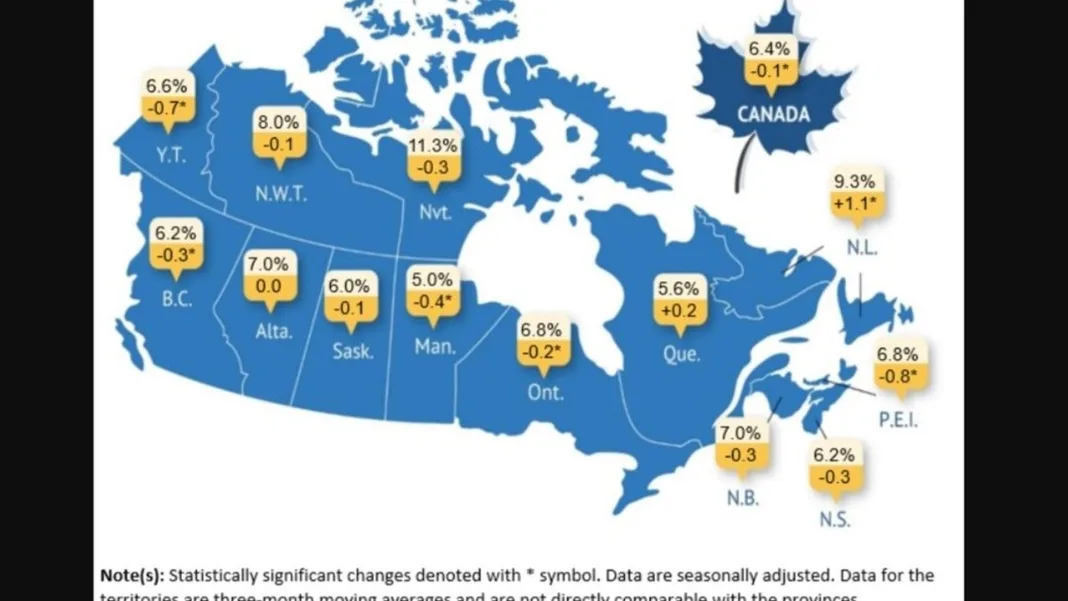
Unemployment rates across Canada for July 2026 (with June figures in brackets) were as follows:
* **Manitoba:** 5.0% (5.4)
* **Quebec:** 5.6% (5.4)
* **Saskatchewan:** 6.0% (6.1)
* **Nova Scotia:** 6.2% (6.5)
* **British Columbia:** 6.2% (6.5)
* **Ontario:** 6.8% (7.0)
* **Prince Edward Island:** 6.8% (7.6)
* **Alberta:** 7.0% (7.0)
* **New Brunswick:** 7.0% (7.3)
* **Newfoundland and Labrador:** 9.3% (8.2)
Article and image source: tj.news