The key points are temporarily unavailable. You can still read the full Story below.
Main Points
Human Rights Watch Urges Taliban to Release Detained Aid Workers
Human Rights Watch (HRW) has called on the Taliban rulers of Afghanistan to release several international aid workers who were “forcibly disappeared” from their offices last month. The aid workers, who are still missing, were taken into custody by Taliban security forces on July 18.
According to HRW, the Taliban has provided no information on the whereabouts of the leadership team of the non-governmental group Women and Children Legal Research Foundation (WCLRF), which was arrested in Kabul. The WCLRF delivers assistance programs and conducts research and advocacy on women’s and children’s rights.
The incident occurred after Taliban security forces raided the office of the NGO on June 21, confiscating laptops and phones from staff members. The office was later sealed, and an investigation was launched against the staff members. On July 18, six male staff members were ordered to return to the office to collect their confiscated devices, but they were taken into custody instead.
HRW’s Women’s Rights Director, Macarena Saez, stated that “the Taliban seems to consider any effort to assist women and girls a threat to their abusive rule.” She added that the Taliban should “immediately provide information on the six staff members’ whereabouts and release them if held unlawfully.”
The United Nations has also confirmed the detention of two of its staffers, saying it has not been informed of any charges, nor has it been granted access to the two detained aid workers. The UN’s political mission in Afghanistan, UNAMA, is involved in human rights monitoring and data gathering.
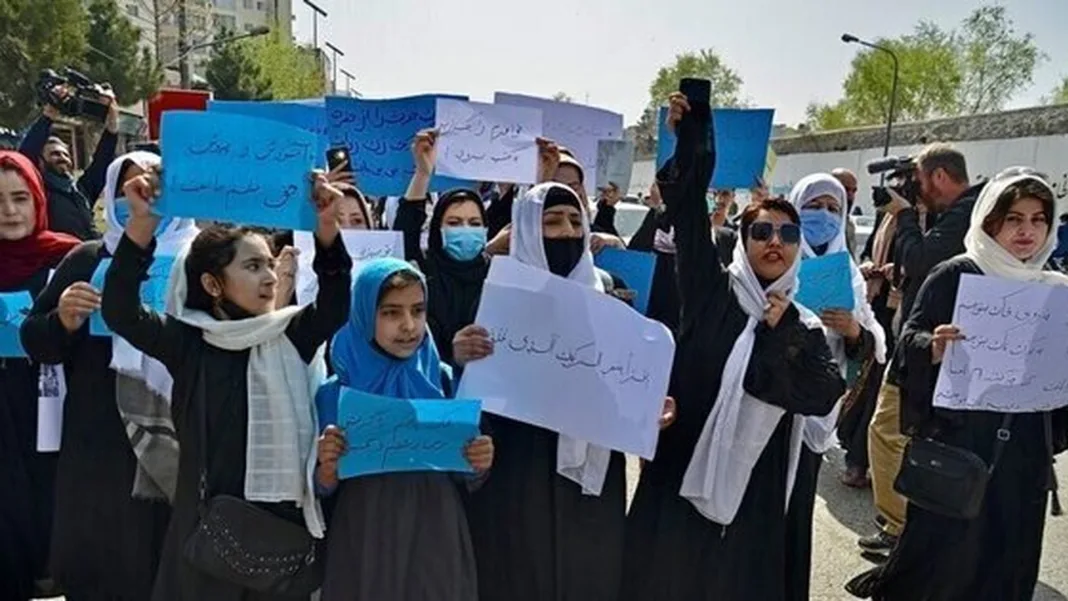
The Taliban’s actions are part of a broader crackdown on women’s rights in Afghanistan. Since seizing power in August 2021, the Taliban has sharply curbed women’s rights, including banning them from most jobs and public appearances. According to the United Nations cultural agency UNESCO, some 2.4 million girls in Afghanistan are barred from attending secondary school.
The director of the WCLRF, Zarqa Yaftali, said that the families of the staff members who disappeared are living in constant fear and uncertainty. The incident has also drawn attention to the Taliban’s restrictions on independent media and journalists’ rights organizations. Nai Supporting Open Media in Afghanistan (Nai SOMA), a journalists’ rights body, says that the Taliban has converted Afghanistan into an “open prison” for media and freedom of expression.
At least six journalists have been killed in incidents of violence relating to the Taliban and the Islamic State militant group over the past five years, according to Nai SOMA. The organization has also reported over 700 incidents of violence against journalists during the same period. The Taliban has revoked the licenses of several media outlets in Kabul and other provinces, accusing them of “unprofessional journalism.”
Article and image source: afghanistansun.com