The key points are temporarily unavailable. You can still read the full Story below.
Main Points
A High Court constitutional challenge led by Senior Counsel Stuart Young is taking direct aim at legislation piloted and defended by Attorney General John Jeremie SC, while raising serious questions about Prime Minister Kamla Persad-Bissessar’s power to intervene in police appointments and receive operational reports. The challenge, filed on Monday, November 16, 2026, by social activist Wendell Eversley, questions whether the Special Operations Act, 2026, unlawfully interferes with the independence of the Commissioner of Police and whether Parliament passed the legislation without the constitutionally required majority. The Attorney General is named as the defendant in the proceedings. Although the Prime Minister is not personally named as a defendant, her statutory powers under the legislation are central to the constitutional challenge. Eversley is not merely questioning how SOZO has been implemented in Maloney. He is asking the High Court to declare the entire Act unconstitutional, null, void and of no effect. Among the most consequential arguments in the 91-page court bundle is the claim that the legislation undermines the constitutional independence of the Commissioner of Police by granting the political executive influence over operational appointments, reporting and police management. Why Does the Prime Minister Have Her Hands in Police Operations? At the centre of the challenge is Section 5 of the Act, which gives the Prime Minister a role in the appointment of Heads of Special Operations. Under the legislation, the Commissioner of Police must designate senior police officers to lead special operations across seven policing districts. However, Sections 5(2) and 5(3) require consultation with the Prime Minister, who may object to a proposed designation after consulting specified officials. Significantly, Attorney General John Jeremie himself acknowledged this power while piloting the Special Operations Bill in the House of Representatives on September 18, 2026. Explaining Clause 5, Jeremie told Parliament: “That appointment is subject to veto by the Prime Minister.” The Attorney General explained that the Prime Minister must first consult the ministers responsible for Homeland Security and Defence, together with the Chief of Defence Staff. That acknowledgement now sits at the heart of the constitutional challenge brought by Eversley and led by Young. In paragraph 28 of his affidavit, Eversley states that the Prime Minister has a “veto power over the Commissioner’s designation.” He argues that this makes an operational police appointment dependent upon the approval of the political executive. Eversley contends that Sections 5(2) and 5(3) breach Section 123A of the Constitution, which protects the Commissioner’s independence in managing the Police Service. The question before the court is whether a Prime Minister should possess the power to reject a senior police officer selected by the Commissioner to lead an operation. The challenge also questions Section 5(4), which requires designated officers to have training in human rights, use of force, community engagement and conflict de-escalation. Although Eversley recognises the importance of such training, he argues that the statutory requirement further restricts the Commissioner’s discretion over police appointments and deployment. Why Must Police Operational Reports Go to the Prime Minister? The affidavit also targets Section 8, raising another question about political involvement in police operations. Under Section 8(1), the Head of Special Operations must submit a report to the Commissioner, who must forward it to the Prime Minister and relevant ministers within three days. Section 8(2) also gives the Prime Minister, following consultation, authority to determine the contents of the report. Eversley argues that the Commissioner is legally required to transmit operational information without amendment, redaction or alteration, despite having constitutionally protected responsibility for managing the Police Service. In paragraph 33, he alleges that the arrangement interferes with the Commissioner’s operational independence and protection from political executive interference. The question is not whether the Government should be informed about national security operations. It is whether elected political officials should have statutory authority over the contents of operational police reports and the appointment of officers leading those operations. The affidavit further questions the disciplinary provisions under Section 8(5) and the requirement under Section 9 for consultation with the Chief of Defence Staff on operational procedures. Where does legitimate ministerial oversight end, and unconstitutional political interference in policing begin? AG Jeremie Defended the Legislation as Proportionate The constitutional challenge places renewed attention on the arguments made by Attorney General John Jeremie when he piloted the Bill through Parliament. During the House debate on September 18, Jeremie acknowledged that the legislation could interfere with constitutional protections, including personal liberty, property, private and family life, and freedom of movement. However, he maintained that such restrictions could be constitutionally justified. “Our view is that any such infringement is reasonable and proportionate,” Jeremie told Parliament, citing Privy Council authorities. The Attorney General argued that constitutional rights are not absolute and that restrictions may be justified where legislation pursues a legitimate objective and satisfies the applicable proportionality test. He also defended the Government’s decision to proceed without a special majority, while acknowledging that the State would face a higher burden of justification before the courts. During the Senate debate on September 24, Jeremie defended the Bill as a proportionate response to Trinidad and Tobago’s crime problem. That defence now faces a direct legal challenge. Eversley accepts that violent crime requires decisive State action. His argument, however, is that the breadth of executive powers and their potential impact on constitutional rights go beyond what the Constitution permits. AG’s Bill Passed After Dramatic 15–15 Senate Deadlock The legal challenge extends beyond police management to the parliamentary process itself. The Special Operations Bill passed the Senate on September 24, 2026, following a dramatic 15–15 deadlock. All 15 Government senators supported the legislation, while six Opposition senators and nine Independent senators opposed it. Senate President Wade Mark exercised his casting vote, producing a final result of 16 votes to 15. Eversley’s affidavit argues that provisions affecting fundamental constitutional rights required compliance with Section 13 of the Constitution. He further contends that provisions allegedly altering the Commissioner’s constitutionally protected powers under Sections 123 and 123A required compliance with the special-majority requirements under Section 54. The applicant maintains that passage by a simple majority was insufficient. The central issue is therefore not merely whether the Senate President was entitled to exercise a casting vote. It is whether the legislation could lawfully be passed by an ordinary majority when the applicant argues that it affects rights and constitutional powers protected by special-majority requirements. If the court accepts that argument, the consequences could extend to the validity of the Act itself. Previous Emergency Detentions Cited as Warning Eversley also references the Government’s use of Preventive Detention Orders during previous States of Emergency. In paragraphs 8 to 11, he alleges that citizens were detained for weeks without criminal charges and that some people who criticised the Government on social media were subjected to detention orders. He refers to parliamentary contributions and newspaper reports as supporting material. These remain allegations in the affidavit, not judicial findings of unlawful conduct. Eversley nevertheless presents those experiences as part of his concern about concentrating additional authority in the political executive. Stuart Young-Led Challenge Seeks to Strike Down Entire Act The challenge is particularly significant because Eversley is not limiting his application to Maloney’s designation as a closed area or the current restrictions affecting residents. In paragraphs 69 to 73, he seeks declarations invalidating several provisions individually, as well as the entire Special Operations Act. The Government maintains that the legislation establishes a framework for combating serious criminality through coordinated police operations, with military assistance where necessary. Eversley’s position is that crime-fighting powers, however necessary, must remain within constitutional limits. The High Court must now examine competing arguments concerning public security, police independence, constitutional rights and the parliamentary process. For Attorney General John Jeremie, the challenge places the constitutional justification he advanced in Parliament under judicial examination. For Prime Minister Kamla Persad-Bissessar, it raises questions about the extent of her statutory involvement in police appointments and operational reporting. For Stuart Young and Wendell Eversley, the case goes beyond Maloney. It asks whether the State, in its pursuit of public safety, has crossed the constitutional boundary separating political authority from independent police management. The central question is no longer only what powers SOZO gives the police. It is also what powers SOZO gives the Prime Minister over the police. Source: Affidavit of Wendell Eversley, filed November 16, 2026, particularly paragraphs 16–36 and 68–73. Attorney General John Jeremie’s parliamentary contributions of September 18 and 24, 2026.
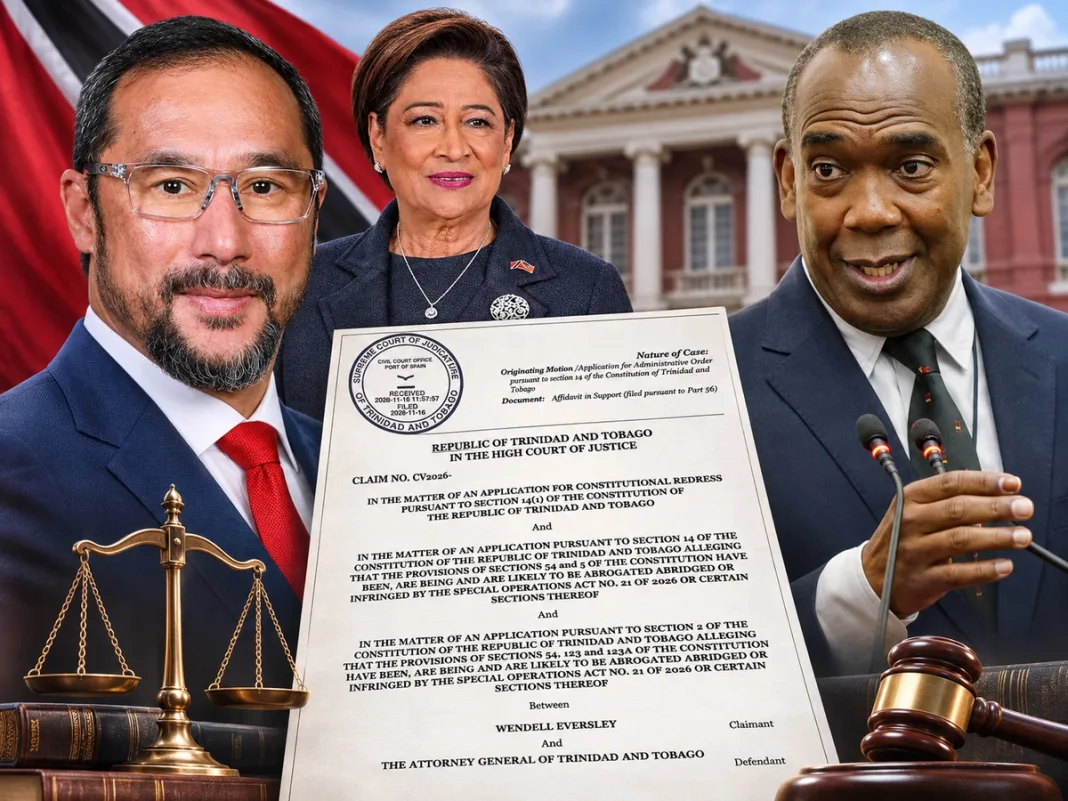
A High Court constitutional challenge led by Senior Counsel Stuart Young is taking direct aim at legislation piloted and defended by Attorney General John Jeremie SC, while raising serious questions about Prime Minister Kamla Persad-Bissessar’s power to intervene in police appointments and receive operational reports.
The challenge, filed on Monday, November 16, 2026, by social activist Wendell Eversley, questions whether the Special Operations Act, 2026, unlawfully interferes with the independence of the Commissioner of Police and whether Parliament passed the legislation without the constitutionally required majority.
The Attorney General is named as the defendant in the proceedings. Although the Prime Minister is not personally named as a defendant, her statutory powers under the legislation are central to the constitutional challenge.
Eversley is not merely questioning how SOZO has been implemented in Maloney. He is asking the High Court to declare the entire Act unconstitutional, null, void and of no effect.
Among the most consequential arguments in the 91-page court bundle is the claim that the legislation undermines the constitutional independence of the Commissioner of Police by granting the political executive influence over operational appointments, reporting and police management.
Why Does the Prime Minister Have Her Hands in Police Operations?
At the centre of the challenge is Section 5 of the Act, which gives the Prime Minister a role in the appointment of Heads of Special Operations.
Under the legislation, the Commissioner of Police must designate senior police officers to lead special operations across seven policing districts.
However, Sections 5(2) and 5(3) require consultation with the Prime Minister, who may object to a proposed designation after consulting specified officials.
Significantly, Attorney General John Jeremie himself acknowledged this power while piloting the Special Operations Bill in the House of Representatives on September 18, 2026.
Explaining Clause 5, Jeremie told Parliament:
“That appointment is subject to veto by the Prime Minister.”
The Attorney General explained that the Prime Minister must first consult the ministers responsible for Homeland Security and Defence, together with the Chief of Defence Staff.
That acknowledgement now sits at the heart of the constitutional challenge brought by Eversley and led by Young.
In paragraph 28 of his affidavit, Eversley states that the Prime Minister has a “veto power over the Commissioner’s designation.”
He argues that this makes an operational police appointment dependent upon the approval of the political executive.
Eversley contends that Sections 5(2) and 5(3) breach Section 123A of the Constitution, which protects the Commissioner’s independence in managing the Police Service.
The question before the court is whether a Prime Minister should possess the power to reject a senior police officer selected by the Commissioner to lead an operation.
The challenge also questions Section 5(4), which requires designated officers to have training in human rights, use of force, community engagement and conflict de-escalation.
Although Eversley recognises the importance of such training, he argues that the statutory requirement further restricts the Commissioner’s discretion over police appointments and deployment.
Why Must Police Operational Reports Go to the Prime Minister?
The affidavit also targets Section 8, raising another question about political involvement in police operations.
Under Section 8(1), the Head of Special Operations must submit a report to the Commissioner, who must forward it to the Prime Minister and relevant ministers within three days.
Section 8(2) also gives the Prime Minister, following consultation, authority to determine the contents of the report.
Eversley argues that the Commissioner is legally required to transmit operational information without amendment, redaction or alteration, despite having constitutionally protected responsibility for managing the Police Service.
In paragraph 33, he alleges that the arrangement interferes with the Commissioner’s operational independence and protection from political executive interference.
The question is not whether the Government should be informed about national security operations. It is whether elected political officials should have statutory authority over the contents of operational police reports and the appointment of officers leading those operations.
The affidavit further questions the disciplinary provisions under Section 8(5) and the requirement under Section 9 for consultation with the Chief of Defence Staff on operational procedures.
Where does legitimate ministerial oversight end, and unconstitutional political interference in policing begin?
AG Jeremie Defended the Legislation as Proportionate
The constitutional challenge places renewed attention on the arguments made by Attorney General John Jeremie when he piloted the Bill through Parliament.
During the House debate on September 18, Jeremie acknowledged that the legislation could interfere with constitutional protections, including personal liberty, property, private and family life, and freedom of movement.
However, he maintained that such restrictions could be constitutionally justified.
“Our view is that any such infringement is reasonable and proportionate,” Jeremie told Parliament, citing Privy Council authorities.
The Attorney General argued that constitutional rights are not absolute and that restrictions may be justified where legislation pursues a legitimate objective and satisfies the applicable proportionality test.
He also defended the Government’s decision to proceed without a special majority, while acknowledging that the State would face a higher burden of justification before the courts.
During the Senate debate on September 24, Jeremie defended the Bill as a proportionate response to Trinidad and Tobago’s crime problem.
That defence now faces a direct legal challenge.
Eversley accepts that violent crime requires decisive State action. His argument, however, is that the breadth of executive powers and their potential impact on constitutional rights go beyond what the Constitution permits.
AG’s Bill Passed After Dramatic 15–15 Senate Deadlock
The legal challenge extends beyond police management to the parliamentary process itself.
The Special Operations Bill passed the Senate on September 24, 2026, following a dramatic 15–15 deadlock.
All 15 Government senators supported the legislation, while six Opposition senators and nine Independent senators opposed it.
Senate President Wade Mark exercised his casting vote, producing a final result of 16 votes to 15.
Eversley’s affidavit argues that provisions affecting fundamental constitutional rights required compliance with Section 13 of the Constitution.
He further contends that provisions allegedly altering the Commissioner’s constitutionally protected powers under Sections 123 and 123A required compliance with the special-majority requirements under Section 54.
The applicant maintains that passage by a simple majority was insufficient.
The central issue is therefore not merely whether the Senate President was entitled to exercise a casting vote.
It is whether the legislation could lawfully be passed by an ordinary majority when the applicant argues that it affects rights and constitutional powers protected by special-majority requirements.
If the court accepts that argument, the consequences could extend to the validity of the Act itself.
Previous Emergency Detentions Cited as Warning
Eversley also references the Government’s use of Preventive Detention Orders during previous States of Emergency.
In paragraphs 8 to 11, he alleges that citizens were detained for weeks without criminal charges and that some people who criticised the Government on social media were subjected to detention orders.
He refers to parliamentary contributions and newspaper reports as supporting material.
These remain allegations in the affidavit, not judicial findings of unlawful conduct.
Eversley nevertheless presents those experiences as part of his concern about concentrating additional authority in the political executive.
Stuart Young-Led Challenge Seeks to Strike Down Entire Act
The challenge is particularly significant because Eversley is not limiting his application to Maloney’s designation as a closed area or the current restrictions affecting residents.
In paragraphs 69 to 73, he seeks declarations invalidating several provisions individually, as well as the entire Special Operations Act.
The Government maintains that the legislation establishes a framework for combating serious criminality through coordinated police operations, with military assistance where necessary.
Eversley’s position is that crime-fighting powers, however necessary, must remain within constitutional limits.
The High Court must now examine competing arguments concerning public security, police independence, constitutional rights and the parliamentary process.
For Attorney General John Jeremie, the challenge places the constitutional justification he advanced in Parliament under judicial examination. For Prime Minister Kamla Persad-Bissessar, it raises questions about the extent of her statutory involvement in police appointments and operational reporting.
For Stuart Young and Wendell Eversley, the case goes beyond Maloney.
It asks whether the State, in its pursuit of public safety, has crossed the constitutional boundary separating political authority from independent police management.
The central question is no longer only what powers SOZO gives the police. It is also what powers SOZO gives the Prime Minister over the police.
Source: Affidavit of Wendell Eversley, filed November 16, 2026, particularly paragraphs 16–36 and 68–73. Attorney General John Jeremie’s parliamentary contributions of September 18 and 24, 2026.
News Desk is the editorial publishing account for Tringlobe Media News, covering breaking news, public affairs, entertainment, community developments and regional stories across Trinidad and Tobago, the Caribbean and internationally.