The key points are temporarily unavailable. You can still read the full Story below.
Main Points
A rare black swallower has been filmed alive more than 4,100 feet beneath the waters of Trinidad and Tobago, offering researchers an unusual glimpse of a deep-sea fish whose extraordinary feeding habits are rarely observed directly. The fish was recorded by the remotely operated vehicle SuBastian at a depth of 1,259 metres, approximately 4,130 feet. Its stomach was so distended that the skin became nearly transparent, allowing internal organs and intestines to show through. Researchers could not determine what the fish had eaten. The footage came from a month-long expedition in July 2026 aboard the Schmidt Ocean Institute research vessel Falkor (too). The expedition was described as the first Caribbean-led exploration of the deep sea of Trinidad and Tobago. Nature World News reported the sighting, citing ScienceAlert and research information from the Woods Hole Oceanographic Institution and Schmidt Ocean Institute. Known scientifically as Chiasmodon niger, the black swallower is generally about 10 to 20 centimetres long. Its large mouth, elongated lower jaw and expandable stomach allow it to swallow prey whole, including animals much larger than itself. A profile from Woods Hole Oceanographic Institution says the fish can consume prey weighing many times its own body mass. The species usually inhabits deep waters, approximately 700 to 3,000 metres below the surface. It is rarely seen alive in its natural habitat, and much of the available knowledge comes from specimens found dead near the ocean surface. There is a reason its unusual appetite can be dangerous. If a swallowed animal is too large to digest quickly, it may begin decomposing inside the fish's stomach. Gas produced during decomposition can accumulate and potentially carry the fish towards the surface. Researchers have therefore encountered dead black swallowers with partly digested prey still protruding from their stomachs. The newly recorded fish provides a rare opportunity to observe an animal with a dramatically expanded stomach in its natural environment. However, the meal itself remains a mystery, and important questions about the species' feeding behaviour and digestion remain unanswered. The expedition's findings extended well beyond this single encounter. According to the report, researchers mapped approximately 11,335 square kilometres of seafloor, equivalent to about 13 per cent of the country's marine territory. The team also confirmed 25 active cold seeps, where methane and other fluids escape from the seabed and support distinctive communities of organisms. Researchers identified at least 20 suspected new species and recorded at least 54 species not previously documented in the country's waters. More than 700 specimens were collected, increasing the deep-sea collection at the University of the West Indies Zoology Museum in St Augustine twelvefold. The work also documented human-made rubbish on the seafloor, underscoring that even remote marine environments are not untouched by human activity. Scientists use such surveys to establish a baseline of species and habitats that can inform future research and help document environmental change. For Trinidad and Tobago, the footage is a striking result from a broader effort to investigate the deep ocean close to home. The black swallower's unidentified meal remains unresolved, but the observation illustrates how much there is still to discover in the country's deep waters.
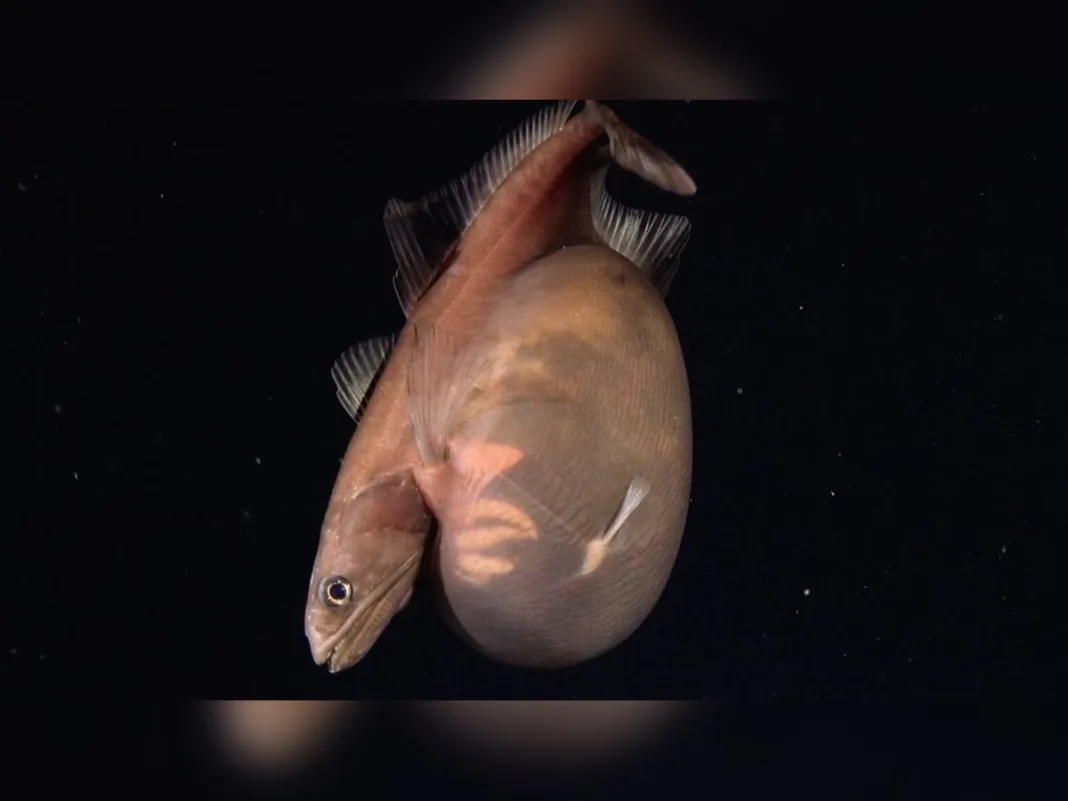
A rare black swallower has been filmed alive more than 4,100 feet beneath the waters of Trinidad and Tobago, offering researchers an unusual glimpse of a deep-sea fish whose extraordinary feeding habits are rarely observed directly.
The fish was recorded by the remotely operated vehicle SuBastian at a depth of 1,259 metres, approximately 4,130 feet. Its stomach was so distended that the skin became nearly transparent, allowing internal organs and intestines to show through. Researchers could not determine what the fish had eaten.
The footage came from a month-long expedition in July 2026 aboard the Schmidt Ocean Institute research vessel Falkor (too). The expedition was described as the first Caribbean-led exploration of the deep sea of Trinidad and Tobago. Nature World News reported the sighting, citing ScienceAlert and research information from the Woods Hole Oceanographic Institution and Schmidt Ocean Institute.
Known scientifically as Chiasmodon niger, the black swallower is generally about 10 to 20 centimetres long. Its large mouth, elongated lower jaw and expandable stomach allow it to swallow prey whole, including animals much larger than itself. A profile from Woods Hole Oceanographic Institution says the fish can consume prey weighing many times its own body mass.
The species usually inhabits deep waters, approximately 700 to 3,000 metres below the surface. It is rarely seen alive in its natural habitat, and much of the available knowledge comes from specimens found dead near the ocean surface.
There is a reason its unusual appetite can be dangerous. If a swallowed animal is too large to digest quickly, it may begin decomposing inside the fish’s stomach. Gas produced during decomposition can accumulate and potentially carry the fish towards the surface. Researchers have therefore encountered dead black swallowers with partly digested prey still protruding from their stomachs.
The newly recorded fish provides a rare opportunity to observe an animal with a dramatically expanded stomach in its natural environment. However, the meal itself remains a mystery, and important questions about the species’ feeding behaviour and digestion remain unanswered.
The expedition’s findings extended well beyond this single encounter. According to the report, researchers mapped approximately 11,335 square kilometres of seafloor, equivalent to about 13 per cent of the country’s marine territory. The team also confirmed 25 active cold seeps, where methane and other fluids escape from the seabed and support distinctive communities of organisms.
Researchers identified at least 20 suspected new species and recorded at least 54 species not previously documented in the country’s waters. More than 700 specimens were collected, increasing the deep-sea collection at the University of the West Indies Zoology Museum in St Augustine twelvefold.
The work also documented human-made rubbish on the seafloor, underscoring that even remote marine environments are not untouched by human activity. Scientists use such surveys to establish a baseline of species and habitats that can inform future research and help document environmental change.
For Trinidad and Tobago, the footage is a striking result from a broader effort to investigate the deep ocean close to home. The black swallower’s unidentified meal remains unresolved, but the observation illustrates how much there is still to discover in the country’s deep waters.
News Desk is the editorial publishing account for Tringlobe Media News, covering breaking news, public affairs, entertainment, community developments and regional stories across Trinidad and Tobago, the Caribbean and internationally.