The key points are temporarily unavailable. You can still read the full Story below.
Main Points
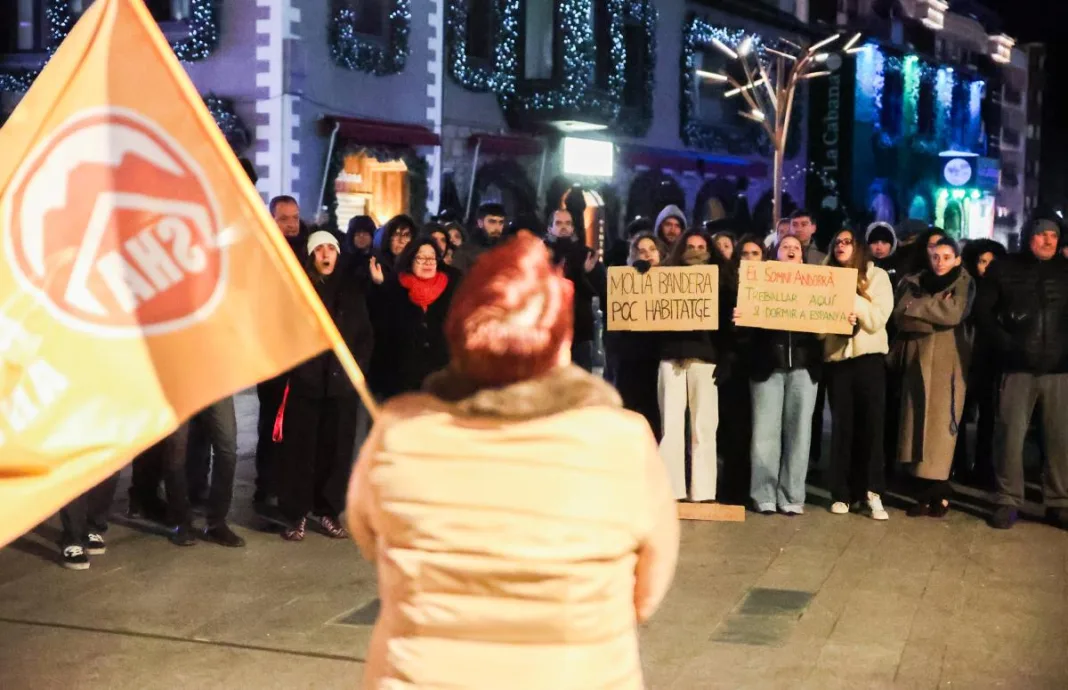
Three years after the historic mobilization that saw more than a thousand citizens take to the streets on December 8, 2023, the housing crisis in Andorra continues to worsen. That evening, around 150 people gathered in the Rotonda square of Andorra la Vella, organized by the Housing Union (Sindicat d’Habitatge). The protest was held to commemorate the anniversary of the movement’s founding and to deliver a direct message to the government: patience has run out. The union’s spokesperson, Rebeca Bonache, said the gathering marks the beginning of a new phase of sustained mobilization. She warned that if negotiations with the government do not yield results before next month, the movement may consider more intense actions, including a border closure on December 8 for the Puríssima, a general strike next year, or a rent strike. The union’s objectives are to secure indefinite contracts and regulated prices, end abusive practices, and prohibit evictions without alternative housing. During the event, participants chanted slogans such as “Housing dignity,” “No people without homes, no homes without people,” and “Enough speculation.” The protest highlighted the socio‑economic reality that has altered life in Andorra. The sustained rise in the price per square meter has caused rents to absorb more than 50–60 % of the average and minimum salaries of many families. The financial strain has made youth independence almost impossible and has contributed to residential exodus to neighboring Alt Urgell. More workers are forced to live in nearby towns such as La Seu d’Urgell because they cannot afford local prices, creating a shortage of staff for local businesses. The debate over housing policy pits two perspectives against each other. The government defends the measures it has implemented so far, including a housing fund, incentives to put vacant apartments on the market, and plans for regulated‑price housing. It argues that these public‑private supply‑side policies need time to take effect. Conversely, professional associations of property owners and real‑estate agents warn that excessive price controls or contract freezes could have the opposite effect, leading to a withdrawal of rental units from the market due to legal uncertainty. At the Rotonda, macroeconomic arguments collided with the everyday realities of families. The protest served as a social thermometer, demonstrating that citizen discontent can no longer be contained within four walls. The Housing Union will meet next week with Minister Conxita Marsol, President of the Ministry of Presidency, Economy, Labour and Housing, to present the testimonies and grievances collected during the demonstration. Article source: Bondia | Image credit: Bondia
Three years after the historic mobilization that saw more than a thousand citizens take to the streets on December 8, 2023, the housing crisis in Andorra continues to worsen. That evening, around 150 people gathered in the Rotonda square of Andorra la Vella, organized by the Housing Union (Sindicat d’Habitatge). The protest was held to commemorate the anniversary of the movement’s founding and to deliver a direct message to the government: patience has run out. The union’s spokesperson, Rebeca Bonache, said the gathering marks the beginning of a new phase of sustained mobilization. She warned that if negotiations with the government do not yield results before next month, the movement may consider more intense actions, including a border closure on December 8 for the Puríssima, a general strike next year, or a rent strike. The union’s objectives are to secure indefinite contracts and regulated prices, end abusive practices, and prohibit evictions without alternative housing. During the event, participants chanted slogans such as “Housing dignity,” “No people without homes, no homes without people,” and “Enough speculation.” The protest highlighted the socio‑economic reality that has altered life in Andorra. The sustained rise in the price per square meter has caused rents to absorb more than 50–60 % of the average and minimum salaries of many families. The financial strain has made youth independence almost impossible and has contributed to residential exodus to neighboring Alt Urgell. More workers are forced to live in nearby towns such as La Seu d’Urgell because they cannot afford local prices, creating a shortage of staff for local businesses. The debate over housing policy pits two perspectives against each other. The government defends the measures it has implemented so far, including a housing fund, incentives to put vacant apartments on the market, and plans for regulated‑price housing. It argues that these public‑private supply‑side policies need time to take effect. Conversely, professional associations of property owners and real‑estate agents warn that excessive price controls or contract freezes could have the opposite effect, leading to a withdrawal of rental units from the market due to legal uncertainty. At the Rotonda, macroeconomic arguments collided with the everyday realities of families. The protest served as a social thermometer, demonstrating that citizen discontent can no longer be contained within four walls. The Housing Union will meet next week with Minister Conxita Marsol, President of the Ministry of Presidency, Economy, Labour and Housing, to present the testimonies and grievances collected during the demonstration.
News Desk is the editorial publishing account for Tringlobe Media News, covering breaking news, public affairs, entertainment, community developments and regional stories across Trinidad and Tobago, the Caribbean and internationally.