The key points are temporarily unavailable. You can still read the full Story below.
Main Points
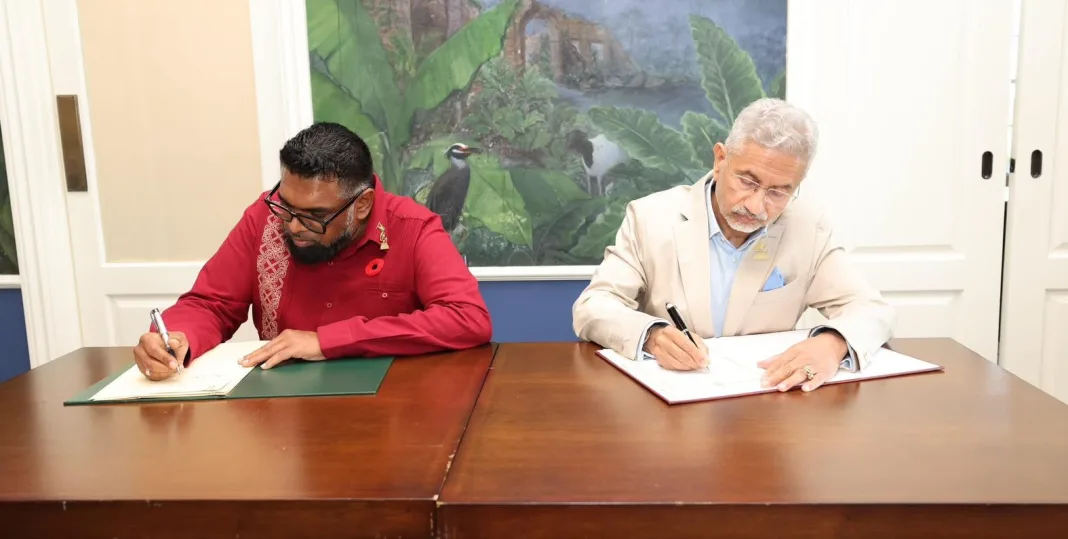
President Dr. Irfaan Ali of Guyana and India’s Minister of External Affairs, Dr. Subrahmanyam Jaishankar, signed three bilateral agreements on the sidelines of the Commonwealth Heads of Government Meeting in Antigua and Barbuda on Wednesday, November 6, 2026. The agreements aim to strengthen cooperation between the two countries in several key areas. The first agreement is a Memorandum of Understanding on Indian grant assistance for the implementation of Quick Impact Projects (QIPs) in Guyana. The second is a Memorandum of Agreement on the supply and installation of micro‑ and small‑enterprise (MSE) manufacturing projects. The third agreement concerns cooperation in digital public infrastructure, including the development of a Unified Payments Interface (UPI)‑like system for Guyana. During the meeting, the two sides reviewed the overall state of India‑Guyana relations and discussed ways to deepen collaboration in areas of mutual interest. The Indian Ministry of External Affairs also announced a new line of credit of US$500 million to support Guyana’s development priorities and infrastructure projects, a move that comes amid concerns about the country’s growing debt burden. Guyana’s debt situation has tightened in 2026. According to the Ministry of Finance’s mid‑year report, the country’s public and publicly guaranteed (PPG) debt increased by nearly US$1 billion in the first half of the year, reaching US$8,573.1 million at the end of June. The total debt burden was US$7.7 billion at the end of 2025, and the government has signalled an intention to raise the debt to US$10.3 billion by the end of 2026. The mid‑year report also detailed the composition of external PPG debt, which totaled US$3,306.4 million (38.6 % of total PPG debt). Multilateral creditors accounted for 61.5 % of external debt, down from 64 % at the end of 2025. Bilateral creditors made up 33.6 % of external debt, up from 30.1 % in 2025, while private creditors represented 4.9 %, a modest one‑percentage‑point decline. Domestic debt stood at US$5,266.7 million (61.4 % of total PPG debt), with Treasury bills comprising about 84.4 % of domestic PPG debt. Debt service payments in the first half of 2026 totaled US$145.7 million, a 30 % increase over the same period in 2025, when payments were US$110 million. Domestic debt service amounted to US$44.2 million, while external debt service was US$101.5 million. Finance Minister Dr. Ashni Singh presented the national budget and highlighted the country’s debt trajectory during the meeting. The agreements signed with India are expected to support Guyana’s economic development and help manage its debt challenges. Article source: Kaieteur News | Image credit: Kaieteur News
President Dr. Irfaan Ali of Guyana and India’s Minister of External Affairs, Dr. Subrahmanyam Jaishankar, signed three bilateral agreements on the sidelines of the Commonwealth Heads of Government Meeting in Antigua and Barbuda on Wednesday, November 6, 2026. The agreements aim to strengthen cooperation between the two countries in several key areas. The first agreement is a Memorandum of Understanding on Indian grant assistance for the implementation of Quick Impact Projects (QIPs) in Guyana. The second is a Memorandum of Agreement on the supply and installation of micro‑ and small‑enterprise (MSE) manufacturing projects. The third agreement concerns cooperation in digital public infrastructure, including the development of a Unified Payments Interface (UPI)‑like system for Guyana. During the meeting, the two sides reviewed the overall state of India‑Guyana relations and discussed ways to deepen collaboration in areas of mutual interest. The Indian Ministry of External Affairs also announced a new line of credit of US$500 million to support Guyana’s development priorities and infrastructure projects, a move that comes amid concerns about the country’s growing debt burden. Guyana’s debt situation has tightened in 2026. According to the Ministry of Finance’s mid‑year report, the country’s public and publicly guaranteed (PPG) debt increased by nearly US$1 billion in the first half of the year, reaching US$8,573.1 million at the end of June. The total debt burden was US$7.7 billion at the end of 2025, and the government has signalled an intention to raise the debt to US$10.3 billion by the end of 2026. The mid‑year report also detailed the composition of external PPG debt, which totaled US$3,306.4 million (38.6 % of total PPG debt). Multilateral creditors accounted for 61.5 % of external debt, down from 64 % at the end of 2025. Bilateral creditors made up 33.6 % of external debt, up from 30.1 % in 2025, while private creditors represented 4.9 %, a modest one‑percentage‑point decline. Domestic debt stood at US$5,266.7 million (61.4 % of total PPG debt), with Treasury bills comprising about 84.4 % of domestic PPG debt. Debt service payments in the first half of 2026 totaled US$145.7 million, a 30 % increase over the same period in 2025, when payments were US$110 million. Domestic debt service amounted to US$44.2 million, while external debt service was US$101.5 million. Finance Minister Dr. Ashni Singh presented the national budget and highlighted the country’s debt trajectory during the meeting. The agreements signed with India are expected to support Guyana’s economic development and help manage its debt challenges.
News Desk is the editorial publishing account for Tringlobe Media News, covering breaking news, public affairs, entertainment, community developments and regional stories across Trinidad and Tobago, the Caribbean and internationally.