The key points are temporarily unavailable. You can still read the full Story below.
Main Points
How Doubles Was Born: The Princes Town Story Behind Trinidad’s Most Famous Street Food For generations, Trinidadians have stood at roadside stalls and made a request that needs almost no explanation: doubles, with slight pepper, plenty pepper, or no pepper at all. Two soft pieces of bara, curried channa and a combination of chutneys and sauces have become such an established part of Trinidad and Tobago life that it is easy to assume doubles has simply always been here. But it hasn't. The story of doubles takes us back roughly 90 years to **Princes Town in south Trinidad**, where Emamool “Mamoodeen” Deen and his wife Rasulan Deen are widely credited with developing the food that eventually became one of Trinidad and Tobago's most famous street foods. Historical accounts place the beginning of their enterprise in **1936**. And perhaps the most surprising part of the story is this: **Doubles was originally a single.** ## It Started With a Family Trying to Survive Mamoodeen and Rasulan were not setting out to create a national food. They were trying to make a better living for their family. According to an account of the Deen family's history published by the Trinidad Guardian, Mamoodeen earned about **25 cents per day** working on a sugar estate, an income that was insufficient for his growing family. In 1936, he and Rasulan began experimenting with food at his father-in-law's home on Bonanza Street in Princes Town. Their early product was remarkably simple: **fried channa**. The Guardian's account says the couple bought channa, salt, pepper and paper, with the intention of preparing small cone-shaped packages that could be sold for one cent each. Mamoodeen began selling them, and the additional income showed enough promise for the family to continue experimenting. ## Before Doubles, There Was Channa As the business developed, so did the food. Fried channa was followed by other preparations, including boiled and curried channa. Chutney was added, and eventually Mamoodeen tried something that would prove crucial to the doubles story. He put the curried channa onto **one bara**. Bara — a fried flatbread — already existed within Indian culinary traditions before doubles was created. What the Deens were doing was combining familiar elements in a new way and turning them into inexpensive street food. Customers liked it. But apparently, one bara wasn't enough. ## The Single Becomes a Double According to the Deen family account, customers began asking Mamoodeen for **another bara** with their channa. They wanted him to **“double-up” on the bara**. And from that simple customer request, the food began taking the form Trinidadians recognize today: curried channa served between two pieces of bara. The name followed. **Doubles.** Newsday's historical account dates the Deens' operation to 1936 and says the name evolved after customers requested that the single bara be doubled. A Trinidad and Tobago primary-school social studies text records essentially the same history. So the food we now automatically expect to contain two bara apparently **started with one**. ## The Ali Family Becomes Part of the Story As demand increased, the doubles story expanded beyond Mamoodeen and Rasulan. Mamoodeen's brothers-in-law, **Asgar Ali and Choate Ali**, became involved in the operation. Newsday reports that the brothers were brought into the Deen business as expansion became necessary. They subsequently established their own operation, with Asgar selling in San Fernando and Choate remaining in Princes Town, while Mamoodeen expanded farther north. A 2024 Newsday interview with third-generation vendor Wazim Ali also traces the Ali family's doubles tradition back to his grandfather Asgar and the original Princes Town enterprise. There is, however, an interesting historical disagreement over exactly **when doubles got its name**. One account associated with Ali's Doubles claims the name came later, around 1951, when students at Naparima College began asking for another bara and telling vendors to “double it up.” That differs from the Deen account, which places the development of the name much earlier. Because much of the early history was preserved through family and oral accounts, it is difficult to establish the exact moment someone first used the word “doubles.” What is much clearer is that **the Deen and Ali families of Princes Town were central to its creation and early development**. ## A Food With Indian Roots, Born in Trinidad The doubles story is also part of the much larger history of Indian migration to Trinidad and Tobago. Mamoodeen and Rasulan were descendants of Indians who came to Trinidad during the period of indentureship. Their food reflected culinary traditions involving chickpeas, fried breads, spices and chutneys. Some food histories have drawn connections between doubles and **chole bhature**, a South Asian dish combining spiced chickpeas and fried bread. But the food that developed in Princes Town took on its own ingredients, preparation, proportions and style. It became Trinidadian. Over time, vendors and customers added the combinations now associated with a doubles stand — tamarind, cucumber, mango, chadon beni, kuchela, coconut chutney and, of course, pepper. The result was no longer simply an adaptation of something that existed elsewhere. It became **doubles**. ## Rasulan's Place in the Story The history is sometimes reduced to the story of “the man who invented doubles,” but Rasulan's contribution should not disappear from the telling. Historical accounts consistently place **Mamoodeen and Rasulan together at the beginning of the enterprise in 1936**, preparing and developing the food that Mamoodeen would sell. It was fundamentally a family operation born from economic necessity. That makes the beginnings of doubles particularly remarkable. There was no restaurant chain, major investment or elaborate business plan. There was a family looking for another way to earn money. ## From Princes Town to Trinidad and Tobago Doubles did not remain in Princes Town. As the Deen and Ali operations expanded and other vendors began producing their own versions, the food spread throughout Trinidad. Over generations it became breakfast before school or work, a quick roadside lunch, something to eat after a late night and one of the country's most affordable fast foods. The wooden doubles box also became part of the tradition. Newsday's historical account credits Mamoodeen with building a yellow wooden box fitted to his bicycle for selling doubles — a style of presentation that survived even as bicycles were eventually replaced by cars, vans and permanent stands. Eventually, doubles travelled even farther. As Trinidadians migrated, the food followed them overseas. Accounts of the Deen family's history describe doubles appearing in diaspora communities in cities including New York, Toronto, Miami, London and Winnipeg. A food created out of necessity in Princes Town had become internationally recognizable. ## From Cents to Dollars The changing price of doubles also gives a glimpse of just how long it has been part of Trinidadian life. Historical price figures supplied for the doubles tradition place the cost at around **two cents in 1938**, with prices gradually increasing through the decades. The timeline shows doubles reaching around $1 during the 1980s, $2 by 1999, $3 in 2007, $4 in 2015, $5 in 2017 and **$6 by 2022**. The numbers have changed dramatically, but doubles has maintained the same basic appeal: a relatively inexpensive, filling meal that can be prepared quickly and eaten almost anywhere. ## More Than Street Food Perhaps the most remarkable part of the doubles story is what happened after its creation. A food with roots in an Indo-Trinidadian family and the experience of Indian descendants in Trinidad gradually crossed ethnic, religious and social boundaries. Today, doubles belongs to the wider culture of Trinidad and Tobago. The person standing next to you at a doubles vendor could come from almost any background. And the ritual is instantly familiar. How many? Slight pepper? Everything? Those few words represent the final chapter, so far, of a story that began nearly 90 years ago with a struggling family in Princes Town. Fried channa became curried channa. The channa was placed on a bara. Customers asked for another. The bara was doubled. And somewhere in that simple process, **one of Trinidad and Tobago's greatest food traditions was born**. Today there are countless vendors, recipes and variations, but beneath every doubles remains that remarkable history. Two bara. Channa. Chutney. Pepper. And a story that started with **a single**.
How Doubles Was Born: The Princes Town Story Behind Trinidad’s Most Famous Street Food
For generations, Trinidadians have stood at roadside stalls and made a request that needs almost no explanation: doubles, with slight pepper, plenty pepper, or no pepper at all.
Two soft pieces of bara, curried channa and a combination of chutneys and sauces have become such an established part of Trinidad and Tobago life that it is easy to assume doubles has simply always been here.
But it hasn’t.
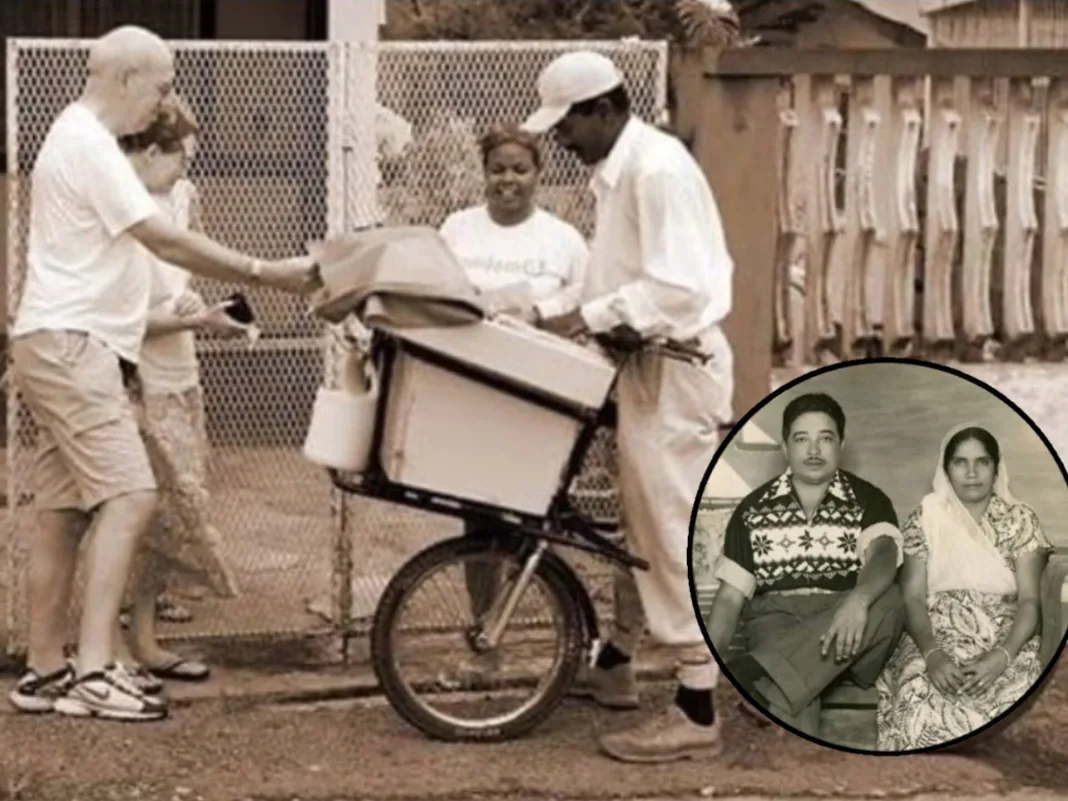
The story of doubles takes us back roughly 90 years to **Princes Town in south Trinidad**, where Emamool “Mamoodeen” Deen and his wife Rasulan Deen are widely credited with developing the food that eventually became one of Trinidad and Tobago’s most famous street foods. Historical accounts place the beginning of their enterprise in **1936**.
And perhaps the most surprising part of the story is this:
**Doubles was originally a single.**
## It Started With a Family Trying to Survive
Mamoodeen and Rasulan were not setting out to create a national food.
They were trying to make a better living for their family.
According to an account of the Deen family’s history published by the Trinidad Guardian, Mamoodeen earned about **25 cents per day** working on a sugar estate, an income that was insufficient for his growing family.
In 1936, he and Rasulan began experimenting with food at his father-in-law’s home on Bonanza Street in Princes Town.
Their early product was remarkably simple: **fried channa**.
The Guardian’s account says the couple bought channa, salt, pepper and paper, with the intention of preparing small cone-shaped packages that could be sold for one cent each.
Mamoodeen began selling them, and the additional income showed enough promise for the family to continue experimenting.
## Before Doubles, There Was Channa
As the business developed, so did the food.
Fried channa was followed by other preparations, including boiled and curried channa. Chutney was added, and eventually Mamoodeen tried something that would prove crucial to the doubles story.
He put the curried channa onto **one bara**.
Bara — a fried flatbread — already existed within Indian culinary traditions before doubles was created. What the Deens were doing was combining familiar elements in a new way and turning them into inexpensive street food.
Customers liked it.
But apparently, one bara wasn’t enough.
## The Single Becomes a Double
According to the Deen family account, customers began asking Mamoodeen for **another bara** with their channa.
They wanted him to **“double-up” on the bara**.
And from that simple customer request, the food began taking the form Trinidadians recognize today: curried channa served between two pieces of bara.
The name followed.
**Doubles.**
Newsday’s historical account dates the Deens’ operation to 1936 and says the name evolved after customers requested that the single bara be doubled. A Trinidad and Tobago primary-school social studies text records essentially the same history.
So the food we now automatically expect to contain two bara apparently **started with one**.
## The Ali Family Becomes Part of the Story
As demand increased, the doubles story expanded beyond Mamoodeen and Rasulan.
Mamoodeen’s brothers-in-law, **Asgar Ali and Choate Ali**, became involved in the operation.
Newsday reports that the brothers were brought into the Deen business as expansion became necessary. They subsequently established their own operation, with Asgar selling in San Fernando and Choate remaining in Princes Town, while Mamoodeen expanded farther north.
A 2024 Newsday interview with third-generation vendor Wazim Ali also traces the Ali family’s doubles tradition back to his grandfather Asgar and the original Princes Town enterprise.
There is, however, an interesting historical disagreement over exactly **when doubles got its name**.
One account associated with Ali’s Doubles claims the name came later, around 1951, when students at Naparima College began asking for another bara and telling vendors to “double it up.”
That differs from the Deen account, which places the development of the name much earlier.
Because much of the early history was preserved through family and oral accounts, it is difficult to establish the exact moment someone first used the word “doubles.”
What is much clearer is that **the Deen and Ali families of Princes Town were central to its creation and early development**.
## A Food With Indian Roots, Born in Trinidad
The doubles story is also part of the much larger history of Indian migration to Trinidad and Tobago.
Mamoodeen and Rasulan were descendants of Indians who came to Trinidad during the period of indentureship. Their food reflected culinary traditions involving chickpeas, fried breads, spices and chutneys.
Some food histories have drawn connections between doubles and **chole bhature**, a South Asian dish combining spiced chickpeas and fried bread. But the food that developed in Princes Town took on its own ingredients, preparation, proportions and style.
It became Trinidadian.
Over time, vendors and customers added the combinations now associated with a doubles stand — tamarind, cucumber, mango, chadon beni, kuchela, coconut chutney and, of course, pepper.
The result was no longer simply an adaptation of something that existed elsewhere.
It became **doubles**.
## Rasulan’s Place in the Story
The history is sometimes reduced to the story of “the man who invented doubles,” but Rasulan’s contribution should not disappear from the telling.
Historical accounts consistently place **Mamoodeen and Rasulan together at the beginning of the enterprise in 1936**, preparing and developing the food that Mamoodeen would sell.
It was fundamentally a family operation born from economic necessity.
That makes the beginnings of doubles particularly remarkable.
There was no restaurant chain, major investment or elaborate business plan.
There was a family looking for another way to earn money.
## From Princes Town to Trinidad and Tobago
Doubles did not remain in Princes Town.
As the Deen and Ali operations expanded and other vendors began producing their own versions, the food spread throughout Trinidad.
Over generations it became breakfast before school or work, a quick roadside lunch, something to eat after a late night and one of the country’s most affordable fast foods.
The wooden doubles box also became part of the tradition. Newsday’s historical account credits Mamoodeen with building a yellow wooden box fitted to his bicycle for selling doubles — a style of presentation that survived even as bicycles were eventually replaced by cars, vans and permanent stands.
Eventually, doubles travelled even farther.
As Trinidadians migrated, the food followed them overseas. Accounts of the Deen family’s history describe doubles appearing in diaspora communities in cities including New York, Toronto, Miami, London and Winnipeg.
A food created out of necessity in Princes Town had become internationally recognizable.
## From Cents to Dollars
The changing price of doubles also gives a glimpse of just how long it has been part of Trinidadian life.
Historical price figures supplied for the doubles tradition place the cost at around **two cents in 1938**, with prices gradually increasing through the decades. The timeline shows doubles reaching around $1 during the 1980s, $2 by 1999, $3 in 2007, $4 in 2015, $5 in 2017 and **$6 by 2022**.
The numbers have changed dramatically, but doubles has maintained the same basic appeal: a relatively inexpensive, filling meal that can be prepared quickly and eaten almost anywhere.
## More Than Street Food
Perhaps the most remarkable part of the doubles story is what happened after its creation.
A food with roots in an Indo-Trinidadian family and the experience of Indian descendants in Trinidad gradually crossed ethnic, religious and social boundaries.
Today, doubles belongs to the wider culture of Trinidad and Tobago.
The person standing next to you at a doubles vendor could come from almost any background.
And the ritual is instantly familiar.
How many?
Slight pepper?
Everything?
Those few words represent the final chapter, so far, of a story that began nearly 90 years ago with a struggling family in Princes Town.
Fried channa became curried channa.
The channa was placed on a bara.
Customers asked for another.
The bara was doubled.
And somewhere in that simple process, **one of Trinidad and Tobago’s greatest food traditions was born**.
Today there are countless vendors, recipes and variations, but beneath every doubles remains that remarkable history.
News Desk is the editorial publishing account for Tringlobe Media News, covering breaking news, public affairs, entertainment, community developments and regional stories across Trinidad and Tobago, the Caribbean and internationally.