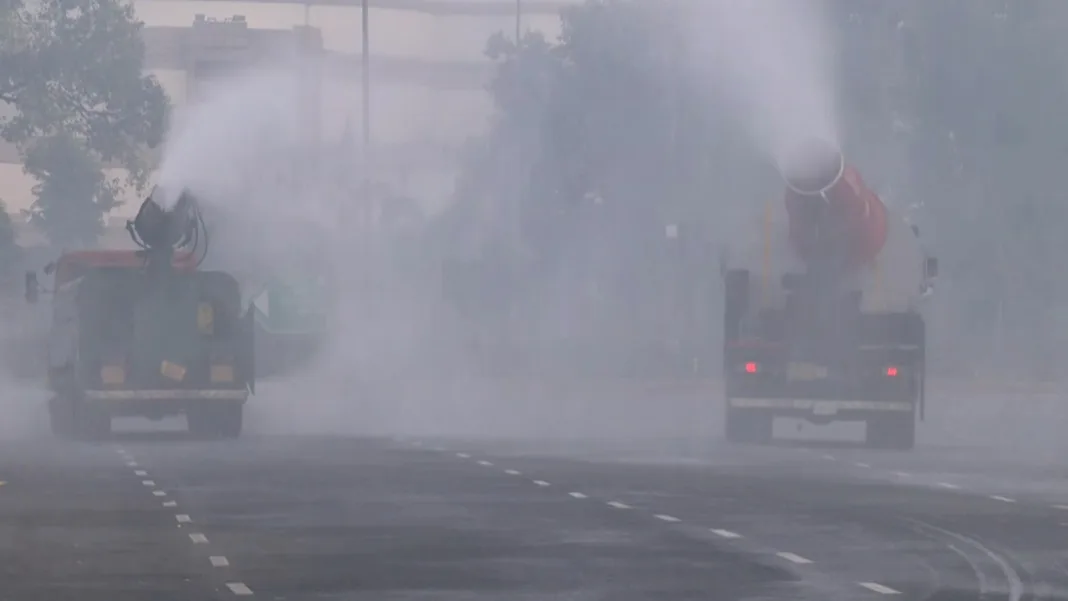
New Delhi, Nov 06 (ANI): Municipal authorities deploy truck-mounted water sprinklers to undertake water sprinkling operations as the Air Quality Index (AQI) in the area around India Gate is 403, categorised as 'Severe', as per the CPCB (Central Pollution Control Board), in New Delhi on Friday. (ANI Video Grab)
The key points are temporarily unavailable. You can still read the full Story below.
Main Points
Several air-quality monitoring stations in Delhi-NCR experienced significant data outages in the days leading up to Diwali, according to data from the Central Pollution Control Board (CPCB). An analysis by The Indian Express found that at least 11 stations reported gaps in particulate pollution data on Friday, a period during which the city’s air quality remained in the "Very Poor" category for the fifth consecutive day. The 24-hour average Air Quality Index (AQI) was recorded at 382 on Friday, with forecasts suggesting a decline into the "Severe" category over the weekend. In response to the deteriorating air quality, the Commission for Air Quality Management (CAQM) has implemented stage three emergency measures under the Graded Response Action Plan (GRAP). The data disruptions affected various locations, including Nehru Nagar, Burari Crossing, Vasundhara Enclave, and Nangloi. Across the capital’s 59 monitoring stations, there were 144 missing PM2.5 readings and 282 missing PM10 readings throughout the week. Some stations, such as NSIT Dwarka, Nangloi, and IIT Delhi, experienced complete outages across all 24 air-quality and meteorological parameters for several hours. Notably, the PM10 monitor at the ITO station remained non-functional for 86 consecutive hours between November 1 and November 4. A senior scientist at the Delhi Pollution Control Committee (DPCC) stated that the agency’s central server is configured to trigger an operational alert when a station fails to transmit telemetry for three consecutive hours. Nodal officers are then tasked with investigating whether the outages are caused by power interruptions, sensor malfunctions, server issues, or calibration errors. These gaps in data are significant because the CPCB’s National AQI methodology requires a minimum of 16 hours of readings for at least three pollutants—including either PM2.5 or PM10—to calculate a valid daily AQI. If a station fails to meet these criteria, the daily AQI is marked as having insufficient data, potentially leaving localized pollution levels unrepresented in official assessments. Article source: Indian Express | Image credit: Indian Express
Several air-quality monitoring stations in Delhi-NCR experienced significant data outages in the days leading up to Diwali, according to data from the Central Pollution Control Board (CPCB). An analysis by The Indian Express found that at least 11 stations reported gaps in particulate pollution data on Friday, a period during which the city’s air quality remained in the “Very Poor” category for the fifth consecutive day. The 24-hour average Air Quality Index (AQI) was recorded at 382 on Friday, with forecasts suggesting a decline into the “Severe” category over the weekend. In response to the deteriorating air quality, the Commission for Air Quality Management (CAQM) has implemented stage three emergency measures under the Graded Response Action Plan (GRAP). The data disruptions affected various locations, including Nehru Nagar, Burari Crossing, Vasundhara Enclave, and Nangloi. Across the capital’s 59 monitoring stations, there were 144 missing PM2.5 readings and 282 missing PM10 readings throughout the week. Some stations, such as NSIT Dwarka, Nangloi, and IIT Delhi, experienced complete outages across all 24 air-quality and meteorological parameters for several hours. Notably, the PM10 monitor at the ITO station remained non-functional for 86 consecutive hours between November 1 and November 4. A senior scientist at the Delhi Pollution Control Committee (DPCC) stated that the agency’s central server is configured to trigger an operational alert when a station fails to transmit telemetry for three consecutive hours. Nodal officers are then tasked with investigating whether the outages are caused by power interruptions, sensor malfunctions, server issues, or calibration errors. These gaps in data are significant because the CPCB’s National AQI methodology requires a minimum of 16 hours of readings for at least three pollutants—including either PM2.5 or PM10—to calculate a valid daily AQI. If a station fails to meet these criteria, the daily AQI is marked as having insufficient data, potentially leaving localized pollution levels unrepresented in official assessments.
News Desk is the editorial publishing account for Tringlobe Media News, covering breaking news, public affairs, entertainment, community developments and regional stories across Trinidad and Tobago, the Caribbean and internationally.