The key points are temporarily unavailable. You can still read the full Story below.
Main Points
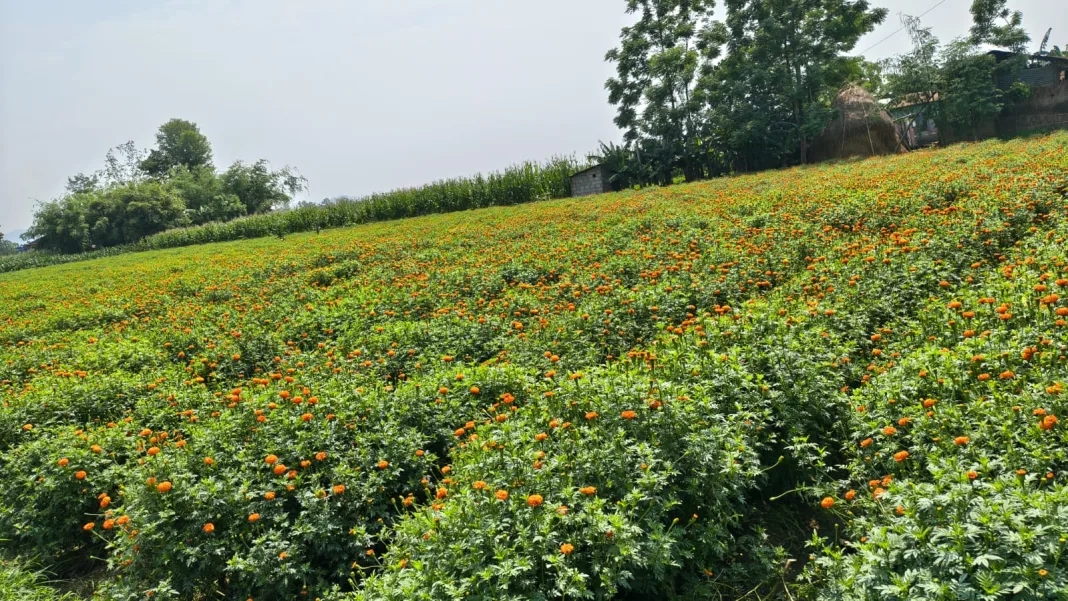
Waling (Syangja), October 28: The number of farmers engaged in commercial floriculture is steadily increasing in Syangja district. Once limited to subsistence farming for household use, flower production has now evolved into a commercial enterprise, driven by the crop's resilience against monkey damage—a significant issue for other local crops—and high market demand. The rise in local production has significantly reduced the district's reliance on imported flowers and garlands. Until a few years ago, Syangja depended on supplies from India, Butwal, and Pokhara for festivals and public events. Today, the trend has reversed, with locally produced flowers and garlands being exported to those same regions. Farmers are primarily focusing on marigold production, timed specifically for the Dashain and Tihar festivals. Chandra Rana, a farmer from Rupakhani in Galyang Municipality-5, has been cultivating marigolds commercially for the past eight years. Inspired by his success, other farmers in the region have also adopted the practice. Currently, a group of seven farmers, including Rana, is cultivating marigolds across six locations in Galyang Municipality and Kaligandaki Rural Municipality, with each site spanning two ropanis of land. "Although we cultivate in separate locations, we collaborate on sourcing seeds and seedlings, sharing cultivation techniques, and coordinating marketing efforts," Rana explained. He added that the group consolidates their harvest to meet large-scale market demands. Despite the growth, farmers face some challenges. Dilmaya Rana, a farmer from Galyang-2, noted that early blooming before Tihar and fluctuating market prices during the pre-Dashain period have raised concerns regarding market stability. Currently, marigold garlands are being sold at wholesale prices of Rs 50 and retail prices of Rs 70. Loose flowers are priced at Rs 100 per kilogram wholesale and Rs 200 per kilogram retail. The farmers have successfully supplied their produce to Pokhara during the Dashain season and are now preparing to ship their harvest to Butwal for Tihar. While demand from traders in these cities remains steady, local farmers noted that they occasionally struggle to secure competitive prices when forced to compete with cheaper imported flowers from India. Article source: Gorkhapatra National Daily | Image credit: Gorkhapatra National Daily
Waling (Syangja), October 28: The number of farmers engaged in commercial floriculture is steadily increasing in Syangja district. Once limited to subsistence farming for household use, flower production has now evolved into a commercial enterprise, driven by the crop’s resilience against monkey damage—a significant issue for other local crops—and high market demand. The rise in local production has significantly reduced the district’s reliance on imported flowers and garlands. Until a few years ago, Syangja depended on supplies from India, Butwal, and Pokhara for festivals and public events. Today, the trend has reversed, with locally produced flowers and garlands being exported to those same regions. Farmers are primarily focusing on marigold production, timed specifically for the Dashain and Tihar festivals. Chandra Rana, a farmer from Rupakhani in Galyang Municipality-5, has been cultivating marigolds commercially for the past eight years. Inspired by his success, other farmers in the region have also adopted the practice. Currently, a group of seven farmers, including Rana, is cultivating marigolds across six locations in Galyang Municipality and Kaligandaki Rural Municipality, with each site spanning two ropanis of land. “Although we cultivate in separate locations, we collaborate on sourcing seeds and seedlings, sharing cultivation techniques, and coordinating marketing efforts,” Rana explained. He added that the group consolidates their harvest to meet large-scale market demands. Despite the growth, farmers face some challenges. Dilmaya Rana, a farmer from Galyang-2, noted that early blooming before Tihar and fluctuating market prices during the pre-Dashain period have raised concerns regarding market stability. Currently, marigold garlands are being sold at wholesale prices of Rs 50 and retail prices of Rs 70. Loose flowers are priced at Rs 100 per kilogram wholesale and Rs 200 per kilogram retail. The farmers have successfully supplied their produce to Pokhara during the Dashain season and are now preparing to ship their harvest to Butwal for Tihar. While demand from traders in these cities remains steady, local farmers noted that they occasionally struggle to secure competitive prices when forced to compete with cheaper imported flowers from India.
News Desk is the editorial publishing account for Tringlobe Media News, covering breaking news, public affairs, entertainment, community developments and regional stories across Trinidad and Tobago, the Caribbean and internationally.