The key points are temporarily unavailable. You can still read the full Story below.
Main Points
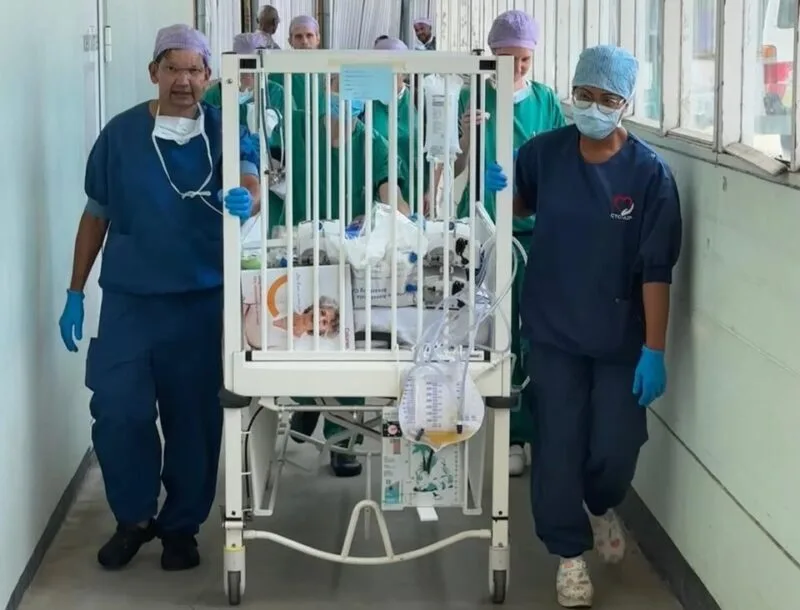
The Universitair Medisch Centrum Groningen (UMCG) completed its fifth annual pediatric cardiac surgery mission to Suriname on 26 October, having successfully operated on seven children with congenital heart defects during a little over a week. “Things are going well,” said pediatric cardiac surgeon Ryan Accord, who led the 14‑person mission, to the Dutch newspaper Ware Tijd. Accord noted that the collaboration between the Dutch team and local staff at the Academisch Ziekenhuis Paramaribo had again proceeded smoothly, allowing the team to perform more complex procedures than in previous years. He declined to give details about the specific surgeries, citing that the children had not yet all been discharged. Accord called the mission a “good example of how cooperation can yield results in the long term.” One of the participants was a Surinamese pediatrician who is currently training as a child cardiologist in Rotterdam. He was able to contribute full‑time to the care of the children during the mission, illustrating how Surinamese doctors can gain experience and gradually take on more responsibilities. The mission began on 19 October with two major operations. The schedule was coordinated with the intensive‑care unit to ensure adequate postoperative care. Accord said that a fully independent Surinamese pediatric cardiac surgery team is “difficult to achieve” because the procedures are highly specialized and the patient volume is too low to build sufficient experience for a year‑round team. In the Netherlands, four pediatric cardiac centers serve a population of about 18 million people. The missions therefore provide specialized care in Suriname without requiring a permanent team on site. Not all planned operations were carried out. One child did not appear for surgery, and Accord suspected that parental anxiety may have played a role. Families sometimes receive short‑notice invitations to surgery, which can create uncertainty and fear. In response, the team is developing an educational film to better prepare parents and children for the surgical process and hospital stay. The film will be made available in several Surinamese languages to reach as many families as possible. Accord hopes that this will increase parents’ confidence in the treatment pathway. Accord concluded that the mission demonstrated that high‑quality care can be delivered and that children who need surgery should have the opportunity to receive it. He expects another mission to Suriname to take place next year. Article source: De Ware Tijd | Image credit: De Ware Tijd
The Universitair Medisch Centrum Groningen (UMCG) completed its fifth annual pediatric cardiac surgery mission to Suriname on 26 October, having successfully operated on seven children with congenital heart defects during a little over a week. “Things are going well,” said pediatric cardiac surgeon Ryan Accord, who led the 14‑person mission, to the Dutch newspaper Ware Tijd. Accord noted that the collaboration between the Dutch team and local staff at the Academisch Ziekenhuis Paramaribo had again proceeded smoothly, allowing the team to perform more complex procedures than in previous years. He declined to give details about the specific surgeries, citing that the children had not yet all been discharged. Accord called the mission a “good example of how cooperation can yield results in the long term.” One of the participants was a Surinamese pediatrician who is currently training as a child cardiologist in Rotterdam. He was able to contribute full‑time to the care of the children during the mission, illustrating how Surinamese doctors can gain experience and gradually take on more responsibilities. The mission began on 19 October with two major operations. The schedule was coordinated with the intensive‑care unit to ensure adequate postoperative care. Accord said that a fully independent Surinamese pediatric cardiac surgery team is “difficult to achieve” because the procedures are highly specialized and the patient volume is too low to build sufficient experience for a year‑round team. In the Netherlands, four pediatric cardiac centers serve a population of about 18 million people. The missions therefore provide specialized care in Suriname without requiring a permanent team on site. Not all planned operations were carried out. One child did not appear for surgery, and Accord suspected that parental anxiety may have played a role. Families sometimes receive short‑notice invitations to surgery, which can create uncertainty and fear. In response, the team is developing an educational film to better prepare parents and children for the surgical process and hospital stay. The film will be made available in several Surinamese languages to reach as many families as possible. Accord hopes that this will increase parents’ confidence in the treatment pathway. Accord concluded that the mission demonstrated that high‑quality care can be delivered and that children who need surgery should have the opportunity to receive it. He expects another mission to Suriname to take place next year.
News Desk is the editorial publishing account for Tringlobe Media News, covering breaking news, public affairs, entertainment, community developments and regional stories across Trinidad and Tobago, the Caribbean and internationally.