The key points are temporarily unavailable. You can still read the full Story below.
Main Points
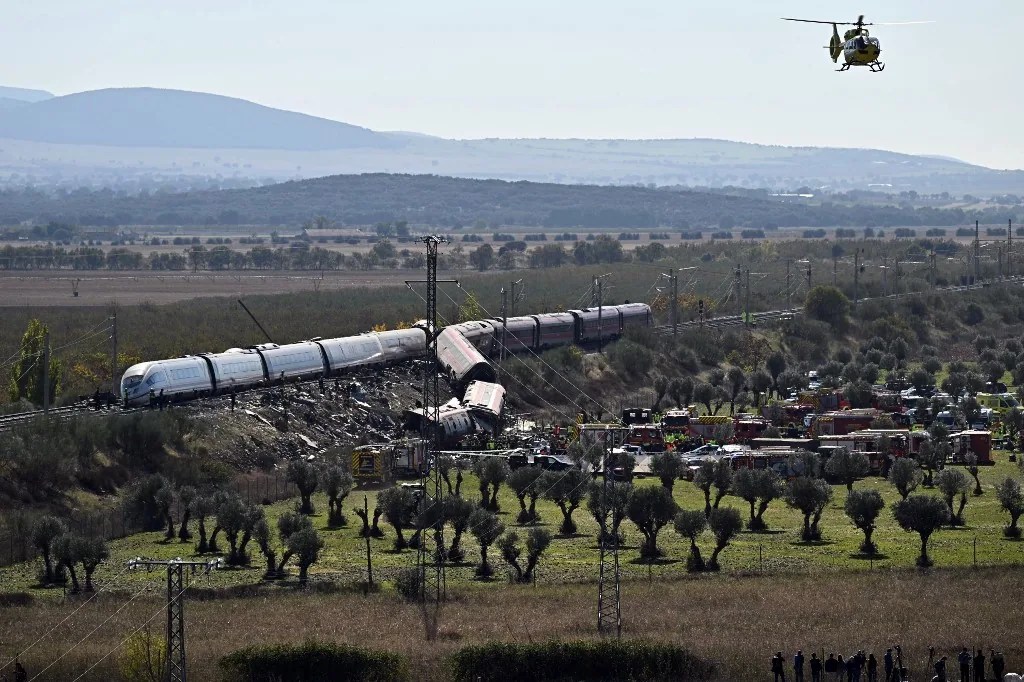
Spanish news agencies, including El Pais and RTVE, released audio recordings that show conversations between two train drivers and the Madrid control centre in the hours before a fatal collision. In one recording a control‑centre operator instructs a Renfe driver to resume normal speed after a series of technical problems. The operator says, “Continue your journey, then proceed under the side signal block at normal speed, normal operating mode.” The driver replies, “Normal speed?” and the speed limiter confirms, “Yes.” The side signal block is a backup track used when the automatic signalling or data‑transfer system fails. A second recording features the Iryo train driver reporting that communication with the signalling system had been lost and that the trains were stopped at Urdan. The driver says, “The train is standing before the Urdan entrance signal.” After a brief exchange the driver receives instructions to continue. In a later recording the Iryo driver again contacts the control centre, stating that the train will not allow him to operate the safety system and that he remains in front of the entrance lamp: “The train does not allow me to control the safety system. Therefore I am still standing before the entrance lamp.” This suggests that the control centre was notified that the Iryo train remained stationary while the Renfe train approached. Spanish Transport Minister Óscar Puente said the control centre’s role is to decide when trains can restart after a system fault. He explained that a computer error caused five trains to stop initially, including the two that later collided. Puente added that in the event of a system fault “the control centre takes over the control,” and that the decision to restart the trains was made under “unexplained circumstances,” according to a BBC report. Article source: Magyar Hirlap | Image credit: Magyar Hirlap
Spanish news agencies, including El Pais and RTVE, released audio recordings that show conversations between two train drivers and the Madrid control centre in the hours before a fatal collision. In one recording a control‑centre operator instructs a Renfe driver to resume normal speed after a series of technical problems. The operator says, “Continue your journey, then proceed under the side signal block at normal speed, normal operating mode.” The driver replies, “Normal speed?” and the speed limiter confirms, “Yes.” The side signal block is a backup track used when the automatic signalling or data‑transfer system fails. A second recording features the Iryo train driver reporting that communication with the signalling system had been lost and that the trains were stopped at Urdan. The driver says, “The train is standing before the Urdan entrance signal.” After a brief exchange the driver receives instructions to continue. In a later recording the Iryo driver again contacts the control centre, stating that the train will not allow him to operate the safety system and that he remains in front of the entrance lamp: “The train does not allow me to control the safety system. Therefore I am still standing before the entrance lamp.” This suggests that the control centre was notified that the Iryo train remained stationary while the Renfe train approached. Spanish Transport Minister Óscar Puente said the control centre’s role is to decide when trains can restart after a system fault. He explained that a computer error caused five trains to stop initially, including the two that later collided. Puente added that in the event of a system fault “the control centre takes over the control,” and that the decision to restart the trains was made under “unexplained circumstances,” according to a BBC report.
News Desk is the editorial publishing account for Tringlobe Media News, covering breaking news, public affairs, entertainment, community developments and regional stories across Trinidad and Tobago, the Caribbean and internationally.