The key points are temporarily unavailable. You can still read the full Story below.
Main Points
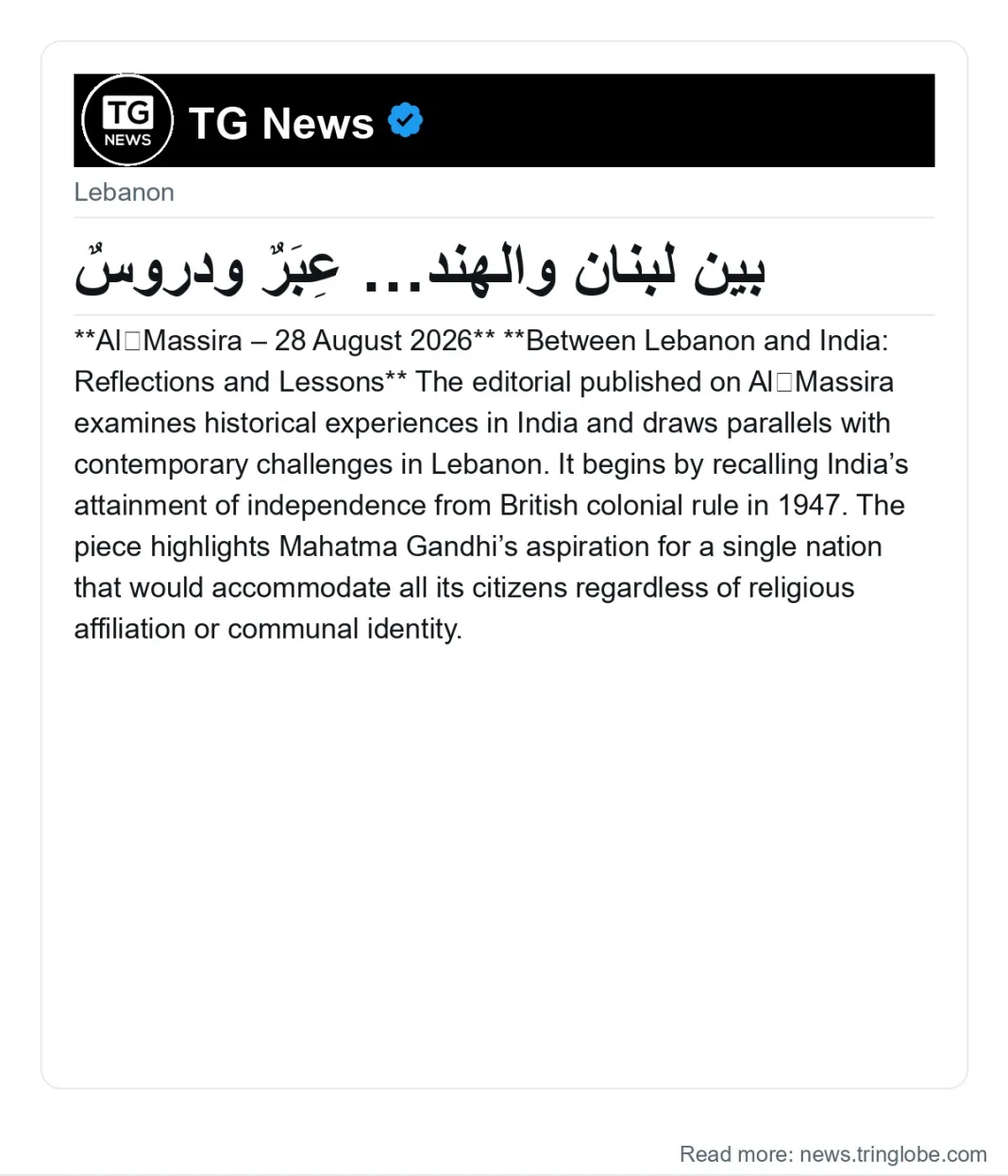
**Al‑Massira – 28 August 2026** **Between Lebanon and India: Reflections and Lessons** The editorial published on Al‑Massira examines historical experiences in India and draws parallels with contemporary challenges in Lebanon. It begins by recalling India’s attainment of independence from British colonial rule in 1947. The piece highlights Mahatma Gandhi’s aspiration for a single nation that would accommodate all its citizens regardless of religious affiliation or communal identity. According to the article, Gandhi devoted considerable effort to persuading Muslim leaders to preserve the unity of the newly independent country, arguing that citizenship was the essential guarantee of freedom, dignity, and shared coexistence. The commentary notes that the majority of leaders of the All‑India Muslim League, headed by Muhammad Ali Jinnah, held a different view. While the article does not elaborate on the specifics of the Muslim League’s position, it indicates that the divergence between Gandhi’s inclusive vision and the Muslim League’s stance contributed to the eventual partition of the subcontinent. The author uses these historical observations to suggest that Lebanon might derive lessons from India’s experience regarding the management of religious and communal diversity. No specific policy recommendations are offered, and the piece does not present new data or investigative findings. The article is a reflective editorial rather than a news report; it does not contain statements from officials or newly released documents. All references are to well‑known historical events: India’s 1947 independence, Gandhi’s advocacy for a united, secular nation, and the leadership of Muhammad Ali Jinnah within the Muslim League. Article and image source: almassira.com
**Al‑Massira – 28 August 2026**
**Between Lebanon and India: Reflections and Lessons**
The editorial published on Al‑Massira examines historical experiences in India and draws parallels with contemporary challenges in Lebanon. It begins by recalling India’s attainment of independence from British colonial rule in 1947. The piece highlights Mahatma Gandhi’s aspiration for a single nation that would accommodate all its citizens regardless of religious affiliation or communal identity. According to the article, Gandhi devoted considerable effort to persuading Muslim leaders to preserve the unity of the newly independent country, arguing that citizenship was the essential guarantee of freedom, dignity, and shared coexistence.
The commentary notes that the majority of leaders of the All‑India Muslim League, headed by Muhammad Ali Jinnah, held a different view. While the article does not elaborate on the specifics of the Muslim League’s position, it indicates that the divergence between Gandhi’s inclusive vision and the Muslim League’s stance contributed to the eventual partition of the subcontinent.
The author uses these historical observations to suggest that Lebanon might derive lessons from India’s experience regarding the management of religious and communal diversity. No specific policy recommendations are offered, and the piece does not present new data or investigative findings.
The article is a reflective editorial rather than a news report; it does not contain statements from officials or newly released documents. All references are to well‑known historical events: India’s 1947 independence, Gandhi’s advocacy for a united, secular nation, and the leadership of Muhammad Ali Jinnah within the Muslim League.
News Desk is the editorial publishing account for Tringlobe Media News, covering breaking news, public affairs, entertainment, community developments and regional stories across Trinidad and Tobago, the Caribbean and internationally.