The key points are temporarily unavailable. You can still read the full Story below.
Main Points
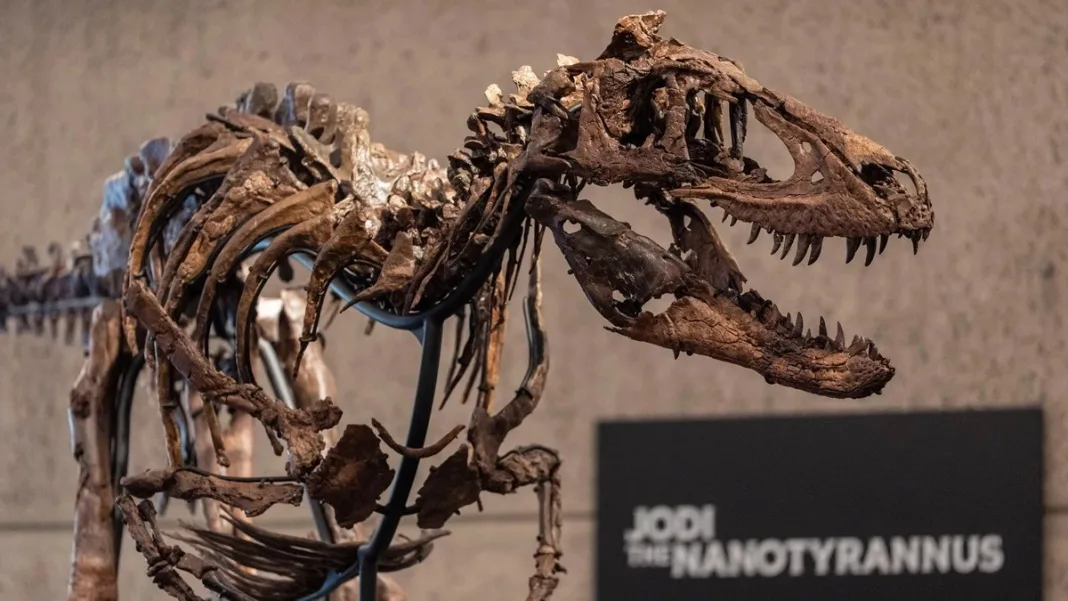
In New York, Sotheby’s auctioned a nearly complete skeleton of a small theropod dinosaur for more than €42 million. The specimen, a Nanotyrannus nicknamed “Jodie,” was discovered in 2019 in Montana and dates to about 67 million years ago, the late Cretaceous period. The auction, which lasted only 12 minutes, exceeded Sotheby’s initial estimate of €5–8 million by more than five times. The buyer’s identity remains undisclosed, and it is unclear whether the skeleton will be displayed publicly or kept in a private collection. Jodie consists of roughly 191 fossilized bones, making it one of only three well-preserved Nanotyrannus skeletons known worldwide. The dinosaur measured about 4.7 m from snout to tail and stood roughly 2.7 m tall, considerably smaller than the larger Tyrannosaurus rex, which could reach 13 m in length and 5 m in height. The sale has drawn criticism from the scientific community. Paleontologists worry that rare specimens sold to private collectors may become inaccessible for research and public viewing. One American scientist, speaking to The Guardian, questioned the justification for the high price, noting that the total cost of excavation, preparation, and assembly of a skeleton likely does not exceed $1 million. He also highlighted that the market for dinosaur fossils continues to rise, citing a recent sale of a T. rex skeleton for about €44 million. The auction raises broader questions about whether unique geological and paleontological artifacts should remain in museums, where they can be studied and exhibited, or whether they can be legitimately traded on the private market. Article source: Business & the Baltics | Image credit: Business & the Baltics
In New York, Sotheby’s auctioned a nearly complete skeleton of a small theropod dinosaur for more than €42 million. The specimen, a Nanotyrannus nicknamed “Jodie,” was discovered in 2019 in Montana and dates to about 67 million years ago, the late Cretaceous period. The auction, which lasted only 12 minutes, exceeded Sotheby’s initial estimate of €5–8 million by more than five times. The buyer’s identity remains undisclosed, and it is unclear whether the skeleton will be displayed publicly or kept in a private collection. Jodie consists of roughly 191 fossilized bones, making it one of only three well-preserved Nanotyrannus skeletons known worldwide. The dinosaur measured about 4.7 m from snout to tail and stood roughly 2.7 m tall, considerably smaller than the larger Tyrannosaurus rex, which could reach 13 m in length and 5 m in height. The sale has drawn criticism from the scientific community. Paleontologists worry that rare specimens sold to private collectors may become inaccessible for research and public viewing. One American scientist, speaking to The Guardian, questioned the justification for the high price, noting that the total cost of excavation, preparation, and assembly of a skeleton likely does not exceed $1 million. He also highlighted that the market for dinosaur fossils continues to rise, citing a recent sale of a T. rex skeleton for about €44 million. The auction raises broader questions about whether unique geological and paleontological artifacts should remain in museums, where they can be studied and exhibited, or whether they can be legitimately traded on the private market.
News Desk is the editorial publishing account for Tringlobe Media News, covering breaking news, public affairs, entertainment, community developments and regional stories across Trinidad and Tobago, the Caribbean and internationally.