A decade after the former ArcelorMittal steel plant at Point Lisas went silent, a US-backed industrial revival is officially underway, with plans for up to US$750 million in investment, as many as 1,000 permanent jobs and the potential to position Trinidad and Tobago as a major supplier of vanadium to the United States.
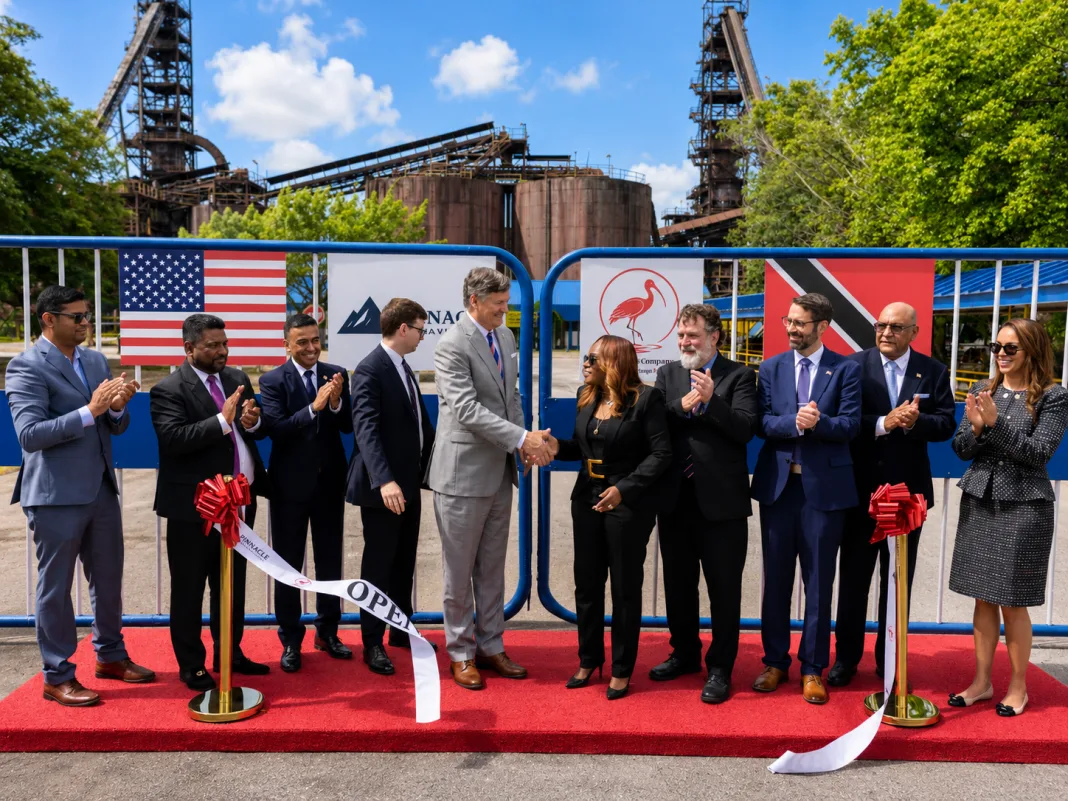
Ibis Steel Company of Trinidad and Tobago has formally begun the refurbishment of the former ArcelorMittal facility at Point Lisas, marking what company and government officials hope will become one of the most significant industrial restarts in Trinidad and Tobago in years.
The local company is backed by United States parent company Pinnacle Steel and Vanadium Corporation, whose plans extend well beyond simply restarting conventional steel production.
Pinnacle CEO Edwin Bennett announced an initial planned investment of US$250 million to refurbish and restart the facility, with approximately 350 jobs expected during the restart phase and around 500 full-time positions once production begins.
The company is targeting first production by the end of 2027.
Bennett also outlined a longer-term expansion involving an additional US$500 million in investment, which could eventually double permanent employment to approximately 1,000 workers.
That would take Pinnacle’s proposed investment in the Point Lisas operation to approximately US$750 million.
But perhaps the most significant element of the project is what the company intends to produce alongside steel: vanadium.
TRINIDAD COULD ENTER CRITICAL MINERALS MARKET
Vanadium is a strategic metal used in several advanced industrial applications, including strengthening steel, aerospace manufacturing and battery technology.
According to Bennett, Pinnacle’s vision is for the Trinidad and Tobago operation to eventually produce the equivalent of approximately 50 per cent of total United States vanadium consumption.
He said that amount would be roughly equivalent to 100 per cent of the quantity of vanadium currently imported by the United States.
Bennett told those gathered at Point Lisas that China and Russia account for more than 80 per cent of global vanadium production.
That concentration has made alternative sources increasingly important as the United States and other Western economies attempt to secure critical-mineral supply chains outside of China and Russia.
Pinnacle believes Trinidad and Tobago could become part of that new supply network.
“Our vision is to produce the equivalent of 50% of American consumption of vanadium,” Bennett said.
He described the Point Lisas operation as a potential critical asset in the development of Western mineral supply chains.
If those ambitions are realised, the project would represent more than the revival of a steel plant.
It could place Trinidad and Tobago within a strategically important supply chain serving industries ranging from steel and energy storage to aerospace and advanced manufacturing.
A PLANT IDLE FOR A DECADE
The Point Lisas facility has been largely dormant since ArcelorMittal closed its Trinidad operations in March 2016.
The closure displaced 644 workers and delivered a major blow to communities that had depended on the country’s steel industry.
Bennett acknowledged the significance of bringing the facility back after approximately ten years of inactivity.
He said many people had discussed restarting the plant over the years, but Pinnacle was now moving into the refurbishment stage with the intention of not merely restoring what previously existed, but creating a more advanced operation.
The company’s ambition, he said, is to develop one of the world’s most technologically advanced, low-cost and environmentally responsible steel mills.
The new local operating company has been branded Ibis Steel Company of Trinidad and Tobago, drawing its identity from the scarlet ibis, one of the country’s best-known national symbols.
JEARLEAN JOHN: LOCALS MUST BENEFIT
Minister of Works and Infrastructure Jearlean John used the occasion to place the project within a much broader story of industrial decline and renewal in central Trinidad.
John recalled the shutdown of Caroni (1975) Limited in 2003 and the closure of the steel facility 13 years later in 2016.
She said the two closures devastated thousands of workers and families along the country’s central industrial corridor.
Now, she said, Trinidad and Tobago has an opportunity to create a new industrial economy on the same ground.
John stressed that the existing Point Lisas infrastructure provides the project with an important advantage.
Rather than starting entirely from scratch, major industrial infrastructure already exists at the site, while many Trinidad and Tobago nationals still possess the skills and institutional knowledge required to operate heavy industrial facilities.
For John, however, foreign investment alone will not be enough.
She argued that Trinidad and Tobago must ensure local workers are trained for the industries being attracted to the country.
Among the occupations she identified were millwright technicians, electricians, riggers, welders, crane operators, laboratory and quality-control personnel, safety officers and logistics and port workers.
John called for a structured training pipeline involving internationally recognised qualifications, practical training on equipment used by industry and paid internships incorporated into arrangements with operators.
Her position was clear: development cannot simply mean providing a location for a foreign company to operate while the economic benefits bypass Trinidad and Tobago workers.
LANDAU: ‘LAZARUS ARISING FROM THE DEAD’
The significance Washington is attaching to the project was underscored by the presence of United States Deputy Secretary of State Christopher Landau, one of the most senior officials in the U.S. State Department.
Landau delivered the feature address at Point Lisas and described the ceremony as one of the most emotional he had attended since assuming his role.
Looking at the dormant industrial infrastructure surrounding him, Landau compared the plant’s planned revival to “Lazarus arising from the dead.”
He drew parallels between Trinidad and Tobago’s loss of steel manufacturing and the industrial decline experienced in parts of the United States.
Landau argued that over several decades the United States allowed important mining, processing and manufacturing capabilities to move overseas, creating dependencies on foreign countries for materials now regarded as strategically important.
That, he said, is why the Point Lisas project matters to Washington.
“When we’re talking about the strategic imperative of ensuring our critical mineral supply chain, this is exactly what we’re talking about,” Landau said.
For the United States, the project offers the prospect of another source of strategically important material.
For Trinidad and Tobago, it offers investment, jobs and the possibility of moving further into higher-value industrial production.
Landau described that alignment as a genuine “win-win” opportunity.
US OFFICIAL PRAISES PERSAD-BISSESSAR
Landau also used his address to deliver a strong endorsement of the developing relationship between Washington and the Government of Prime Minister Kamla Persad-Bissessar.
He described Persad-Bissessar as an “incredible partner” and said he believed her administration was opening the door to a new vision for relations between the United States and the Caribbean.
Landau said his presence in Trinidad and Tobago was intended as a demonstration of recognition, respect and appreciation for that partnership.
He also acknowledged the role played by the United States Embassy in facilitating dialogue between Pinnacle and the Government of Trinidad and Tobago.
At the same time, he stressed that the investment itself is being driven by private enterprise, describing the relationship as one involving the Trinidad and Tobago Government, the United States Government and the American private sector.
FROM STEEL TO A STRATEGIC SUPPLY CHAIN
The proposed transformation of Point Lisas is significant because the facility is not being presented simply as a return to the steel industry of the past.
The vision outlined at the ceremony combines steel production, metal recycling and strategic-mineral development, with vanadium at the centre of Pinnacle’s international ambitions.
That potentially gives Trinidad and Tobago a different role in its economic relationship with the United States.
Rather than participating only as a destination for American investment, the country could become a supplier of material considered important to American industry.
John highlighted that distinction during her address, asking the audience to consider the significance of a nation of approximately 1.4 million people potentially becoming a material part of the supply chain of the world’s largest economy.
“Not as a supplicant, but as a supplier,” she said.
THE REAL TEST COMES NEXT
Despite the optimism surrounding the gate-opening ceremony, the scale of the undertaking remains substantial.
The facility has been idle for approximately a decade and must undergo an extensive refurbishment and recommissioning programme before production can resume.
Pinnacle’s first major benchmark is now clear: first production by the end of 2027.
If the company delivers on its initial plans, approximately US$250 million would be invested and around 500 permanent jobs created once production begins.
If the subsequent US$500 million expansion also materialises, the total proposed investment would rise to approximately US$750 million and permanent employment could reach around 1,000.
And if the vanadium production targets are achieved, the implications could extend well beyond Point Lisas.
A facility remembered for one of the country’s most painful industrial closures could become part of an international effort to diversify critical-mineral supply chains away from China and Russia.
For Trinidad and Tobago, that would represent something more consequential than reopening an old steel mill.
It would mean using existing industrial infrastructure, a skilled workforce and the country’s strategic relationship with the United States to compete in a new generation of global manufacturing and critical-mineral industries.
After ten years of silence, the gates at Point Lisas have opened again.
The next milestone will be seeing the furnaces return to production.