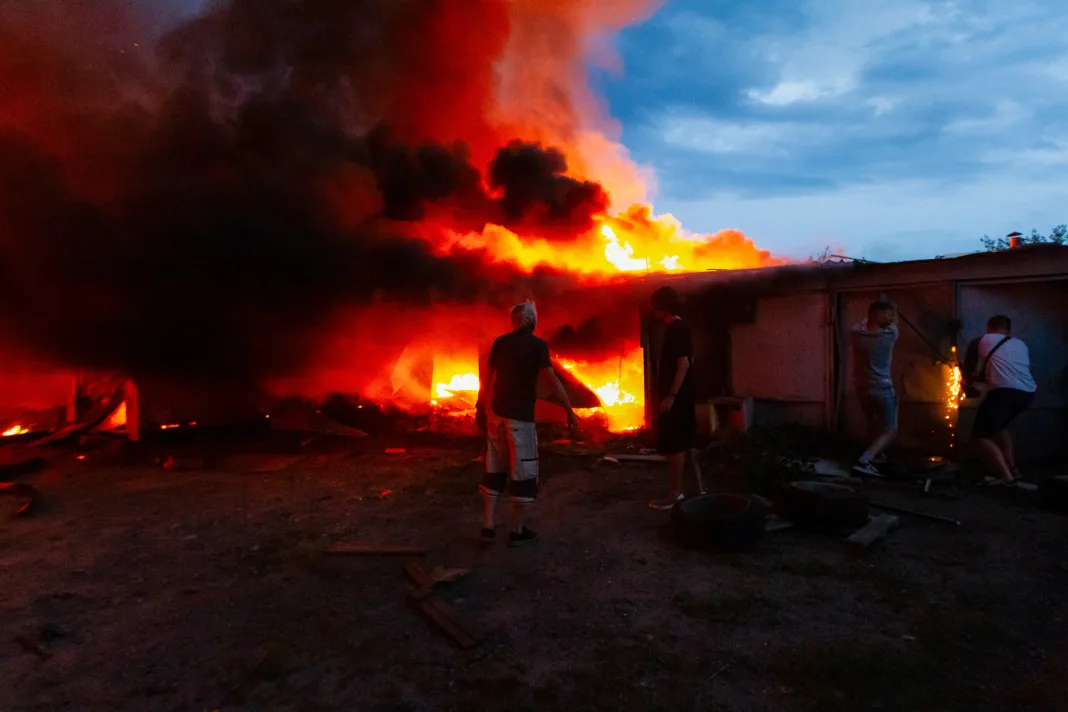
Men stand beside garages engulfed in flames following a massive combined Russian attack, Kyiv, Ukraine, on July 6, 2026. Russian forces launched a large-scale attack on the capital using ballistic and cruise missiles as well as attack drones, causing destruction to apartment buildings and civilian infrastructure across several districts of the city. The Podilskyi district suffered the most severe damage. At least 11 people were killed and 46 others were injured (Photo by Kyrylo Chubotin/Ukrinform/ABACAPRESS.COM
The key points are temporarily unavailable. You can still read the full Story below.
Main Points
Ukrainian forces reportedly carried out a large‑scale drone operation against several targets in the Moscow, Rostov and Vladimir regions during the night of Thursday to Friday, according to The Kyiv Independent. The outlet stated that it could not independently verify the specific targets or the extent of the damage. ExileNova+ and SuperNova+ monitoring channels reported that a Yandex data‑center in the Vladimir region—located roughly 500 km from the Ukrainian border—was struck during the operation. Video footage taken by local residents shows strong explosions and anti‑aircraft systems in action near residential buildings. Yandex announced on 11 October that the facility had been completely shut down following the attack. This incident marked the third consecutive day of strikes on Yandex data centers in Russia, after confirmed attacks in the Reazan and Kaluga regions on 8 and 9 October. The series of attacks follows Ukrainian President Volodymyr Zelensky’s statement that Ukraine would respond in kind to Russian assaults on its internet infrastructure. Earlier that night, Ukrainian drones forced the closure of airspace over several Moscow airports. The opposition Russian news channel Astra reported that departures and arrivals at Vnukovo, Domodedovo, Zhukovsky and Sheremetyevo airports were cancelled. Moscow mayor Sergei Sobyanin said that more than 59 Ukrainian drones were destroyed by the city’s anti‑aircraft systems. The airspace closure is described by some as a partial fulfillment of Zelensky’s September threat that Russia’s airspace would become “de facto closed.” Zelensky added that “there will simply be drones in Russian skies at a scale that must be taken into account.” It remains unclear which specific targets in the Moscow area were hit. Witness footage shows flames lighting the night sky, accompanied by drone noise and powerful explosions. On 9 October, several Moscow airports temporarily suspended flights after alleged Ukrainian drones and balloons entered the surrounding airspace. Approximately 950 km southeast of Moscow, Ukrainian drones attacked targets in the Rostov region. Governor Yuri Sliusar reported that production and storage facilities were damaged and that a fire broke out in the city of Aksai. He also noted that the Certkovsky district and the town of Bataisk were among the areas affected. Article source: Mediafax | Image credit: Mediafax
Ukrainian forces reportedly carried out a large‑scale drone operation against several targets in the Moscow, Rostov and Vladimir regions during the night of Thursday to Friday, according to The Kyiv Independent. The outlet stated that it could not independently verify the specific targets or the extent of the damage. ExileNova+ and SuperNova+ monitoring channels reported that a Yandex data‑center in the Vladimir region—located roughly 500 km from the Ukrainian border—was struck during the operation. Video footage taken by local residents shows strong explosions and anti‑aircraft systems in action near residential buildings. Yandex announced on 11 October that the facility had been completely shut down following the attack. This incident marked the third consecutive day of strikes on Yandex data centers in Russia, after confirmed attacks in the Reazan and Kaluga regions on 8 and 9 October. The series of attacks follows Ukrainian President Volodymyr Zelensky’s statement that Ukraine would respond in kind to Russian assaults on its internet infrastructure. Earlier that night, Ukrainian drones forced the closure of airspace over several Moscow airports. The opposition Russian news channel Astra reported that departures and arrivals at Vnukovo, Domodedovo, Zhukovsky and Sheremetyevo airports were cancelled. Moscow mayor Sergei Sobyanin said that more than 59 Ukrainian drones were destroyed by the city’s anti‑aircraft systems. The airspace closure is described by some as a partial fulfillment of Zelensky’s September threat that Russia’s airspace would become “de facto closed.” Zelensky added that “there will simply be drones in Russian skies at a scale that must be taken into account.” It remains unclear which specific targets in the Moscow area were hit. Witness footage shows flames lighting the night sky, accompanied by drone noise and powerful explosions. On 9 October, several Moscow airports temporarily suspended flights after alleged Ukrainian drones and balloons entered the surrounding airspace. Approximately 950 km southeast of Moscow, Ukrainian drones attacked targets in the Rostov region. Governor Yuri Sliusar reported that production and storage facilities were damaged and that a fire broke out in the city of Aksai. He also noted that the Certkovsky district and the town of Bataisk were among the areas affected.
News Desk is the editorial publishing account for Tringlobe Media News, covering breaking news, public affairs, entertainment, community developments and regional stories across Trinidad and Tobago, the Caribbean and internationally.