The key points are temporarily unavailable. You can still read the full Story below.
Main Points
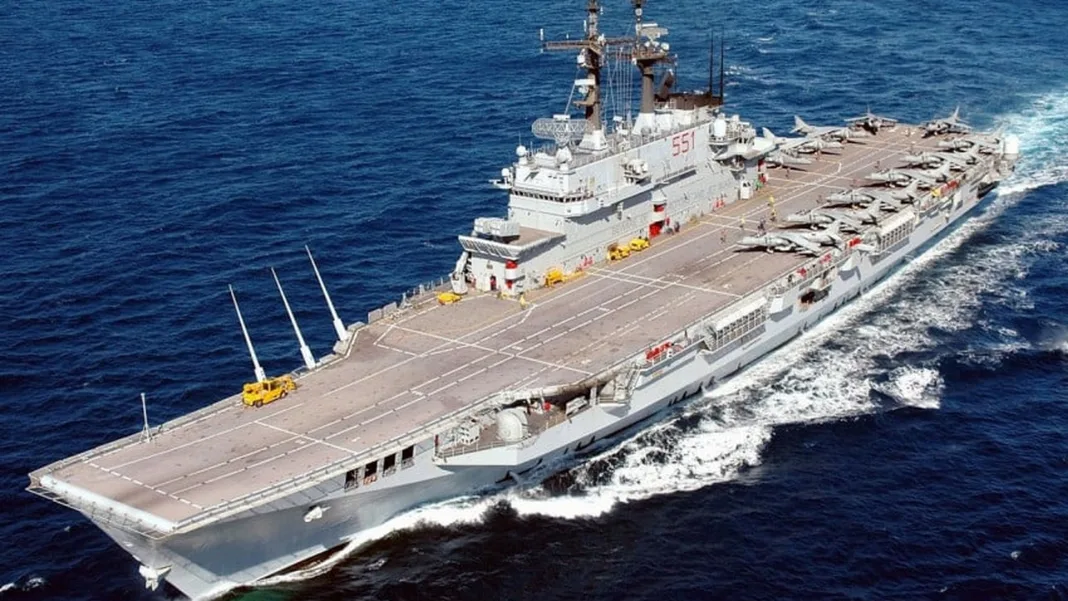
The Italian light aircraft carrier Giuseppe Garibaldi (C551) has become a subject of discussion following reports regarding a potential transfer plan to Indonesia. While significantly smaller than the supercarriers operated by the United States, such as the Nimitz or Gerald R. Ford classes, the vessel has served as a key component of the Italian Navy for several decades.
Constructed at the Monfalcone shipyard in Italy, the Giuseppe Garibaldi had its keel laid on March 26, 1981. It was launched on June 4, 1983, and officially entered service with the Italian Navy, or Marina Militare, on September 30, 1985.
According to official data from the Marina Militare, the vessel measures 180.2 meters in length, with a waterline width of 23.4 meters and a flight deck width of approximately 30.4 meters. Its draft is 6.7 meters. The ship has a full-load displacement of approximately 13,850 tons, which increased to roughly 14,150 tons following modernization efforts.
The ship is powered by a Combined Gas and Gas (COGAG) system, utilizing four Fiat/General Electric LM2500 gas turbines. This system generates approximately 60.4 megawatts, or over 80,000 horsepower, distributed through two shafts. The vessel is capable of reaching a maximum speed of 30 knots, or approximately 56 kilometers per hour, with a cruising range of 7,000 nautical miles at a speed of 20 knots.
Designed as a light aircraft carrier, the Giuseppe Garibaldi is equipped to operate Short Take-Off and Vertical Landing (STOVL) aircraft and various helicopters. Depending on the mission configuration, the ship can carry between 18 and 20 aircraft. Compatible aircraft include the AV-8B Plus Harrier II, as well as EH101, SH90A, and AB212 helicopters. The flight deck measures approximately 173.8 meters in length.
Beyond its aviation capabilities, the vessel is designed to perform command functions and carries defensive armament. The use of STOVL aircraft allows the ship to operate combat aircraft without the need for the catapult systems found on larger aircraft carriers.
Article and image source: international.sindonews.com