The key points are temporarily unavailable. You can still read the full Story below.
Main Points
Campbell's General Theory of Quantum Gravity Takes Aim at Einstein's General Relativity, Drawing on Observable Scientific Data Mathematician and theoretical physics researcher Ramone J. Campbell is advancing a proposed General Theory of Quantum Gravity that seeks to challenge conventional explanations of gravity established by Albert Einstein more than a century ago. Campbell's research explores whether gravity can be understood through fundamental particle interactions, motion and physical mechanisms rather than relying exclusively on Einstein's description of gravity as the curvature of spacetime. The proposed framework draws attention to two major scientific observations: the ability of certain subatomic particles to travel through solid matter and the detection of gravitational waves moving across the universe. While these phenomena have been experimentally established, their relationship to Campbell's proposed theory remains a subject for mathematical investigation and independent scientific testing. Taking Aim at Einstein's General Relativity Einstein's General Theory of Relativity, introduced in 1915, fundamentally changed humanity's understanding of gravity. Rather than describing gravity simply as a force attracting objects, Einstein demonstrated mathematically how matter and energy influence the curvature of spacetime, affecting the movement of planets, stars and other objects. His theory has successfully explained numerous astronomical observations, including the bending of light around massive objects, gravitational time dilation and the existence of gravitational waves. However, one of the greatest challenges in modern physics remains reconciling General Relativity with quantum mechanics, the branch of physics that explains the behaviour of matter and energy at extremely small scales. Campbell's General Theory of Quantum Gravity seeks to contribute to this unresolved scientific challenge by investigating whether gravitational phenomena can be explained through an underlying particle-based mechanism. His approach considers the possibility that hypothetical gravitational particles, known as gravitons, may play a fundamental role in producing gravitational effects. Scientific Evidence: Particles Passing Through Solid Matter One of the observations highlighted in Campbell's research involves the remarkable ability of certain subatomic particles to pass through enormous quantities of solid matter. Neutrinos, for example, are elementary particles with extremely small masses and no electric charge. Because they interact very weakly with ordinary matter, neutrinos can travel through substantial quantities of rock and other materials without being absorbed or scattered. A major demonstration of this phenomenon occurred through the CERN Neutrinos to Gran Sasso project in Europe. Between 2006 and 2012, neutrinos generated at CERN travelled approximately 732 kilometres through the Earth's crust to the Gran Sasso National Laboratory in Italy. The experiment demonstrated how particles can travel through solid matter despite the presence of enormous numbers of atoms along their paths. Campbell considers such observations relevant to investigating the relationship between fundamental particles, matter and gravitational interactions. Within his proposed framework, he explores the possibility that gravitational particles and their associated interactions could operate throughout physical matter. However, neutrinos are experimentally established particles, while gravitons remain hypothetical. The ability of neutrinos to penetrate matter does not establish that gravitons behave in the same way. Gravitational Waves: Another Major Scientific Discovery A second important observation discussed in Campbell's work is the detection of gravitational waves. On September 14, 2015, scientists at the Laser Interferometer Gravitational-Wave Observatory, known as LIGO, detected gravitational waves produced by the merger of two black holes approximately 1.3 billion light-years from Earth. The discovery was publicly announced on February 11, 2016. Gravitational waves are disturbances in spacetime that travel outward from powerful cosmic events, including collisions involving black holes and neutron stars. Their detection represented one of the most significant achievements in modern astrophysics and confirmed a major prediction made by Einstein approximately a century earlier. Campbell's General Theory of Quantum Gravity also addresses the generation and propagation of gravitational waves. According to the description of his proposed framework, Campbell investigates whether interactions involving gravitons and rotating or moving bodies could provide a deeper physical explanation for gravitational-wave generation. His approach explores the possibility that gravitational effects emerge from interactions involving fundamental particles rather than being described solely through the geometry of spacetime. Although gravitational waves have been experimentally detected, those observations currently support Einstein's General Relativity and do not independently verify Campbell's proposed explanation. Could Gravity Be Explained Through Fundamental Particles? At the centre of Campbell's research is the question of whether gravity has an underlying quantum mechanism. Modern physics already describes several fundamental interactions through quantum fields and their associated particles. For example, electromagnetic interactions are described through quantum electrodynamics, in which photons play an important role. The graviton, meanwhile, is a hypothetical particle associated with attempts to describe gravity quantum mechanically. Campbell's proposed framework investigates whether gravitational phenomena can be understood through the behaviour and interactions of such particles. His research considers how moving and rotating bodies might interact with a surrounding gravitational particle framework, potentially producing effects associated with gravitational attraction and wave propagation. He also explores relationships involving matter, motion, space and time through a broader mathematical approach described as a motional-spacetime framework. These ideas seek to address fundamental questions about the nature of gravity and whether an alternative mathematical description could provide additional insight into the physical universe. Does Observable Scientific Data Verify Campbell's Theory? The distinction between established scientific observations and verification of a particular theory is essential. The CERN neutrino experiments demonstrate that neutrinos can travel through large quantities of solid matter. Similarly, LIGO's observations demonstrate that gravitational waves exist and can be measured using highly sensitive instruments. Both discoveries provide valuable scientific information that researchers can use when developing and testing theories. However, demonstrating that a phenomenon exists is not the same as proving that a particular proposed theory correctly explains it. For Campbell's General Theory of Quantum Gravity to achieve independent scientific verification, its mathematical predictions would need to be tested against experimental observations. Those predictions would also need to demonstrate measurable results that distinguish the proposed framework from established gravitational theories. Potential investigations could include gravitational-wave propagation, particle interactions, gravitational effects involving rotating bodies and other measurable phenomena associated with quantum gravity. The research material provided to TG News does not establish that Campbell's theory has undergone independent experimental verification or that its predictions have been confirmed through peer-reviewed experimental studies. The Search for a Unified Understanding of the Universe Despite more than a century of scientific progress, researchers continue to investigate how gravity operates at the quantum level. General Relativity remains highly successful in explaining gravitational phenomena on large scales, while quantum mechanics provides an exceptionally accurate description of matter and interactions at microscopic scales. Developing a complete framework that reconciles these two descriptions remains one of the most important unresolved challenges in theoretical physics. Campbell's General Theory of Quantum Gravity represents his proposed contribution to that search. By examining established observations involving subatomic particles and gravitational waves, he seeks to investigate whether a deeper mathematical explanation can connect gravity, matter, motion and quantum interactions. The potential scientific significance of his work will ultimately depend on whether the framework can produce mathematically consistent, testable predictions that withstand independent scientific scrutiny. For Campbell, the objective is to investigate whether the physical mechanisms governing gravity extend beyond the explanations currently established by conventional theories. While his proposed framework challenges aspects of the traditional understanding of gravity, Einstein's General Relativity remains strongly supported by experimental evidence. Campbell's research therefore represents an alternative theoretical proposal awaiting the independent testing necessary to determine whether it can contribute new, scientifically supported insights into the fundamental nature of the universe.
Campbell's General Theory of Quantum Gravity Takes Aim at Einstein's General Relativity, Drawing on Observable Scientific Data
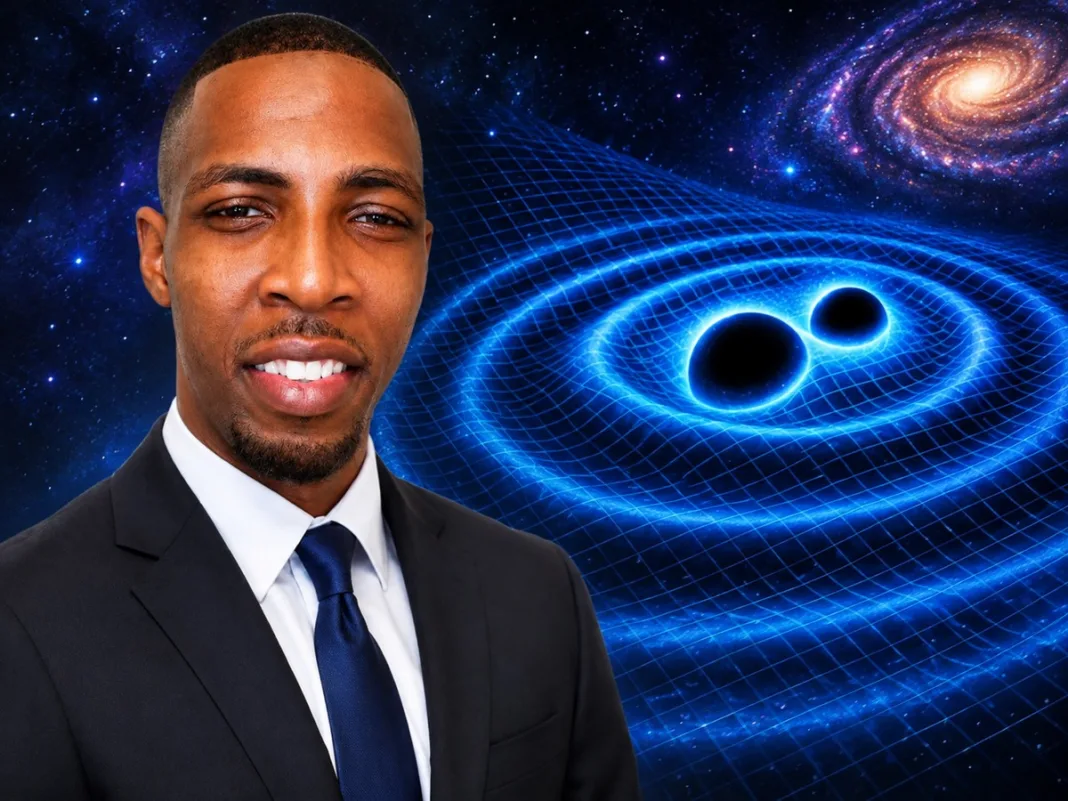
Mathematician and theoretical physics researcher Ramone J. Campbell is advancing a proposed General Theory of Quantum Gravity that seeks to challenge conventional explanations of gravity established by Albert Einstein more than a century ago.
Campbell's research explores whether gravity can be understood through fundamental particle interactions, motion and physical mechanisms rather than relying exclusively on Einstein's description of gravity as the curvature of spacetime.
The proposed framework draws attention to two major scientific observations: the ability of certain subatomic particles to travel through solid matter and the detection of gravitational waves moving across the universe.
While these phenomena have been experimentally established, their relationship to Campbell's proposed theory remains a subject for mathematical investigation and independent scientific testing.
Taking Aim at Einstein's General Relativity
Einstein's General Theory of Relativity, introduced in 1915, fundamentally changed humanity's understanding of gravity.
Rather than describing gravity simply as a force attracting objects, Einstein demonstrated mathematically how matter and energy influence the curvature of spacetime, affecting the movement of planets, stars and other objects.
His theory has successfully explained numerous astronomical observations, including the bending of light around massive objects, gravitational time dilation and the existence of gravitational waves.
However, one of the greatest challenges in modern physics remains reconciling General Relativity with quantum mechanics, the branch of physics that explains the behaviour of matter and energy at extremely small scales.
Campbell's General Theory of Quantum Gravity seeks to contribute to this unresolved scientific challenge by investigating whether gravitational phenomena can be explained through an underlying particle-based mechanism.
His approach considers the possibility that hypothetical gravitational particles, known as gravitons, may play a fundamental role in producing gravitational effects.
Scientific Evidence: Particles Passing Through Solid Matter
One of the observations highlighted in Campbell's research involves the remarkable ability of certain subatomic particles to pass through enormous quantities of solid matter.
Neutrinos, for example, are elementary particles with extremely small masses and no electric charge.
Because they interact very weakly with ordinary matter, neutrinos can travel through substantial quantities of rock and other materials without being absorbed or scattered.
A major demonstration of this phenomenon occurred through the CERN Neutrinos to Gran Sasso project in Europe.
Between 2006 and 2012, neutrinos generated at CERN travelled approximately 732 kilometres through the Earth's crust to the Gran Sasso National Laboratory in Italy.
The experiment demonstrated how particles can travel through solid matter despite the presence of enormous numbers of atoms along their paths.
Campbell considers such observations relevant to investigating the relationship between fundamental particles, matter and gravitational interactions.
Within his proposed framework, he explores the possibility that gravitational particles and their associated interactions could operate throughout physical matter.
However, neutrinos are experimentally established particles, while gravitons remain hypothetical. The ability of neutrinos to penetrate matter does not establish that gravitons behave in the same way.
Gravitational Waves: Another Major Scientific Discovery
A second important observation discussed in Campbell's work is the detection of gravitational waves.
On September 14, 2015, scientists at the Laser Interferometer Gravitational-Wave Observatory, known as LIGO, detected gravitational waves produced by the merger of two black holes approximately 1.3 billion light-years from Earth.
The discovery was publicly announced on February 11, 2016.
Gravitational waves are disturbances in spacetime that travel outward from powerful cosmic events, including collisions involving black holes and neutron stars.
Their detection represented one of the most significant achievements in modern astrophysics and confirmed a major prediction made by Einstein approximately a century earlier.
Campbell's General Theory of Quantum Gravity also addresses the generation and propagation of gravitational waves.
According to the description of his proposed framework, Campbell investigates whether interactions involving gravitons and rotating or moving bodies could provide a deeper physical explanation for gravitational-wave generation.
His approach explores the possibility that gravitational effects emerge from interactions involving fundamental particles rather than being described solely through the geometry of spacetime.
Although gravitational waves have been experimentally detected, those observations currently support Einstein's General Relativity and do not independently verify Campbell's proposed explanation.
Could Gravity Be Explained Through Fundamental Particles?
At the centre of Campbell's research is the question of whether gravity has an underlying quantum mechanism.
Modern physics already describes several fundamental interactions through quantum fields and their associated particles.
For example, electromagnetic interactions are described through quantum electrodynamics, in which photons play an important role.
The graviton, meanwhile, is a hypothetical particle associated with attempts to describe gravity quantum mechanically.
Campbell's proposed framework investigates whether gravitational phenomena can be understood through the behaviour and interactions of such particles.
His research considers how moving and rotating bodies might interact with a surrounding gravitational particle framework, potentially producing effects associated with gravitational attraction and wave propagation.
He also explores relationships involving matter, motion, space and time through a broader mathematical approach described as a motional-spacetime framework.
These ideas seek to address fundamental questions about the nature of gravity and whether an alternative mathematical description could provide additional insight into the physical universe.
Does Observable Scientific Data Verify Campbell's Theory?
The distinction between established scientific observations and verification of a particular theory is essential.
The CERN neutrino experiments demonstrate that neutrinos can travel through large quantities of solid matter.
Similarly, LIGO's observations demonstrate that gravitational waves exist and can be measured using highly sensitive instruments.
Both discoveries provide valuable scientific information that researchers can use when developing and testing theories.
However, demonstrating that a phenomenon exists is not the same as proving that a particular proposed theory correctly explains it.
For Campbell's General Theory of Quantum Gravity to achieve independent scientific verification, its mathematical predictions would need to be tested against experimental observations.
Those predictions would also need to demonstrate measurable results that distinguish the proposed framework from established gravitational theories.
Potential investigations could include gravitational-wave propagation, particle interactions, gravitational effects involving rotating bodies and other measurable phenomena associated with quantum gravity.
The research material provided to TG News does not establish that Campbell's theory has undergone independent experimental verification or that its predictions have been confirmed through peer-reviewed experimental studies.
The Search for a Unified Understanding of the Universe
Despite more than a century of scientific progress, researchers continue to investigate how gravity operates at the quantum level.
General Relativity remains highly successful in explaining gravitational phenomena on large scales, while quantum mechanics provides an exceptionally accurate description of matter and interactions at microscopic scales.
Developing a complete framework that reconciles these two descriptions remains one of the most important unresolved challenges in theoretical physics.
Campbell's General Theory of Quantum Gravity represents his proposed contribution to that search.
By examining established observations involving subatomic particles and gravitational waves, he seeks to investigate whether a deeper mathematical explanation can connect gravity, matter, motion and quantum interactions.
The potential scientific significance of his work will ultimately depend on whether the framework can produce mathematically consistent, testable predictions that withstand independent scientific scrutiny.
For Campbell, the objective is to investigate whether the physical mechanisms governing gravity extend beyond the explanations currently established by conventional theories.
While his proposed framework challenges aspects of the traditional understanding of gravity, Einstein's General Relativity remains strongly supported by experimental evidence.
Campbell's research therefore represents an alternative theoretical proposal awaiting the independent testing necessary to determine whether it can contribute new, scientifically supported insights into the fundamental nature of the universe.
News Desk is the editorial publishing account for Tringlobe Media News, covering breaking news, public affairs, entertainment, community developments and regional stories across Trinidad and Tobago, the Caribbean and internationally.