The key points are temporarily unavailable. You can still read the full Story below.
Main Points
Opposition parliamentarians and legal experts have raised a series of concerns over the Special Operations Bill, 2026, warning that the legislation could have significant implications for constitutional rights, policing and communities across Trinidad and Tobago.
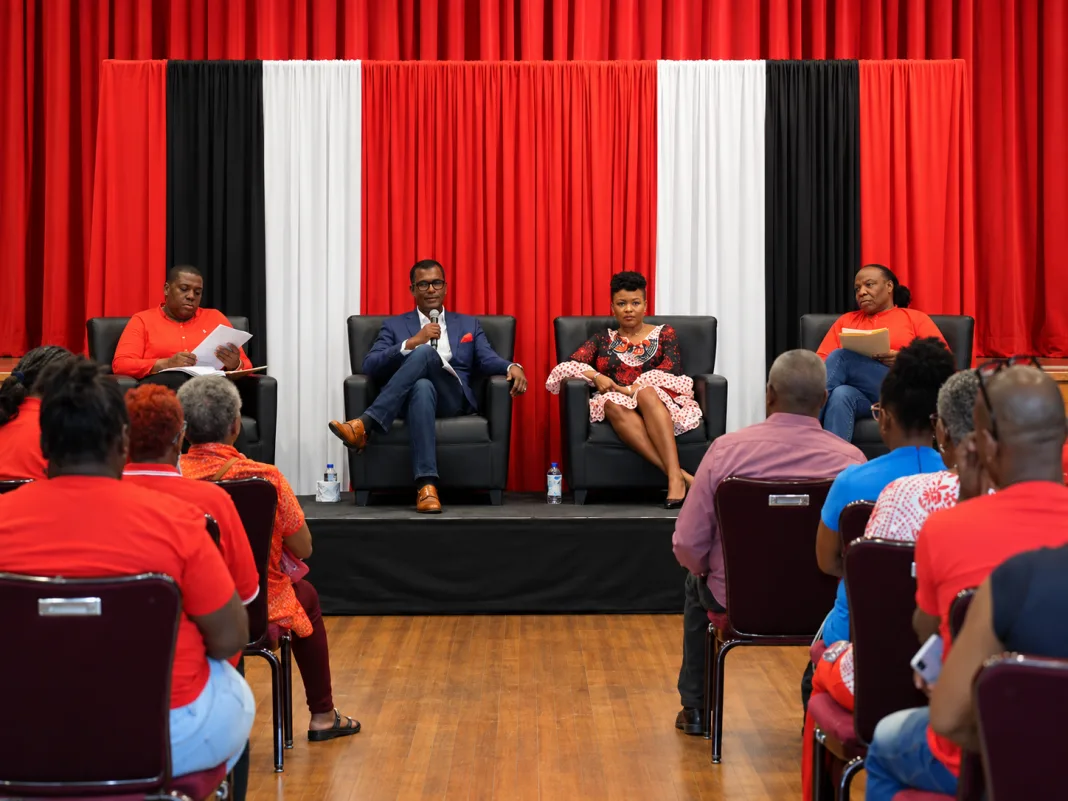
The concerns were raised during a PNM Town Hall Meeting at the Murchison Brown Auditorium at City Hall in Port of Spain, where Laventille West MP Kareem Marcelle, Senior Counsel Larry Lalla, St Ann’s East MP Dr Nyan Gadsby-Dolly and Port of Spain South MP Keith Scotland, SC, addressed members of the public.
Marcelle accused the Government of attempting to bypass constitutional safeguards by introducing legislation capable of restricting citizens’ rights without seeking a three-fifths parliamentary majority.
He argued that rights protected under Sections 4 and 5 of the Constitution, including freedom of movement, enjoyment of property and protections surrounding arrest and detention, could be affected by the proposed legislation.
Marcelle compared the Special Operations Bill with the earlier Zones of Special Operations legislation, which required a special majority and failed to secure sufficient support in the Senate.
He accused the Government of returning with legislation containing similar security measures but structured to be passed by a simple majority.
Marcelle described the bill as unconstitutional and urged citizens to remain vigilant. His position represents the Opposition MP’s interpretation of the legislation, and there has been no court ruling declaring the Special Operations Bill unconstitutional.
Senior Counsel Larry Lalla focused on the legal reasoning behind the use of a simple majority.
Lalla said the Government appears to be relying on principles established through Privy Council rulings which allow legislation affecting certain constitutional rights to survive where the interference pursues a legitimate objective, is rationally connected to that objective and goes no further than reasonably necessary.
He acknowledged that improving public safety is a legitimate objective and said measures such as closed areas, cordons and curfews could be rationally connected to fighting serious crime.
Lalla’s concern was whether some of the powers contained in the bill could be considered more intrusive than necessary.
He pointed to provisions allowing areas to be declared closed based on factors including escalating violent crime, illegal firearms and gang intimidation.
Lalla argued that terms such as “escalating rates of violent crime” and the “prevalence” of illegal firearms are too broad and could give excessive discretion to those responsible for deciding which communities are subjected to special operations.
He said he believed those provisions could become the subject of a constitutional challenge.
Lalla also questioned provisions surrounding the appointment of Heads of Special Operations and the level of involvement given to the Prime Minister.
He argued that the Police Service must remain insulated from political influence and raised concerns about circumstances in which the Prime Minister could object to an officer selected to lead special operations.
He also questioned reporting provisions requiring information about special operations to be submitted to the Prime Minister and relevant ministers.
Lalla argued that political office holders should not be given excessive influence over operational policing matters.
Dr Nyan Gadsby-Dolly focused on what she described as the absence of a strong social intervention component in the legislation.
She contrasted the Special Operations Bill with the previous ZOSO proposal, which included provisions aimed at social transformation in affected communities.
Gadsby-Dolly argued that crime cannot be addressed through enforcement alone and said Government policy must also address the social conditions that can contribute to young people becoming involved in criminal activity.
She also raised concerns about school social workers and guidance counsellors whose contracts, she said, had not been renewed, arguing that those professionals form an important part of the safety net for vulnerable children.
Gadsby-Dolly questioned what she described as an increasing emphasis on policing while preventative social interventions were being reduced.
Port of Spain South MP Keith Scotland, SC, meanwhile, focused on how the legislation could affect residents of communities declared closed areas.
Scotland highlighted provisions allowing barriers and roadblocks to be established and restricting entry into or departure from closed areas.
Under the proposed legislation, people entering or leaving designated closed areas could be required to obtain permits, subject to exemptions.
Those permits may specify the times during which a person can enter or leave and impose conditions governing their movement.
Scotland warned residents to pay close attention to those provisions, arguing that they could have a direct impact on people going to work, returning home or travelling through affected communities.
He also highlighted provisions allowing cordons to be established within closed areas and curfews requiring people to remain inside their premises during specified hours.
Scotland further raised concerns about powers allowing police officers conducting special operations to search a person, place or vehicle without a warrant where there is reasonable suspicion that an offence is being committed, has been committed or is about to be committed.
He also highlighted penalties for breaches of certain restrictions, which can include fines and imprisonment upon conviction.
Another concern raised by Scotland involved body-worn cameras.
He noted that the legislation provides for officers conducting special operations to use body cameras as far as possible and subject to the availability of resources.
Scotland argued that the wording does not amount to an absolute guarantee that every special operation will be recorded.
The Government has maintained that the Special Operations Bill is intended to strengthen the State’s ability to combat serious criminal activity.
The legislation provides for policing districts, special operations involving police officers with or without Defence Force assistance, human rights and use-of-force training, operational reporting and protocols governing cooperation between the Police Service and Defence Force.
The bill was passed in the House of Representatives and received its first reading in the Senate on September 22.
The PNM panel maintained that while stronger action against serious crime is necessary, the powers being granted under the legislation must also be scrutinised for their potential impact on constitutional rights, police independence and communities subjected to special operations.
The transcript records the arguments made by Marcelle, Lalla, Gadsby-Dolly and Scotland at the town hall. Parliament’s official record confirms the bill’s purpose, its House passage and its first Senate reading on September 22, 2026.