The key points are temporarily unavailable. You can still read the full Story below.
Main Points
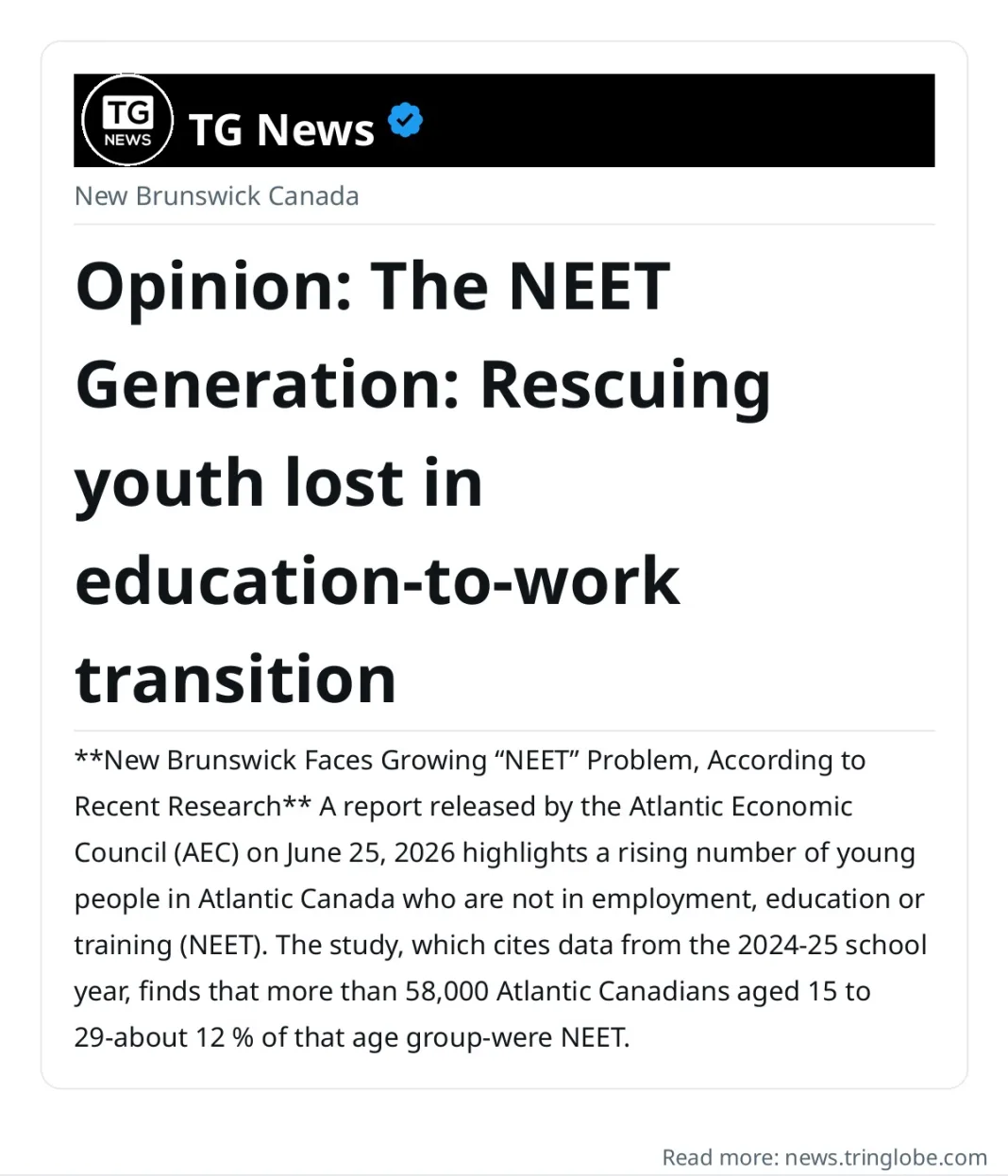
**New Brunswick Faces Growing “NEET” Problem, According to Recent Research** A report released by the Atlantic Economic Council (AEC) on June 25, 2026 highlights a rising number of young people in Atlantic Canada who are not in employment, education or training (NEET). The study, which cites data from the 2024‑25 school year, finds that more than 58,000 Atlantic Canadians aged 15 to 29—about 12 % of that age group—were NEET. In New Brunswick alone, the figure is 14 % for youths aged 16 to 25, placing the province behind only Newfoundland and Labrador among Canadian provinces. The AEC report, supported by economists from the University of New Brunswick (UNB), identifies a “leakage” in the education‑to‑employment pipeline. It estimates that the forgone income associated with NEET young adults aged 20 to 29 in Atlantic Canada exceeded $470 million. **Context in the United Kingdom** The United Kingdom has long monitored the NEET phenomenon. A government‑commissioned review led by former New Labour cabinet minister Alan Milburn, released on May 28, 2026, estimates that nearly one million 16‑ to 24‑year‑olds in the UK are NEET—approximately one in eight. The review warns that, without significant intervention, the proportion could rise to one in six within five years. The Guardian has referred to NEET youth in Britain as the “lost generation,” noting that 60 % have never held a job and 84 % express a desire to work or enter training. Many report poor mental health or severe learning challenges. **New Brunswick’s Education‑to‑Employment Pipeline** The AEC report points to several indicators of systemic leakage in New Brunswick: – About 15 % of students fail to complete high school within three years of entering Grade 10, roughly 1,180 students. – PISA results show that 28 % of students lack baseline proficiency in reading, 31 % in mathematics, and 23 % in science. – At the post‑secondary level, approximately 40 % of university undergraduates and 27 % of college students do not complete their programs. While a student who leaves university is not automatically NEET, and low PISA performance does not guarantee labour‑market disengagement, the combination of these statistics suggests persistent leakage at multiple points in the pipeline. **Policy and Business Response** Business leaders in New Brunswick, including heads of the provincial chambers of commerce, have emphasized attracting investment, encouraging immigration, and fostering technological innovation. The AEC report argues that the NEET issue exposes the weakness of treating education, workforce development, mental health, and economic development as separate silos. The province’s upcoming Talent for Growth Summit on September 25, 2026, is expected to bring together business, government, post‑secondary institutions, economic‑development agencies, immigration and settlement organizations, community groups, and young people to address the evidence of the NEET problem. **Academic Research** The UNB Pond Deshpande Centre’s “Skills to Pathways” project is conducting research on the NEET issue. The centre’s findings aim to inform policy decisions and help build bridges across the various sectors involved. **Key Takeaway** The AEC report underscores that the NEET problem is not merely a statistical anomaly but a systemic issue affecting the transition of young people from education to the workforce. Addressing it will require coordinated action across education, employment, health, and economic development sectors. Article and image source: tj.news
**New Brunswick Faces Growing “NEET” Problem, According to Recent Research**
A report released by the Atlantic Economic Council (AEC) on June 25, 2026 highlights a rising number of young people in Atlantic Canada who are not in employment, education or training (NEET). The study, which cites data from the 2024‑25 school year, finds that more than 58,000 Atlantic Canadians aged 15 to 29—about 12 % of that age group—were NEET. In New Brunswick alone, the figure is 14 % for youths aged 16 to 25, placing the province behind only Newfoundland and Labrador among Canadian provinces.
The AEC report, supported by economists from the University of New Brunswick (UNB), identifies a “leakage” in the education‑to‑employment pipeline. It estimates that the forgone income associated with NEET young adults aged 20 to 29 in Atlantic Canada exceeded $470 million.
**Context in the United Kingdom**
The United Kingdom has long monitored the NEET phenomenon. A government‑commissioned review led by former New Labour cabinet minister Alan Milburn, released on May 28, 2026, estimates that nearly one million 16‑ to 24‑year‑olds in the UK are NEET—approximately one in eight. The review warns that, without significant intervention, the proportion could rise to one in six within five years. The Guardian has referred to NEET youth in Britain as the “lost generation,” noting that 60 % have never held a job and 84 % express a desire to work or enter training. Many report poor mental health or severe learning challenges.
The AEC report points to several indicators of systemic leakage in New Brunswick:
– About 15 % of students fail to complete high school within three years of entering Grade 10, roughly 1,180 students.
– PISA results show that 28 % of students lack baseline proficiency in reading, 31 % in mathematics, and 23 % in science.
– At the post‑secondary level, approximately 40 % of university undergraduates and 27 % of college students do not complete their programs.
While a student who leaves university is not automatically NEET, and low PISA performance does not guarantee labour‑market disengagement, the combination of these statistics suggests persistent leakage at multiple points in the pipeline.
**Policy and Business Response**
Business leaders in New Brunswick, including heads of the provincial chambers of commerce, have emphasized attracting investment, encouraging immigration, and fostering technological innovation. The AEC report argues that the NEET issue exposes the weakness of treating education, workforce development, mental health, and economic development as separate silos.
The province’s upcoming Talent for Growth Summit on September 25, 2026, is expected to bring together business, government, post‑secondary institutions, economic‑development agencies, immigration and settlement organizations, community groups, and young people to address the evidence of the NEET problem.
**Academic Research**
The UNB Pond Deshpande Centre’s “Skills to Pathways” project is conducting research on the NEET issue. The centre’s findings aim to inform policy decisions and help build bridges across the various sectors involved.
**Key Takeaway**
The AEC report underscores that the NEET problem is not merely a statistical anomaly but a systemic issue affecting the transition of young people from education to the workforce. Addressing it will require coordinated action across education, employment, health, and economic development sectors.
News Desk is the editorial publishing account for Tringlobe Media News, covering breaking news, public affairs, entertainment, community developments and regional stories across Trinidad and Tobago, the Caribbean and internationally.