The key points are temporarily unavailable. You can still read the full Story below.
Main Points
Roshni Yadav, a Deputy Copy Editor at The Indian Express, writes for the UPSC section. She can be reached at roshni.yadav@indianexpress.com. Oil spill incident in the United Arab Emirates On Saturday, 24 October, authorities in the emirate of Ras Al Khaimah announced that all beaches would be closed until further notice following an offshore oil leak. The incident prompted beach closures in neighbouring Umm Al Quwain and Sharjah. The Ministry of Climate Change and Environment said that all beaches and coastal areas around the city of Umm Al Quwain were temporarily closed until technical teams completed assessments and determined the necessary safety and marine protection measures. UAE officials have not identified the tanker involved or the cause of the spill. Understanding oil spills Oil spills can result from natural disasters, human error, equipment failure, or accidents involving tankers, drilling rigs, pipelines, or refineries. When oil enters water, it spreads rapidly, forming a surface layer that blocks sunlight and disrupts photosynthesis in marine plants and phytoplankton, which are essential for oxygen production. The severity of an oil spill depends on several factors, including the type of oil, the volume released, weather conditions, and proximity to sensitive ecosystems. Consequences can be immediate—such as toxic exposure to marine fauna—and long‑term, affecting marine ecosystems, habitats, and local economies. Oil can coat the feathers of birds, impairing insulation and increasing the risk of hypothermia and drowning. Fish and invertebrates may experience reproductive and growth challenges. Bioaccumulation of toxic substances can threaten higher‑level predators, including humans, and reduce biodiversity. Coastal ecosystems such as mangroves, coral reefs, and marshlands are particularly vulnerable. Oil can suffocate these habitats, killing vital plants and animals, and recovery may take decades, with some species facing extinction. Communities that depend on fishing and tourism often suffer significant economic losses, and cleanup operations can be costly and time‑consuming. Cleanup methods Oil spills are difficult to manage because oil spreads quickly and rough seas or strong currents complicate efforts. Common cleanup techniques include: Skimming – removing oil from the sea surface before it reaches sensitive areas. In‑situ burning – burning concentrated patches of oil. Chemical dispersants – breaking oil into smaller droplets to facilitate microbial degradation. Each method has drawbacks. Chemical dispersants can harm marine life, and manual cleanup is labor‑intensive and often ineffective in remote areas. Natural processes such as weathering, evaporation, emulsification, biodegradation, and oxidation also help reduce spill severity, though their effectiveness varies between freshwater and marine environments. Regulatory framework The International Convention for the Prevention of Pollution from Ships (MARPOL) governs oil spill prevention. MARPOL, established in 1978, contains six annexes covering oil, noxious liquids, dangerous goods, sewage, garbage, and air pollution from ships. India is a signatory and enforces MARPOL provisions through domestic legislation, including the Merchant Shipping Act, which addresses civil liability and pollution prevention certificates. Indian ports maintain oil spill contingency plans, and the Indian Coast Guard serves as the nodal agency. India’s National Oil Spill Disaster Contingency Plan (NOSDCP), promulgated by the Indian Coast Guard, is the apex plan for responding to oil spill disasters in Indian waters. It outlines roles and responsibilities for central and state agencies, port authorities, oil‑handling agencies, and other stakeholders. The plan categorizes response requirements into three tiers: Tier 1 – preparedness and immediate response to a mild spill (up to 700 tons) within a facility’s own capabilities. Tier 2 – coordinated response to a spill between 700 and 10,000 tons. Tier 3 – major spill requiring national and international resources (over 10,000 tons). The Indian Coast Guard, operating under the Ministry of Defence, coordinates pollution response operations and implements the NOSDCP, which falls under the purview of the National Disaster Management Authority, Ministry of Home Affairs. Quiz question The article includes a quiz question on the factors influencing the consequences of oil spills. The correct answer is (d) all four factors: type of oil, volume of the spill, weather conditions, and proximity to sensitive ecosystems. Article source: Indian Express | Image credit: Indian Express
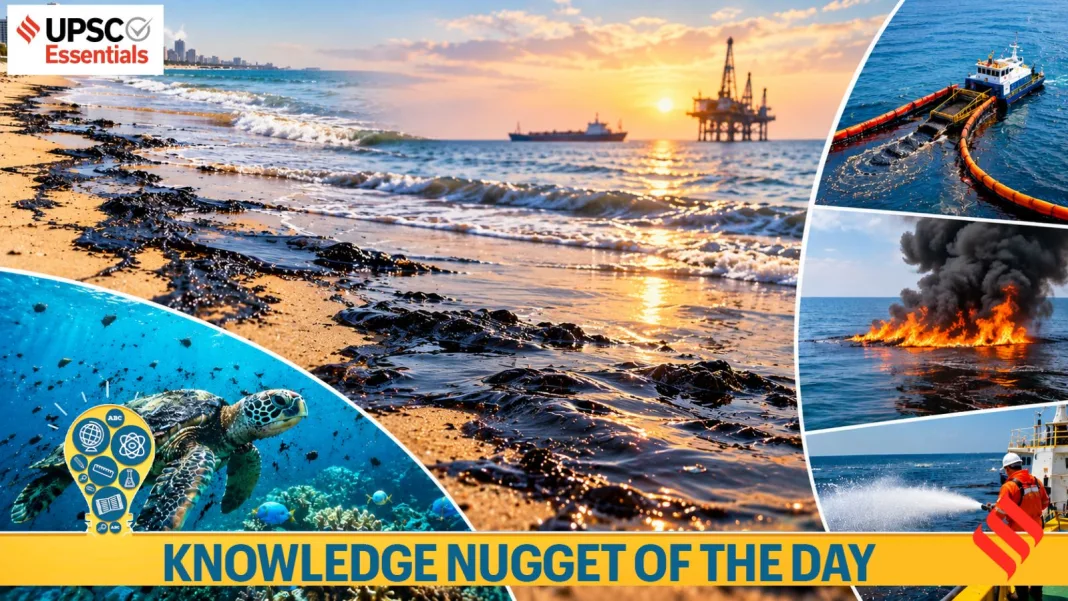
Roshni Yadav, a Deputy Copy Editor at The Indian Express, writes for the UPSC section. She can be reached at roshni.yadav@indianexpress.com. Oil spill incident in the United Arab Emirates On Saturday, 24 October, authorities in the emirate of Ras Al Khaimah announced that all beaches would be closed until further notice following an offshore oil leak. The incident prompted beach closures in neighbouring Umm Al Quwain and Sharjah. The Ministry of Climate Change and Environment said that all beaches and coastal areas around the city of Umm Al Quwain were temporarily closed until technical teams completed assessments and determined the necessary safety and marine protection measures. UAE officials have not identified the tanker involved or the cause of the spill. Understanding oil spills Oil spills can result from natural disasters, human error, equipment failure, or accidents involving tankers, drilling rigs, pipelines, or refineries. When oil enters water, it spreads rapidly, forming a surface layer that blocks sunlight and disrupts photosynthesis in marine plants and phytoplankton, which are essential for oxygen production. The severity of an oil spill depends on several factors, including the type of oil, the volume released, weather conditions, and proximity to sensitive ecosystems. Consequences can be immediate—such as toxic exposure to marine fauna—and long‑term, affecting marine ecosystems, habitats, and local economies. Oil can coat the feathers of birds, impairing insulation and increasing the risk of hypothermia and drowning. Fish and invertebrates may experience reproductive and growth challenges. Bioaccumulation of toxic substances can threaten higher‑level predators, including humans, and reduce biodiversity. Coastal ecosystems such as mangroves, coral reefs, and marshlands are particularly vulnerable. Oil can suffocate these habitats, killing vital plants and animals, and recovery may take decades, with some species facing extinction. Communities that depend on fishing and tourism often suffer significant economic losses, and cleanup operations can be costly and time‑consuming. Cleanup methods Oil spills are difficult to manage because oil spreads quickly and rough seas or strong currents complicate efforts. Common cleanup techniques include: Skimming – removing oil from the sea surface before it reaches sensitive areas. In‑situ burning – burning concentrated patches of oil. Chemical dispersants – breaking oil into smaller droplets to facilitate microbial degradation. Each method has drawbacks. Chemical dispersants can harm marine life, and manual cleanup is labor‑intensive and often ineffective in remote areas. Natural processes such as weathering, evaporation, emulsification, biodegradation, and oxidation also help reduce spill severity, though their effectiveness varies between freshwater and marine environments. Regulatory framework The International Convention for the Prevention of Pollution from Ships (MARPOL) governs oil spill prevention. MARPOL, established in 1978, contains six annexes covering oil, noxious liquids, dangerous goods, sewage, garbage, and air pollution from ships. India is a signatory and enforces MARPOL provisions through domestic legislation, including the Merchant Shipping Act, which addresses civil liability and pollution prevention certificates. Indian ports maintain oil spill contingency plans, and the Indian Coast Guard serves as the nodal agency. India’s National Oil Spill Disaster Contingency Plan (NOSDCP), promulgated by the Indian Coast Guard, is the apex plan for responding to oil spill disasters in Indian waters. It outlines roles and responsibilities for central and state agencies, port authorities, oil‑handling agencies, and other stakeholders. The plan categorizes response requirements into three tiers: Tier 1 – preparedness and immediate response to a mild spill (up to 700 tons) within a facility’s own capabilities. Tier 2 – coordinated response to a spill between 700 and 10,000 tons. Tier 3 – major spill requiring national and international resources (over 10,000 tons). The Indian Coast Guard, operating under the Ministry of Defence, coordinates pollution response operations and implements the NOSDCP, which falls under the purview of the National Disaster Management Authority, Ministry of Home Affairs. Quiz question The article includes a quiz question on the factors influencing the consequences of oil spills. The correct answer is (d) all four factors: type of oil, volume of the spill, weather conditions, and proximity to sensitive ecosystems.
News Desk is the editorial publishing account for Tringlobe Media News, covering breaking news, public affairs, entertainment, community developments and regional stories across Trinidad and Tobago, the Caribbean and internationally.