The key points are temporarily unavailable. You can still read the full Story below.
Main Points
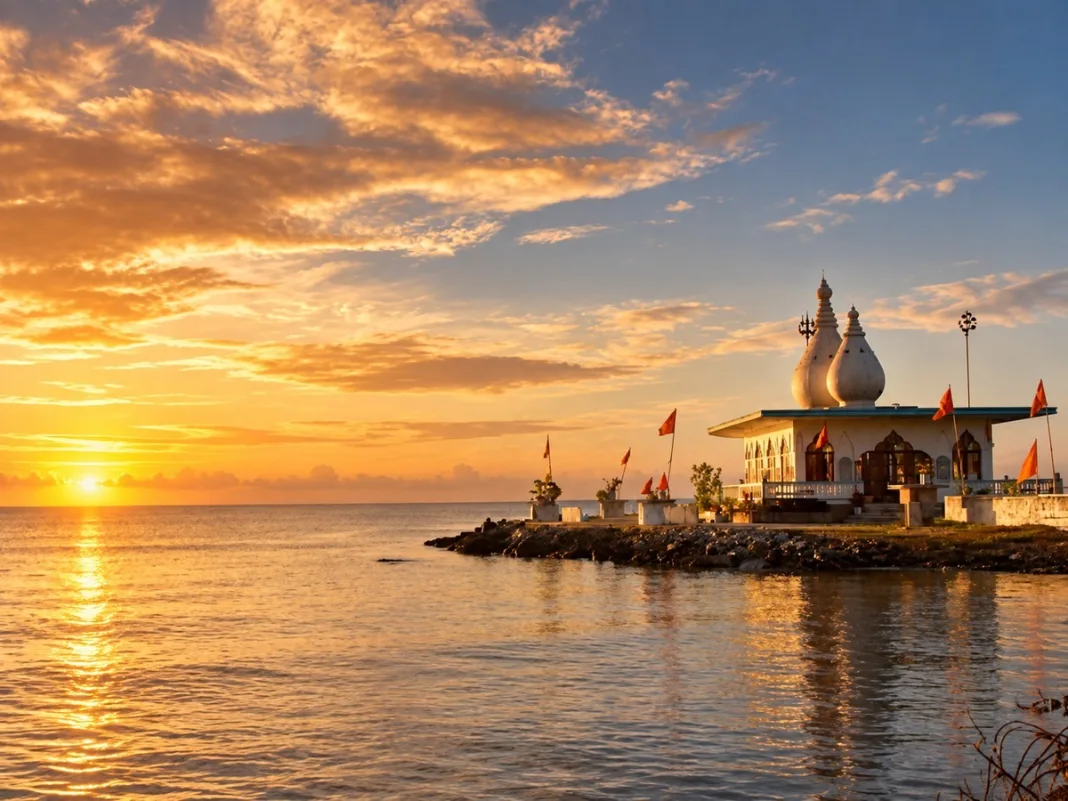
Off the Waterloo coast in central Trinidad stands one of the country’s most distinctive religious landmarks, a Hindu temple built on a man-made island in the Gulf of Paria.
Its story is inseparable from Sewdass Sadhu, an Indian immigrant and labourer whose determination transformed a dispute over land into an enduring symbol of faith and persistence.
Sadhu was born in India in 1903 and came to Trinidad with his parents, who worked on the Waterloo Estates. He later set out to establish a Hindu place of worship near the water, reflecting the sacred landscapes familiar to Indian migrants.
In 1947, Sadhu built his first temple near the Waterloo shoreline on land belonging to the Tate and Lyle sugar company.
The National Trust of Trinidad and Tobago records that the structure was built on private property at McMillan Park. Legal action followed, Sadhu was imprisoned for trespassing and the temple was demolished.
Rather than abandon the project, he turned towards the Gulf of Paria.
Sadhu began creating an artificial island offshore, carrying construction material into the sea largely with the help of his bicycle. The National Trust says the undertaking took about 25 years and was carried out through extraordinary personal effort.
Stone, earth and other material were gradually transported from the shoreline as Sadhu reclaimed enough ground from the Gulf to establish his place of worship beyond the privately owned land.
The temple eventually became a pilgrimage site for Hindu worshippers.
After Sadhu’s death, however, the structure deteriorated and much of it was reclaimed by the sea.
A major restoration effort began in 1994. The rebuilt temple was completed and consecrated in 1995 as the Sewdass Sadhu Shiva Mandir. The National Trust says the project received assistance through Trinidad and Tobago’s Unemployment Relief Programme along with overseas support.
Today, the Temple in the Sea remains connected to the mainland by a pedestrian causeway and is recognised by the National Trust as a National Treasure.
Its significance extends beyond its unusual location.
The temple preserves part of Trinidad and Tobago’s Indian migration and Hindu religious history while standing as a monument to one man’s refusal to abandon his vision after his first place of worship was destroyed.
What began with a conflict over a small piece of shoreline ultimately resulted in one of Trinidad and Tobago’s most recognisable sacred landmarks, built through decades of determination in the waters off Waterloo.