The key points are temporarily unavailable. You can still read the full Story below.
Main Points
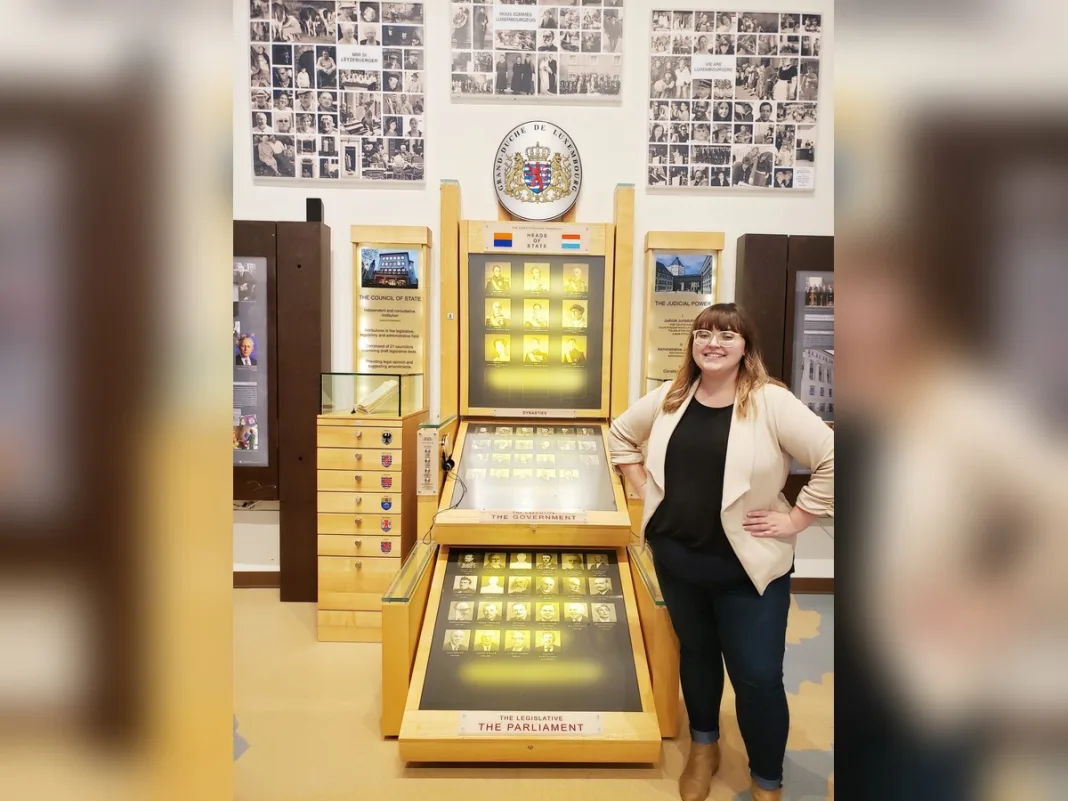
Serena Stuettgen’s first impression of Luxembourg was that of a small European country—nothing more. Yet today, the University of Wisconsin-Milwaukee (UWM) alumna curates the Luxembourg American Cultural Society (LACS) Museum in Belgium, Wisconsin, where she bridges two worlds: the Grand Duchy’s history and its diaspora in the U.S. Her role is more than archival; it’s a living connection. Stuettgen helps descendants trace their Luxembourg lineage, preserves stories of 19th-century immigrants who fled to Wisconsin, and ensures the cultural ties between Luxembourg and America remain vibrant. Her work gained new urgency when Milwaukee Mayor Tom Barrett was nominated as the next U.S. Ambassador to Luxembourg—a testament to the enduring bond between the two regions. Stuettgen’s path to LACS began with a passion for museums, honed during her studies at UWM. She earned a Master’s in public history and museum studies, specialising in Holocaust and Jewish history, which she later applied to Luxembourg’s complex past. ‘I wrote an article for our magazine interviewing a gentleman whose Jewish family escaped Luxembourg after the Nazis took over,’ she explains. ‘It was about bringing my areas of study together with Luxembourg history.’ The museum’s existence in Wisconsin isn’t accidental. In the 1800s, Luxembourg’s population hovered between 200,000 and 300,000. By the late 19th century, 70,000 Luxembourgers had immigrated to the U.S., primarily to Wisconsin, Minnesota, Iowa, and Illinois. Today, LACS stands as a monument to that exodus, housing artefacts, documents, and oral histories that tell the story of resilience and adaptation. Stuettgen’s work extends beyond curation. She collaborates with Luxembourg’s government, which has a strong presence in the museum’s board. In 2009, Grand Duke Henri himself attended LACS’s grand opening—a rare honour that underscores the museum’s significance. ‘It’s a broad enough topic talking about Luxembourg,’ Stuettgen says, ‘that I’m able to focus on my areas of study as well as Luxembourg history.’ For those with Luxembourgish roots, the museum offers a tangible link to their heritage. For others, it’s a window into a lesser-known chapter of American immigration. Stuettgen’s journey—from a curious student to a curator shaping cultural narratives—highlights how history, when shared, becomes a bridge across continents.
Serena Stuettgen’s first impression of Luxembourg was that of a small European country—nothing more. Yet today, the University of Wisconsin-Milwaukee (UWM) alumna curates the Luxembourg American Cultural Society (LACS) Museum in Belgium, Wisconsin, where she bridges two worlds: the Grand Duchy’s history and its diaspora in the U.S.
Her role is more than archival; it’s a living connection. Stuettgen helps descendants trace their Luxembourg lineage, preserves stories of 19th-century immigrants who fled to Wisconsin, and ensures the cultural ties between Luxembourg and America remain vibrant. Her work gained new urgency when Milwaukee Mayor Tom Barrett was nominated as the next U.S. Ambassador to Luxembourg—a testament to the enduring bond between the two regions.
Stuettgen’s path to LACS began with a passion for museums, honed during her studies at UWM. She earned a Master’s in public history and museum studies, specialising in Holocaust and Jewish history, which she later applied to Luxembourg’s complex past. ‘I wrote an article for our magazine interviewing a gentleman whose Jewish family escaped Luxembourg after the Nazis took over,’ she explains. ‘It was about bringing my areas of study together with Luxembourg history.’
The museum’s existence in Wisconsin isn’t accidental. In the 1800s, Luxembourg’s population hovered between 200,000 and 300,000. By the late 19th century, 70,000 Luxembourgers had immigrated to the U.S., primarily to Wisconsin, Minnesota, Iowa, and Illinois. Today, LACS stands as a monument to that exodus, housing artefacts, documents, and oral histories that tell the story of resilience and adaptation.
Stuettgen’s work extends beyond curation. She collaborates with Luxembourg’s government, which has a strong presence in the museum’s board. In 2009, Grand Duke Henri himself attended LACS’s grand opening—a rare honour that underscores the museum’s significance. ‘It’s a broad enough topic talking about Luxembourg,’ Stuettgen says, ‘that I’m able to focus on my areas of study as well as Luxembourg history.’
For those with Luxembourgish roots, the museum offers a tangible link to their heritage. For others, it’s a window into a lesser-known chapter of American immigration. Stuettgen’s journey—from a curious student to a curator shaping cultural narratives—highlights how history, when shared, becomes a bridge across continents.
News Desk is the editorial publishing account for Tringlobe Media News, covering breaking news, public affairs, entertainment, community developments and regional stories across Trinidad and Tobago, the Caribbean and internationally.