The key points are temporarily unavailable. You can still read the full Story below.
Main Points
**Global Green Growth Institute Marks Ten Years of Partnership with Rwanda** *Rwanda – September 1, 2026* – The Global Green Growth Institute (GGGI) will commemorate the tenth anniversary of its Host Country Agreement (HCA) with Rwanda on September 2, 2026. The milestone reflects a decade of collaboration that began when Rwanda joined the inter‑governmental organization in 2013, becoming its second African member state. In an interview with *The New Times*, Caroline Raes, GGGI’s Africa Deputy Regional Director for Quality of Delivery and Rwanda Country Representative, outlined the evolution of the partnership and its future priorities. **Early focus on green cities** Following the signing of the HCA in 2016, GGGI established a permanent office in Rwanda, enabling the agency to expand its support to the Rwandan government. One of the initial priorities was the development of “green cities.” According to Raes, the concept extends beyond tree planting to include infrastructure that promotes sustainable urban growth, efficient land use, and climate‑resilient development. GGGI assisted Rwanda in drafting the *National Roadmap for Green Secondary City Development* in 2016 and later supported the revision of master plans for Kigali and six secondary cities in 2020. The revisions introduced measures to protect wetlands, steer development away from high‑risk zones, and incorporate nature‑based solutions. **Broadening the agenda** The partnership subsequently broadened to address waste management, circular economy, sustainable mobility, green buildings, and nature‑based solutions. GGGI contributed to Rwanda’s e‑mobility sector through an initial showcase and feasibility studies, and supported the establishment of the Super ESCO at Rwanda Energy Group as part of the country’s Energy Efficiency Strategy (2027‑2037), funded by the Agence Française de Développement. Since 2016, GGGI has collaborated with Aviation Travel and Logistics Holding (ATL) to integrate sustainability features into the new Kigali International Airport, which has attained provisional Green Mark certification. **Mobilising finance and implementing projects** GGGI has worked closely with the Rwanda Green Fund (formerly FONERWA) to strengthen its institutional capacity. The collaboration helped Rwanda secure its first Green Climate Fund (GCF) project, the *Green Gicumbi Project*, a US$32.8 million initiative implemented solely by the Rwandan government. The project aims to enhance climate resilience through climate‑smart agriculture, ecosystem restoration, and sustainable land and water management. Raes noted that GGGI has mobilised more than US$52 million in green investment for Rwanda and contributed to the development of approximately 18 green‑growth policies. She added that the institute seeks to leverage each dollar of its own investment to attract up to US$15 of additional financing. **Pilot waste‑management interventions** Among the flagship interventions is the transformation of the Nduba landfill in Kigali. Working with the Rwandan Ministry of Environment and funded by the Grand Duchy of Luxembourg, GGGI introduced waste‑measurement equipment, a biowaste treatment facility processing five tonnes of organic waste daily, and a waste‑sorting facility handling 100 tonnes of recyclables per day. The project created roughly 67 green jobs and is projected to reduce emissions by 15,320 tCO₂eq annually. A pre‑feasibility study for a 400‑tonne capacity Mechanical Biological Treatment (MBT) plant is underway. If realised, the MBT facility, together with an engineered sanitary landfill, could treat a larger share of waste, produce refuse‑derived fuel for cement production, generate electricity for the grid, and reduce greenhouse‑gas emissions by an estimated 64,000 tCO₂eq per year while creating over 300 jobs. **Inclusive climate tools** In 2025, GGGI and the Rwanda Environment Management Authority (REMA) developed the IWACU Gender Equality and Social Inclusion (GESI) tool, an AI‑driven platform designed to track the impacts of climate interventions on women, youth, and persons with disabilities. The tool supports Rwanda’s NDC 3.0 process and has been recognised at the AI for Good Summit in 2026. **Future priorities** Looking ahead, Raes identified three priority areas for GGGI’s continued support in Rwanda: scaling green investment, expanding proven solutions, and ensuring that the green economy generates jobs, particularly for young people. She emphasized that the first decade focused on building foundations, while the next decade will aim to “scale what works and maximise impact” in partnership with Rwandan stakeholders. The upcoming anniversary celebration on September 2 will mark the culmination of a ten‑year collaboration that has sought to integrate green growth into Rwanda’s development agenda. Article source: allafrica.com | Image credit: The New Times
**Global Green Growth Institute Marks Ten Years of Partnership with Rwanda**
*Rwanda – September 1, 2026* – The Global Green Growth Institute (GGGI) will commemorate the tenth anniversary of its Host Country Agreement (HCA) with Rwanda on September 2, 2026. The milestone reflects a decade of collaboration that began when Rwanda joined the inter‑governmental organization in 2013, becoming its second African member state.
In an interview with *The New Times*, Caroline Raes, GGGI’s Africa Deputy Regional Director for Quality of Delivery and Rwanda Country Representative, outlined the evolution of the partnership and its future priorities.
**Early focus on green cities**
Following the signing of the HCA in 2016, GGGI established a permanent office in Rwanda, enabling the agency to expand its support to the Rwandan government. One of the initial priorities was the development of “green cities.” According to Raes, the concept extends beyond tree planting to include infrastructure that promotes sustainable urban growth, efficient land use, and climate‑resilient development.
GGGI assisted Rwanda in drafting the *National Roadmap for Green Secondary City Development* in 2016 and later supported the revision of master plans for Kigali and six secondary cities in 2020. The revisions introduced measures to protect wetlands, steer development away from high‑risk zones, and incorporate nature‑based solutions.
**Broadening the agenda**
The partnership subsequently broadened to address waste management, circular economy, sustainable mobility, green buildings, and nature‑based solutions. GGGI contributed to Rwanda’s e‑mobility sector through an initial showcase and feasibility studies, and supported the establishment of the Super ESCO at Rwanda Energy Group as part of the country’s Energy Efficiency Strategy (2027‑2037), funded by the Agence Française de Développement.
Since 2016, GGGI has collaborated with Aviation Travel and Logistics Holding (ATL) to integrate sustainability features into the new Kigali International Airport, which has attained provisional Green Mark certification.
**Mobilising finance and implementing projects**
GGGI has worked closely with the Rwanda Green Fund (formerly FONERWA) to strengthen its institutional capacity. The collaboration helped Rwanda secure its first Green Climate Fund (GCF) project, the *Green Gicumbi Project*, a US$32.8 million initiative implemented solely by the Rwandan government. The project aims to enhance climate resilience through climate‑smart agriculture, ecosystem restoration, and sustainable land and water management.
Raes noted that GGGI has mobilised more than US$52 million in green investment for Rwanda and contributed to the development of approximately 18 green‑growth policies. She added that the institute seeks to leverage each dollar of its own investment to attract up to US$15 of additional financing.
**Pilot waste‑management interventions**
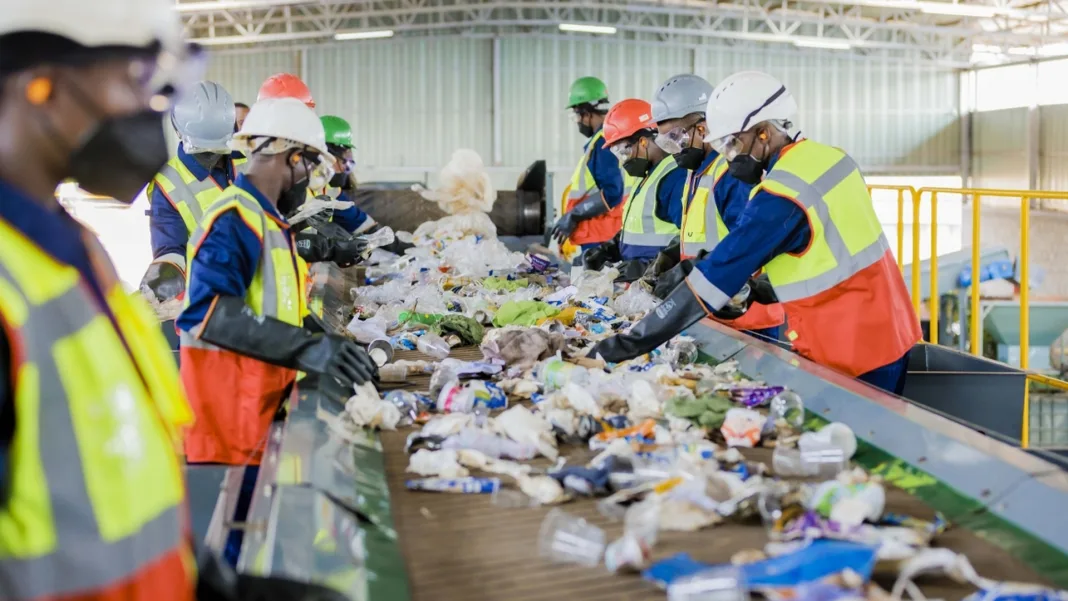
Among the flagship interventions is the transformation of the Nduba landfill in Kigali. Working with the Rwandan Ministry of Environment and funded by the Grand Duchy of Luxembourg, GGGI introduced waste‑measurement equipment, a biowaste treatment facility processing five tonnes of organic waste daily, and a waste‑sorting facility handling 100 tonnes of recyclables per day. The project created roughly 67 green jobs and is projected to reduce emissions by 15,320 tCO₂eq annually.
A pre‑feasibility study for a 400‑tonne capacity Mechanical Biological Treatment (MBT) plant is underway. If realised, the MBT facility, together with an engineered sanitary landfill, could treat a larger share of waste, produce refuse‑derived fuel for cement production, generate electricity for the grid, and reduce greenhouse‑gas emissions by an estimated 64,000 tCO₂eq per year while creating over 300 jobs.
**Inclusive climate tools**
In 2025, GGGI and the Rwanda Environment Management Authority (REMA) developed the IWACU Gender Equality and Social Inclusion (GESI) tool, an AI‑driven platform designed to track the impacts of climate interventions on women, youth, and persons with disabilities. The tool supports Rwanda’s NDC 3.0 process and has been recognised at the AI for Good Summit in 2026.
**Future priorities**
Looking ahead, Raes identified three priority areas for GGGI’s continued support in Rwanda: scaling green investment, expanding proven solutions, and ensuring that the green economy generates jobs, particularly for young people. She emphasized that the first decade focused on building foundations, while the next decade will aim to “scale what works and maximise impact” in partnership with Rwandan stakeholders.
The upcoming anniversary celebration on September 2 will mark the culmination of a ten‑year collaboration that has sought to integrate green growth into Rwanda’s development agenda.
News Desk is the editorial publishing account for Tringlobe Media News, covering breaking news, public affairs, entertainment, community developments and regional stories across Trinidad and Tobago, the Caribbean and internationally.