The key points are temporarily unavailable. You can still read the full Story below.
Main Points
**Fighting and Road Closures Heighten Famine Risk in Sudan’s Kordofan Region** *West Kordofan, Sudan – 27 August 2026* – The Kordofan Observatory, a regional monitoring body, has warned that several localities in West Kordofan are showing signs of an imminent famine. Residents of El Nahud, Wad Banda, El Khuwei and Muglad are reportedly resorting to “ambaz,” the residue left after extracting oil from groundnuts, which is traditionally used as animal feed, as food supplies dwindle and prices surge. In a statement released on Wednesday, the observatory cited testimonies from households indicating a sharp decline in income sources. The price of a “malwa” (approximately 10 kg) of millet has risen to 35,000 Sudanese pounds (SDG), a level the observatory says is beyond the reach of many families. The increased demand for ambaz has also driven up its market price, with a malwa now costing about 10,000 SDG, according to the observatory’s data. The organization attributes the worsening food crisis to recent armed clashes around El Obeid and a broader military buildup by the warring parties. The security situation, it says, has disrupted trade routes and prevented the delivery of goods to several parts of Kordofan. Additionally, the deterioration in security has limited farmers’ ability to access and cultivate their fields, while the rainy season arrived later than usual this year. “The continued fighting, closure of trade routes, and restrictions on humanitarian access could precipitate a widespread humanitarian catastrophe,” the observatory warned. The Kordofan Observatory called on both sides of the conflict to negotiate arrangements that would open and secure trade and humanitarian corridors, ensuring that food and aid can reach civilians. It urged the parties not to use food or humanitarian assistance as leverage against the population. Specifically, the observatory appealed to authorities in Khartoum and the Northern State to reverse decisions that, in its view, block the transport of goods to areas of Kordofan under the control of the Rapid Support Forces (RSF). It also asked the RSF to facilitate trade movement by removing levy checkpoints and other obstacles that contribute to rising prices for basic commodities. Finally, the observatory appealed to humanitarian organisations, both international and local, to prioritize the food and health situation in Kordofan, and to intervene with aid, healthcare services and medicines for the affected residents. *The article was translated from Arabic with the assistance of artificial intelligence and subsequently reviewed and adapted by a human editor.* Article and image source: allafrica.com
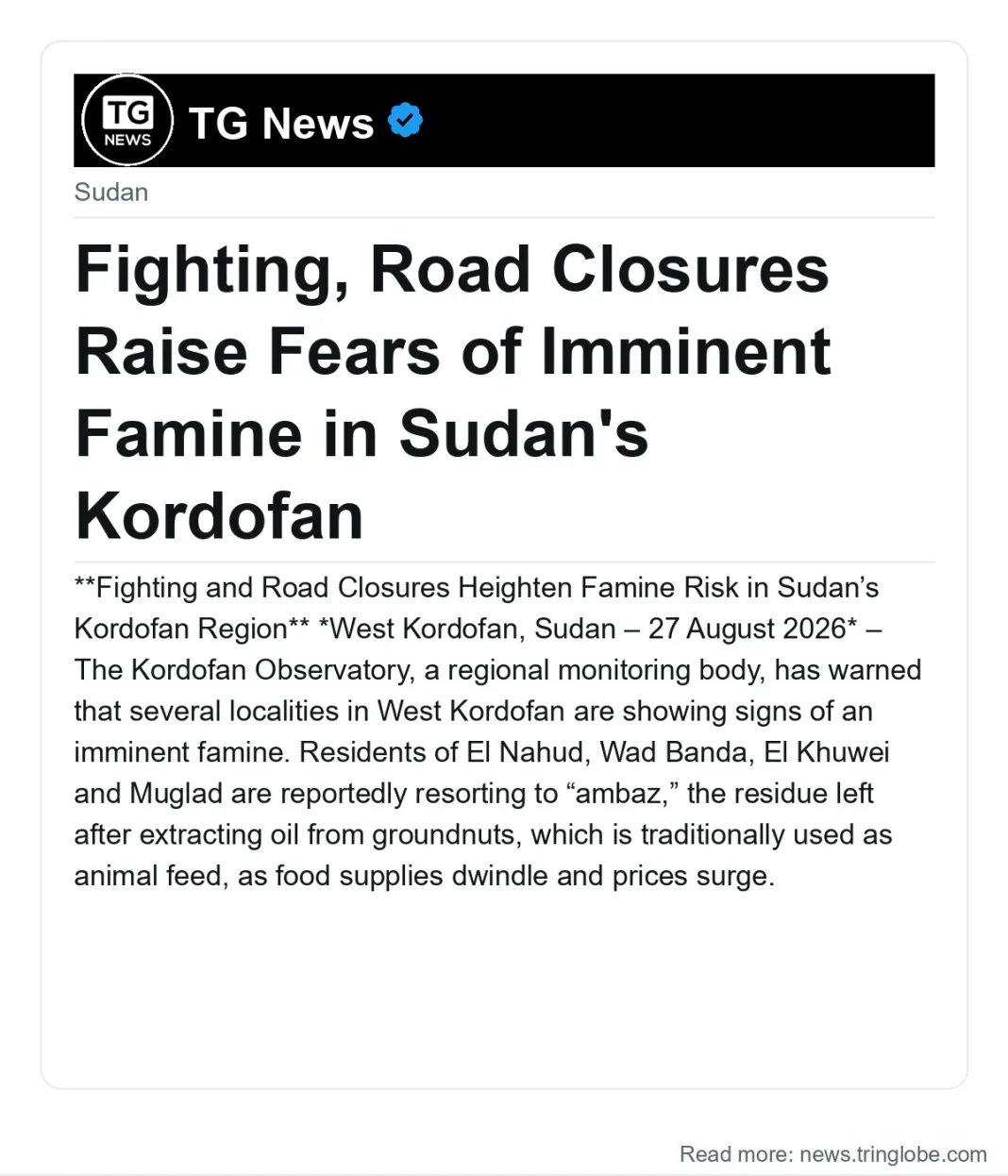
**Fighting and Road Closures Heighten Famine Risk in Sudan’s Kordofan Region**
*West Kordofan, Sudan – 27 August 2026* – The Kordofan Observatory, a regional monitoring body, has warned that several localities in West Kordofan are showing signs of an imminent famine. Residents of El Nahud, Wad Banda, El Khuwei and Muglad are reportedly resorting to “ambaz,” the residue left after extracting oil from groundnuts, which is traditionally used as animal feed, as food supplies dwindle and prices surge.
In a statement released on Wednesday, the observatory cited testimonies from households indicating a sharp decline in income sources. The price of a “malwa” (approximately 10 kg) of millet has risen to 35,000 Sudanese pounds (SDG), a level the observatory says is beyond the reach of many families. The increased demand for ambaz has also driven up its market price, with a malwa now costing about 10,000 SDG, according to the observatory’s data.
The organization attributes the worsening food crisis to recent armed clashes around El Obeid and a broader military buildup by the warring parties. The security situation, it says, has disrupted trade routes and prevented the delivery of goods to several parts of Kordofan. Additionally, the deterioration in security has limited farmers’ ability to access and cultivate their fields, while the rainy season arrived later than usual this year.
“The continued fighting, closure of trade routes, and restrictions on humanitarian access could precipitate a widespread humanitarian catastrophe,” the observatory warned.
The Kordofan Observatory called on both sides of the conflict to negotiate arrangements that would open and secure trade and humanitarian corridors, ensuring that food and aid can reach civilians. It urged the parties not to use food or humanitarian assistance as leverage against the population.
Specifically, the observatory appealed to authorities in Khartoum and the Northern State to reverse decisions that, in its view, block the transport of goods to areas of Kordofan under the control of the Rapid Support Forces (RSF). It also asked the RSF to facilitate trade movement by removing levy checkpoints and other obstacles that contribute to rising prices for basic commodities.
Finally, the observatory appealed to humanitarian organisations, both international and local, to prioritize the food and health situation in Kordofan, and to intervene with aid, healthcare services and medicines for the affected residents.
*The article was translated from Arabic with the assistance of artificial intelligence and subsequently reviewed and adapted by a human editor.*
News Desk is the editorial publishing account for Tringlobe Media News, covering breaking news, public affairs, entertainment, community developments and regional stories across Trinidad and Tobago, the Caribbean and internationally.