The key points are temporarily unavailable. You can still read the full Story below.
Main Points
**Switzerland debates tighter gun regulations after fatal rave shooting** *Zurich, 3 September 2026* – A shooting at a rave in the Aargau municipality on 30 August that left one woman dead and five others injured has reignited discussion over Switzerland’s gun‑ownership rules. The suspect, who was arrested the following day, had legally acquired a number of firearms, including weapons that were later classified as “legacy” weapons under the 2019 reforms. **The incident** Police say the shooter opened fire on attendees of the event, killing a 22‑year‑old woman and wounding five other participants. When authorities detained the suspect, they discovered an arsenal of firearms that had been purchased legally. Police described the shooter as “psychologically unstable.” The suspect’s identity has not been publicly disclosed beyond the fact that he resides in the canton of Jura. **Current gun legislation** Switzerland’s gun policy is built on the principle of “responsible gun ownership,” a legacy of the nation’s militia tradition. Under the existing framework, individuals aged 18 or older may apply for a firearms permit, provided they have no criminal record and are not nationals of countries deemed “sensitive” by the government (including Serbia, Bosnia and Herzegovina, Kosovo, North Macedonia, Turkey, Sri Lanka, Algeria and Albania, unless they hold Swiss citizenship). Applicants undergo a background investigation that typically takes two to three weeks, must pass a safety and weapons‑handling test, and are required to store ammunition separately from the firearm. In 2019, the law was tightened: high‑capacity semi‑automatic weapons could be purchased only for sport shooting or collection purposes, and civilians may carry firearms in public only when traveling to a hunting area or a shooting range. **Legacy weapons** The weapons used in the Aargau shooting included semi‑automatic firearms that had been reclassified as prohibited under the 2019 reforms. Those purchased before the change are classified as “legacy weapons” and were required only to be registered, not confiscated. The shooter’s firearms fell into this category. **Political reactions** The incident has prompted divergent views among Swiss politicians: * **Independent Zurich MP Daniel Jositsch** (Social Democratic Party) argued that stricter controls on legacy weapons could reduce the risk of similar attacks, stating, “There is a risk group. The harder it is for these individuals to obtain a weapon, the lower the likelihood of such acts reoccurring.” * **Franziska Roth**, a deputy for the Greens and Social Democrats (SD), called for a blanket ban on semi‑automatic weapons, adding, “That would mean confiscating weapons that were purchased in the past as well.” * **Reto Nause**, a deputy from The Centre party, cautioned against immediate changes, noting that “there have been no previous incidents in Switzerland involving such a weapon” and that “tightening the law would create significant bureaucracy while yielding little benefit.” He emphasized focusing on the shooter’s mental health rather than the firearms themselves. * **Werner Salzmann**, a deputy for the Swiss People’s Party (SVP), expressed that any amendment to current gun laws “is not necessary.” **Outlook** The debate over legacy weapons and broader gun‑control measures is expected to continue as lawmakers weigh public safety concerns against the administrative implications of tighter regulations. No legislative changes have been announced at this stage. Article and image source: thelocal.ch
**Switzerland debates tighter gun regulations after fatal rave shooting**
*Zurich, 3 September 2026* – A shooting at a rave in the Aargau municipality on 30 August that left one woman dead and five others injured has reignited discussion over Switzerland’s gun‑ownership rules. The suspect, who was arrested the following day, had legally acquired a number of firearms, including weapons that were later classified as “legacy” weapons under the 2019 reforms.
**The incident**
Police say the shooter opened fire on attendees of the event, killing a 22‑year‑old woman and wounding five other participants. When authorities detained the suspect, they discovered an arsenal of firearms that had been purchased legally. Police described the shooter as “psychologically unstable.” The suspect’s identity has not been publicly disclosed beyond the fact that he resides in the canton of Jura.
**Current gun legislation**
Switzerland’s gun policy is built on the principle of “responsible gun ownership,” a legacy of the nation’s militia tradition. Under the existing framework, individuals aged 18 or older may apply for a firearms permit, provided they have no criminal record and are not nationals of countries deemed “sensitive” by the government (including Serbia, Bosnia and Herzegovina, Kosovo, North Macedonia, Turkey, Sri Lanka, Algeria and Albania, unless they hold Swiss citizenship).
Applicants undergo a background investigation that typically takes two to three weeks, must pass a safety and weapons‑handling test, and are required to store ammunition separately from the firearm. In 2019, the law was tightened: high‑capacity semi‑automatic weapons could be purchased only for sport shooting or collection purposes, and civilians may carry firearms in public only when traveling to a hunting area or a shooting range.
**Legacy weapons**
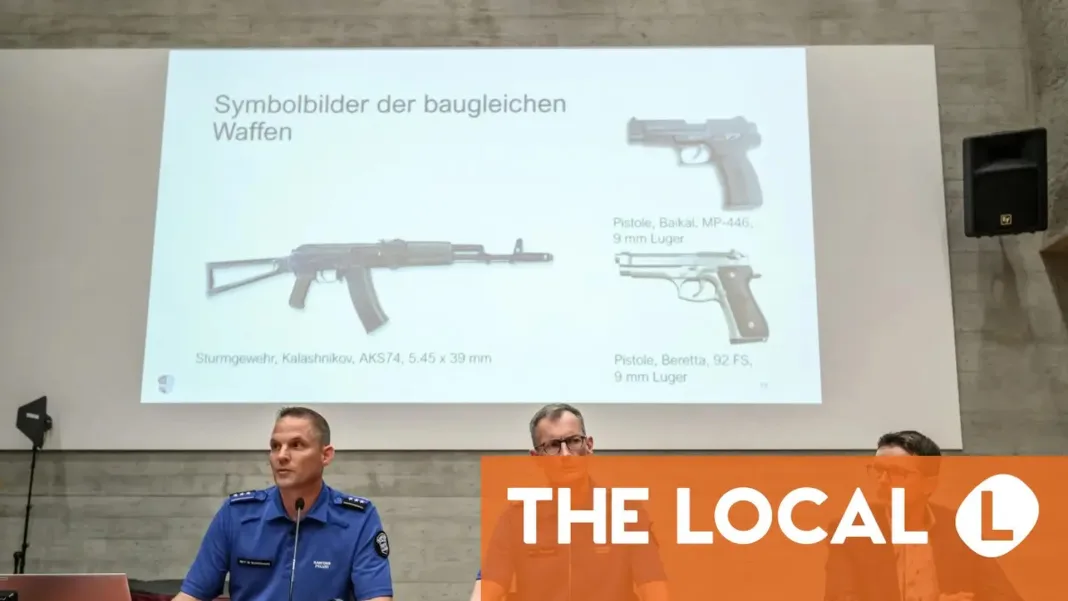
The weapons used in the Aargau shooting included semi‑automatic firearms that had been reclassified as prohibited under the 2019 reforms. Those purchased before the change are classified as “legacy weapons” and were required only to be registered, not confiscated. The shooter’s firearms fell into this category.
**Political reactions**
The incident has prompted divergent views among Swiss politicians:
* **Independent Zurich MP Daniel Jositsch** (Social Democratic Party) argued that stricter controls on legacy weapons could reduce the risk of similar attacks, stating, “There is a risk group. The harder it is for these individuals to obtain a weapon, the lower the likelihood of such acts reoccurring.”
* **Franziska Roth**, a deputy for the Greens and Social Democrats (SD), called for a blanket ban on semi‑automatic weapons, adding, “That would mean confiscating weapons that were purchased in the past as well.”
* **Reto Nause**, a deputy from The Centre party, cautioned against immediate changes, noting that “there have been no previous incidents in Switzerland involving such a weapon” and that “tightening the law would create significant bureaucracy while yielding little benefit.” He emphasized focusing on the shooter’s mental health rather than the firearms themselves.
* **Werner Salzmann**, a deputy for the Swiss People’s Party (SVP), expressed that any amendment to current gun laws “is not necessary.”
**Outlook**
The debate over legacy weapons and broader gun‑control measures is expected to continue as lawmakers weigh public safety concerns against the administrative implications of tighter regulations. No legislative changes have been announced at this stage.
News Desk is the editorial publishing account for Tringlobe Media News, covering breaking news, public affairs, entertainment, community developments and regional stories across Trinidad and Tobago, the Caribbean and internationally.