The key points are temporarily unavailable. You can still read the full Story below.
Main Points
On the eastern side of Barbados, a long palm-lined drive leads towards a coral-stone institution whose history stretches back to the early eighteenth century. Codrington College in St. John is more than a picturesque landmark overlooking the Atlantic. It is one of the Caribbean’s most enduring centres of Anglican theological education and a site closely connected to the colonial history of Barbados. The college traces its origins to Christopher Codrington III, a Barbadian-born colonial administrator and Oxford-educated landowner who died in 1710. His will provided for the establishment of an educational institution in Barbados. The college that eventually emerged from that bequest opened in the eighteenth century, and official Barbados tourism planning documents describe it as the oldest Anglican theological college in the Western Hemisphere. Its architecture was shaped by European academic traditions. The main building was conceived with the appearance of an Oxford college quadrangle, although financial limitations meant that only part of the intended design was completed. The surviving buildings, chapel and landscaped grounds nevertheless created a distinctive academic setting unlike most other historic sites on the island. The chapel remains one of the most notable parts of the property, with a panelled vaulted ceiling and traditional interior features. Outside, the grounds include mature trees, lawns and an ornamental pond fed by a natural spring. Ducks and fish have become familiar features around the pond, while the elevated location provides broad views towards Barbados’ Atlantic coast. Codrington College also developed important links with universities overseas. From 1875 until 1955 it was affiliated with Durham University in England, allowing students to qualify for Durham degrees. From 1965, the college became affiliated with the University of the West Indies and continued its role as a theological institution serving the Anglican Church in the Province of the West Indies. The history surrounding the college also reflects the more difficult realities of Barbados’ plantation era. Christopher Codrington’s wealth and estates were connected to the sugar plantation economy and the labour of enslaved Africans. Modern historical research into the Codrington estates has increasingly examined that legacy alongside the educational and religious institutions that emerged from his bequests, adding an important layer of context to the site’s story. Today, Codrington College remains both an educational institution and a place visited for its historic surroundings. Families and other visitors are drawn to its gardens, Atlantic views and distinctive avenue of palms, while its buildings continue to represent centuries of religious and academic life in Barbados. That combination makes Codrington College unusual among Barbados historical sites. Behind the peaceful lawns and familiar postcard views is a story involving education, religion, colonial wealth, architecture and the wider transformation of Barbadian society. More than three centuries after Codrington’s death, the institution bearing his name remains a visible reminder of how deeply the island’s modern landscape is connected to its complex past.
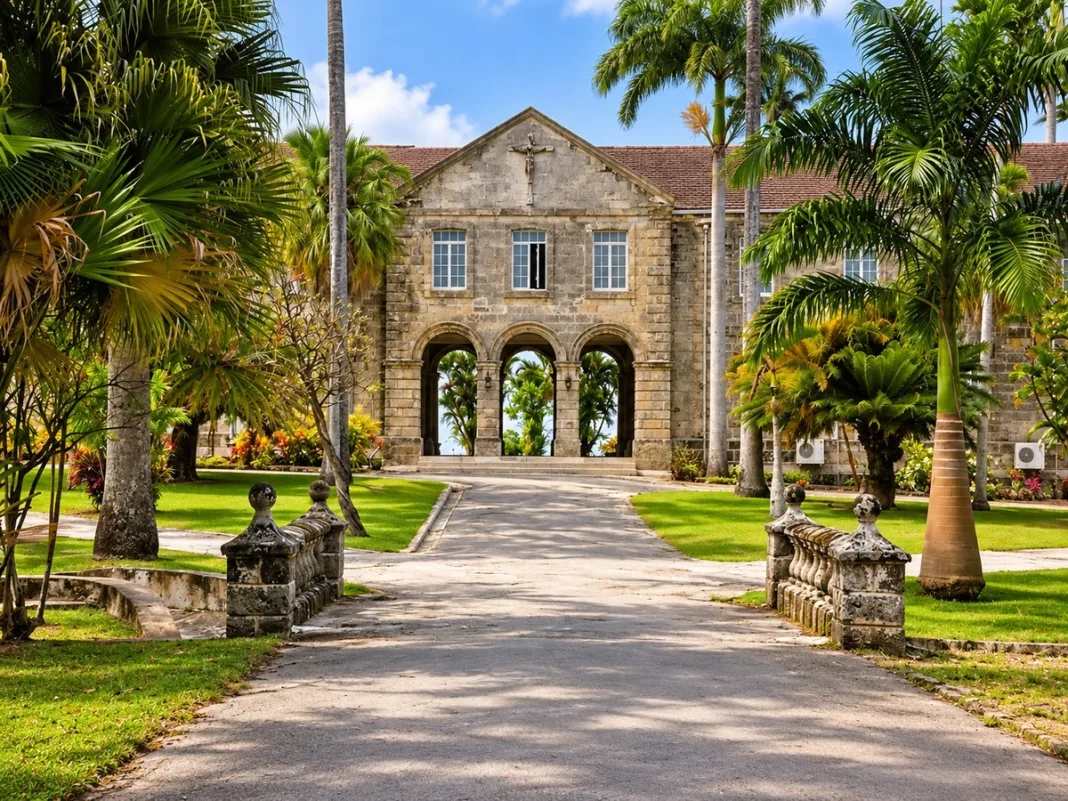
On the eastern side of Barbados, a long palm-lined drive leads towards a coral-stone institution whose history stretches back to the early eighteenth century. Codrington College in St. John is more than a picturesque landmark overlooking the Atlantic. It is one of the Caribbean’s most enduring centres of Anglican theological education and a site closely connected to the colonial history of Barbados.
The college traces its origins to Christopher Codrington III, a Barbadian-born colonial administrator and Oxford-educated landowner who died in 1710. His will provided for the establishment of an educational institution in Barbados. The college that eventually emerged from that bequest opened in the eighteenth century, and official Barbados tourism planning documents describe it as the oldest Anglican theological college in the Western Hemisphere.
Its architecture was shaped by European academic traditions. The main building was conceived with the appearance of an Oxford college quadrangle, although financial limitations meant that only part of the intended design was completed. The surviving buildings, chapel and landscaped grounds nevertheless created a distinctive academic setting unlike most other historic sites on the island.
The chapel remains one of the most notable parts of the property, with a panelled vaulted ceiling and traditional interior features. Outside, the grounds include mature trees, lawns and an ornamental pond fed by a natural spring. Ducks and fish have become familiar features around the pond, while the elevated location provides broad views towards Barbados’ Atlantic coast.
Codrington College also developed important links with universities overseas. From 1875 until 1955 it was affiliated with Durham University in England, allowing students to qualify for Durham degrees. From 1965, the college became affiliated with the University of the West Indies and continued its role as a theological institution serving the Anglican Church in the Province of the West Indies.
The history surrounding the college also reflects the more difficult realities of Barbados’ plantation era. Christopher Codrington’s wealth and estates were connected to the sugar plantation economy and the labour of enslaved Africans. Modern historical research into the Codrington estates has increasingly examined that legacy alongside the educational and religious institutions that emerged from his bequests, adding an important layer of context to the site’s story.
Today, Codrington College remains both an educational institution and a place visited for its historic surroundings. Families and other visitors are drawn to its gardens, Atlantic views and distinctive avenue of palms, while its buildings continue to represent centuries of religious and academic life in Barbados.
That combination makes Codrington College unusual among Barbados historical sites. Behind the peaceful lawns and familiar postcard views is a story involving education, religion, colonial wealth, architecture and the wider transformation of Barbadian society. More than three centuries after Codrington’s death, the institution bearing his name remains a visible reminder of how deeply the island’s modern landscape is connected to its complex past.
News Desk is the editorial publishing account for Tringlobe Media News, covering breaking news, public affairs, entertainment, community developments and regional stories across Trinidad and Tobago, the Caribbean and internationally.