The key points are temporarily unavailable. You can still read the full Story below.
Main Points
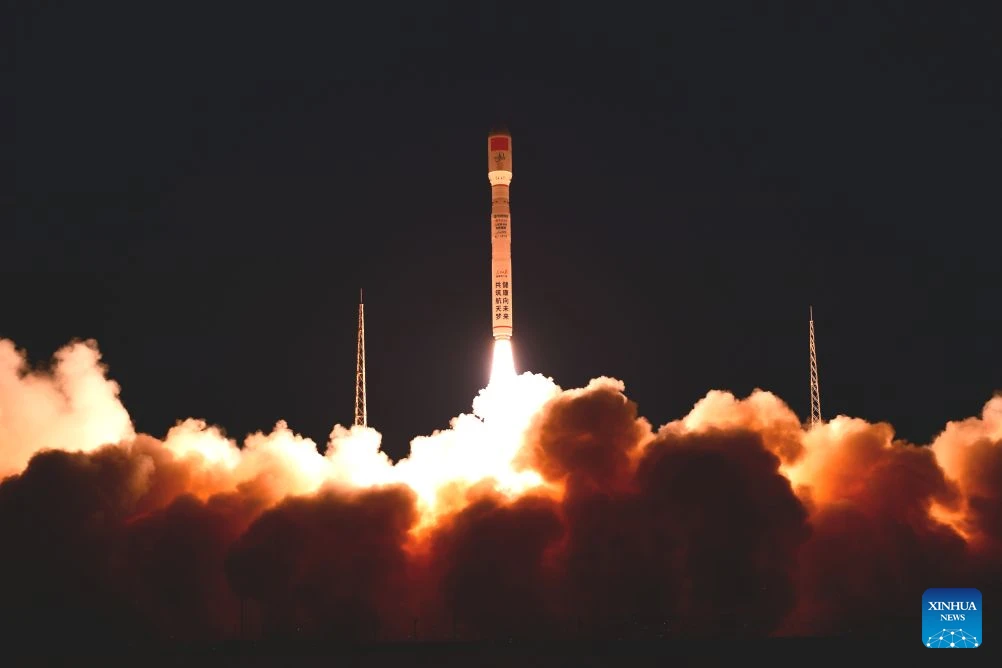
The Chinese private aerospace company Galactic Energy has successfully conducted the inaugural launch of its CERES-2 commercial carrier rocket, placing four satellites into orbit. According to the Xinhua News Agency, the launch took place on Saturday at 7:37 a.m. Beijing time from the Jiuquan Satellite Launch Center in northwestern China. The four satellites were successfully deployed into a sun-synchronous orbit at an altitude of 535 kilometers. These satellites are designed for a variety of applications, including ocean remote sensing, commercial meteorological services, university-led scientific research, and space situational awareness. Developers stated that the successful test flight and the precise orbital insertion of the satellites mark the official commencement of the CERES-2 rocket's operational phase. The medium-lift launch vehicle is designed specifically for commercial missions. It features three solid-propellant stages followed by a liquid-propellant upper stage. With a launch mass of approximately 100 tons, the CERES-2 is capable of delivering up to 1.3 tons of payload into a 500-kilometer sun-synchronous orbit. The rocket is engineered for versatility, with the capability to be launched from both land-based and sea-based platforms. A representative for Galactic Energy stated that the company intends to continue enhancing the efficiency and reliability of its solid-propellant rockets to meet the growing demand for the deployment and replenishment of small and medium-sized satellite constellations, as well as the establishment of larger space-based systems. Article source: News.am | Image credit: News.am
The Chinese private aerospace company Galactic Energy has successfully conducted the inaugural launch of its CERES-2 commercial carrier rocket, placing four satellites into orbit. According to the Xinhua News Agency, the launch took place on Saturday at 7:37 a.m. Beijing time from the Jiuquan Satellite Launch Center in northwestern China. The four satellites were successfully deployed into a sun-synchronous orbit at an altitude of 535 kilometers. These satellites are designed for a variety of applications, including ocean remote sensing, commercial meteorological services, university-led scientific research, and space situational awareness. Developers stated that the successful test flight and the precise orbital insertion of the satellites mark the official commencement of the CERES-2 rocket’s operational phase. The medium-lift launch vehicle is designed specifically for commercial missions. It features three solid-propellant stages followed by a liquid-propellant upper stage. With a launch mass of approximately 100 tons, the CERES-2 is capable of delivering up to 1.3 tons of payload into a 500-kilometer sun-synchronous orbit. The rocket is engineered for versatility, with the capability to be launched from both land-based and sea-based platforms. A representative for Galactic Energy stated that the company intends to continue enhancing the efficiency and reliability of its solid-propellant rockets to meet the growing demand for the deployment and replenishment of small and medium-sized satellite constellations, as well as the establishment of larger space-based systems.
News Desk is the editorial publishing account for Tringlobe Media News, covering breaking news, public affairs, entertainment, community developments and regional stories across Trinidad and Tobago, the Caribbean and internationally.