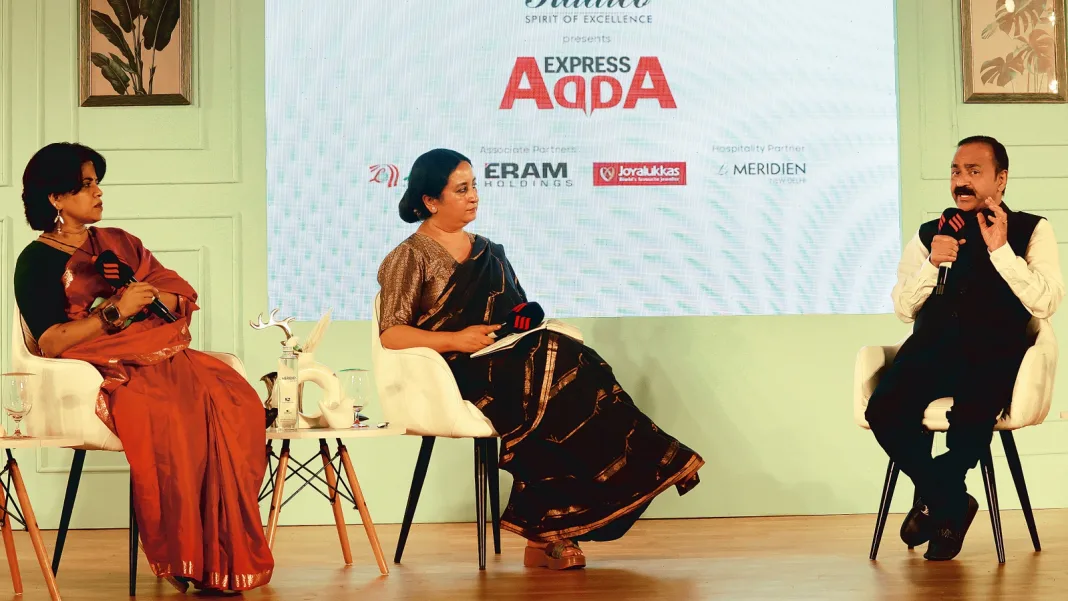
Chief Minister of karalam VD Satheesan in conversation with Vandita Mishra,National Opinion Editor,& Liz Mathew , Deputy Editor with express duringThe Indian Express Adda on 23 October 2026,New Delhi.Express photo by Renuka puri.
The key points are temporarily unavailable. You can still read the full Story below.
Main Points
Kerala Chief Minister V.D. Satheesan outlines vision for the state and the Congress‑led UDF coalition In a recent interview with The Indian Express editors Vandita Mishra and Liz Mathew, Kerala Chief Minister V.D. Satheesan discussed the challenges he faces as a new leader, his long‑term plans for the state, and the Congress‑led United Democratic Front (UDF) coalition’s role in national politics. ### Pressure of a new mandate Satheesan said that the main pressure he feels comes from the public’s expectations rather than from within his own party or coalition. “People are expecting more from us because before the election, we kept our communication lines open with them,” he explained. He added that the UDF, which includes ten parties, “acts like a single party” and is focused on delivering on its promises. ### Five‑year vision for Kerala The chief minister outlined a five‑year plan that focuses on transforming Kerala into a “port city” and an aviation hub. He cited the state’s two international sea ports, a container terminal, 18 mini ports and a 600‑km coastline as assets that can be leveraged. “We want to make Kerala the most civilised society in terms of how it treats its elderly,” he said, referring to the department for senior citizens that was created in his first cabinet and a bill guaranteeing their rights. Other priorities include: Aviation – four international airports, a global convention centre in Cochin, an aviation institute, pilot training, maintenance, repair and overhaul (MRO) facilities, and upgraded cargo services. Economic development – integration of senior citizens as mentors for young entrepreneurs and support for Kudumbashree women units to achieve economic self‑reliance. Tourism – upgrades to infrastructure and services to boost the sector. ### Fiscal realities Satheesan acknowledged that Kerala’s revenue‑raising capacity is narrowing while committed expenditures remain high. He cited a white paper presented to the legislature that shows committed expenditure at 80 % of revenue, with debt exceeding ₹5 lakh crore. “We are facing a fiscal crisis,” he said. He rejected the idea of raising taxes, arguing that “to stimulate the economy, first, the government has to spend.” He cited the Onam distribution of nearly ₹4,000 crore to the poor and lower‑middle class as an example of demand‑side stimulus that helped the state achieve its largest GST share since the tax’s introduction. He also noted that Kerala’s share of tax devolution has fallen from 3.5 % in the 10th Finance Commission to 2.32 % in the latest commission, and that the shift from the Planning Commission to NITI Aayog has reduced the state’s share of centrally funded projects. ### Southern alliance and inter‑state coordination The chief minister welcomed the idea of a “southern alliance” led by Andhra Pradesh’s Chief Minister N. Chandrababu Naidu. He said that coordination among southern states could improve bargaining power with the centre, especially on issues such as the GST Council and tax devolution. ### Student protests and law enforcement Satheesan addressed the student protests that have taken place across India, including in Kerala. He said that the protests stem from real concerns about unemployment and the relevance of the education system. “We have declared a global job watch in my budget and appointed experts in 12 sectors to monitor job trends,” he explained. Regarding the police filing FIRs against protesters, he said the action was taken when roadblocks were erected and that the FIRs were later quashed. ### Coalition dynamics and national politics When asked about the UDF’s ability to form coalitions, Satheesan said that coalition politics is a reality and that the UDF will rally behind Rahul Gandhi. He denied that the party would “dump a coalition partner post‑election” and said that such decisions are made after elections to ensure a stable government. On the relationship with the central government, he said that the state will pursue “cooperative federalism” under constitutional provisions while maintaining a firm stance against the BJP and the Sangh Parivar on ideological grounds. ### Secularism and political alliances Satheesan reaffirmed the UDF’s commitment to secularism, noting that the party has faced accusations of being influenced by the Muslim League, a key partner in the coalition. He said that the party’s secular stance remains a core principle. — The interview provides a comprehensive overview of V.D. Satheesan’s priorities for Kerala, the fiscal challenges the state faces, and the Congress‑led UDF’s strategy in both state and national politics. Article source: Indian Express | Image credit: Indian Express
Kerala Chief Minister V.D. Satheesan outlines vision for the state and the Congress‑led UDF coalition In a recent interview with The Indian Express editors Vandita Mishra and Liz Mathew, Kerala Chief Minister V.D. Satheesan discussed the challenges he faces as a new leader, his long‑term plans for the state, and the Congress‑led United Democratic Front (UDF) coalition’s role in national politics. ### Pressure of a new mandate Satheesan said that the main pressure he feels comes from the public’s expectations rather than from within his own party or coalition. “People are expecting more from us because before the election, we kept our communication lines open with them,” he explained. He added that the UDF, which includes ten parties, “acts like a single party” and is focused on delivering on its promises. ### Five‑year vision for Kerala The chief minister outlined a five‑year plan that focuses on transforming Kerala into a “port city” and an aviation hub. He cited the state’s two international sea ports, a container terminal, 18 mini ports and a 600‑km coastline as assets that can be leveraged. “We want to make Kerala the most civilised society in terms of how it treats its elderly,” he said, referring to the department for senior citizens that was created in his first cabinet and a bill guaranteeing their rights. Other priorities include: Aviation – four international airports, a global convention centre in Cochin, an aviation institute, pilot training, maintenance, repair and overhaul (MRO) facilities, and upgraded cargo services. Economic development – integration of senior citizens as mentors for young entrepreneurs and support for Kudumbashree women units to achieve economic self‑reliance. Tourism – upgrades to infrastructure and services to boost the sector. ### Fiscal realities Satheesan acknowledged that Kerala’s revenue‑raising capacity is narrowing while committed expenditures remain high. He cited a white paper presented to the legislature that shows committed expenditure at 80 % of revenue, with debt exceeding ₹5 lakh crore. “We are facing a fiscal crisis,” he said. He rejected the idea of raising taxes, arguing that “to stimulate the economy, first, the government has to spend.” He cited the Onam distribution of nearly ₹4,000 crore to the poor and lower‑middle class as an example of demand‑side stimulus that helped the state achieve its largest GST share since the tax’s introduction. He also noted that Kerala’s share of tax devolution has fallen from 3.5 % in the 10th Finance Commission to 2.32 % in the latest commission, and that the shift from the Planning Commission to NITI Aayog has reduced the state’s share of centrally funded projects. ### Southern alliance and inter‑state coordination The chief minister welcomed the idea of a “southern alliance” led by Andhra Pradesh’s Chief Minister N. Chandrababu Naidu. He said that coordination among southern states could improve bargaining power with the centre, especially on issues such as the GST Council and tax devolution. ### Student protests and law enforcement Satheesan addressed the student protests that have taken place across India, including in Kerala. He said that the protests stem from real concerns about unemployment and the relevance of the education system. “We have declared a global job watch in my budget and appointed experts in 12 sectors to monitor job trends,” he explained. Regarding the police filing FIRs against protesters, he said the action was taken when roadblocks were erected and that the FIRs were later quashed. ### Coalition dynamics and national politics When asked about the UDF’s ability to form coalitions, Satheesan said that coalition politics is a reality and that the UDF will rally behind Rahul Gandhi. He denied that the party would “dump a coalition partner post‑election” and said that such decisions are made after elections to ensure a stable government. On the relationship with the central government, he said that the state will pursue “cooperative federalism” under constitutional provisions while maintaining a firm stance against the BJP and the Sangh Parivar on ideological grounds. ### Secularism and political alliances Satheesan reaffirmed the UDF’s commitment to secularism, noting that the party has faced accusations of being influenced by the Muslim League, a key partner in the coalition. He said that the party’s secular stance remains a core principle. — The interview provides a comprehensive overview of V.D. Satheesan’s priorities for Kerala, the fiscal challenges the state faces, and the Congress‑led UDF’s strategy in both state and national politics.
News Desk is the editorial publishing account for Tringlobe Media News, covering breaking news, public affairs, entertainment, community developments and regional stories across Trinidad and Tobago, the Caribbean and internationally.