The key points are temporarily unavailable. You can still read the full Story below.
Main Points
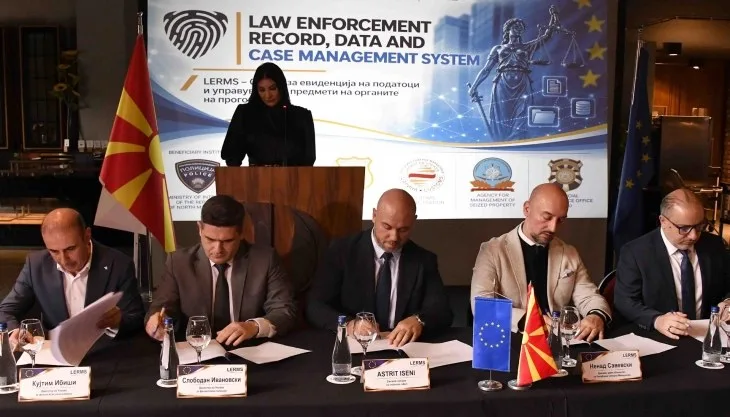
Six North Macedonian institutions have signed a memorandum to create a unified data‑sharing system aimed at combating organized crime, corruption, money laundering and terrorism financing. The agreement was signed in Skopje on Tuesday and is part of the European Union‑funded LERMS project – the “Evidence, Data and Management System for Law‑Enforcement Bodies”. The institutions involved are the Public Prosecutor’s Office, the Ministry of Interior, the Customs Administration, the Directorate of Financial Police, the Directorate of Financial Intelligence and the Agency for Seized Asset Management. They will be linked through a single, automated platform that will enable secure data exchange, automated statistical reporting and analytics, and real‑time tracking of assets throughout the criminal justice process. This includes pre‑trial actions, criminal proceedings, prosecutorial and judicial procedures, financial investigations, and asset seizure and confiscation. State Prosecutor Nenad Saveski emphasized that accurate, timely, and high‑quality data exchange is essential for effective action against organized crime, corruption and financial crime. “Statistical data should give us a comprehensive view of trends at any moment and keep us one step ahead of crime,” he said. He added that coordinated and rapid data sharing will prevent the spread of inaccurate or unverified information that can harm procedures, while increasing institutional efficiency and credibility. Financial Police Director Sllobodan Ivanovski highlighted the current problem: his department files criminal charges but receives delayed responses from the prosecutor’s office regarding the initiation or termination of proceedings. “This system is important because it will provide real‑time data,” he said, expressing hope that the network will speed up and improve judicial processes. Roberta Korteze, the European Union Delegation’s representative in the country, described the signing as confirmation of the EU’s long‑term commitment to the rule of law. “Stronger institutions, closer cooperation, and concrete progress in law‑enforcement are what we are building together,” she said. She called attention to the importance of financial investigations and the seizure of assets obtained through criminal activity. According to Korteze, the long‑term value of LERMS will depend on its regular use, ongoing investment in personnel and technology, and sustained collaboration among the participating institutions. Article source: 24 Orë | Image credit: 24 Orë
Six North Macedonian institutions have signed a memorandum to create a unified data‑sharing system aimed at combating organized crime, corruption, money laundering and terrorism financing. The agreement was signed in Skopje on Tuesday and is part of the European Union‑funded LERMS project – the “Evidence, Data and Management System for Law‑Enforcement Bodies”. The institutions involved are the Public Prosecutor’s Office, the Ministry of Interior, the Customs Administration, the Directorate of Financial Police, the Directorate of Financial Intelligence and the Agency for Seized Asset Management. They will be linked through a single, automated platform that will enable secure data exchange, automated statistical reporting and analytics, and real‑time tracking of assets throughout the criminal justice process. This includes pre‑trial actions, criminal proceedings, prosecutorial and judicial procedures, financial investigations, and asset seizure and confiscation. State Prosecutor Nenad Saveski emphasized that accurate, timely, and high‑quality data exchange is essential for effective action against organized crime, corruption and financial crime. “Statistical data should give us a comprehensive view of trends at any moment and keep us one step ahead of crime,” he said. He added that coordinated and rapid data sharing will prevent the spread of inaccurate or unverified information that can harm procedures, while increasing institutional efficiency and credibility. Financial Police Director Sllobodan Ivanovski highlighted the current problem: his department files criminal charges but receives delayed responses from the prosecutor’s office regarding the initiation or termination of proceedings. “This system is important because it will provide real‑time data,” he said, expressing hope that the network will speed up and improve judicial processes. Roberta Korteze, the European Union Delegation’s representative in the country, described the signing as confirmation of the EU’s long‑term commitment to the rule of law. “Stronger institutions, closer cooperation, and concrete progress in law‑enforcement are what we are building together,” she said. She called attention to the importance of financial investigations and the seizure of assets obtained through criminal activity. According to Korteze, the long‑term value of LERMS will depend on its regular use, ongoing investment in personnel and technology, and sustained collaboration among the participating institutions.
News Desk is the editorial publishing account for Tringlobe Media News, covering breaking news, public affairs, entertainment, community developments and regional stories across Trinidad and Tobago, the Caribbean and internationally.