The key points are temporarily unavailable. You can still read the full Story below.
Main Points
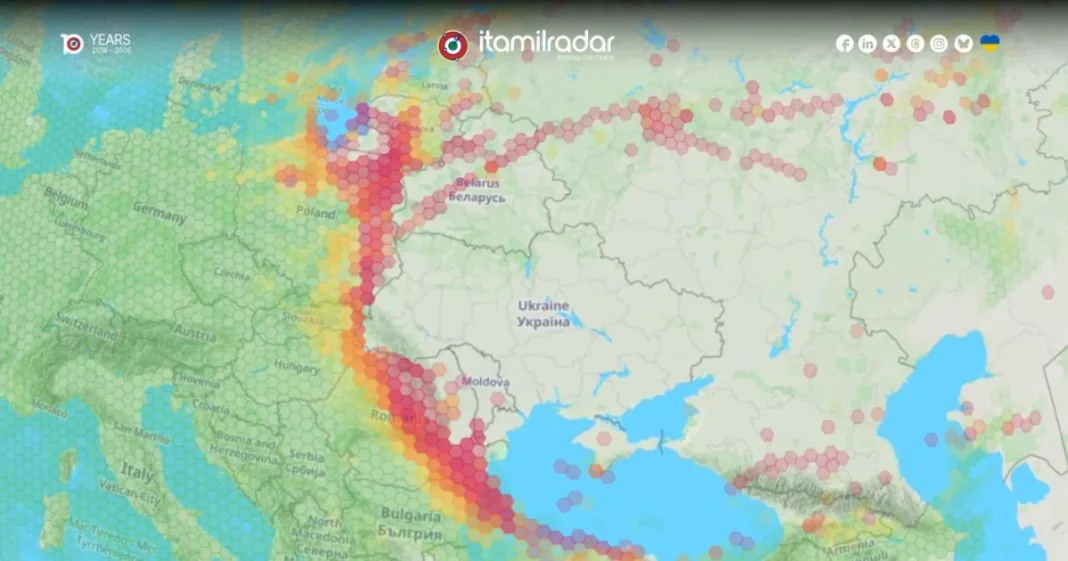
GPS jamming has been detected along almost the entire eastern flank of NATO, from the southern Baltic Sea to the western Black Sea, according to a map released by the Italian air‑traffic monitoring project ItaMilRadar. The map, based on data from the AirNav Radar platform, shows a near‑continuous zone of interference that crosses Lithuania, eastern Poland, Romania and Bulgaria, extending to the western Black Sea. The strongest signals were reported near the Russian enclave of Kaliningrad on the Baltic coast, along the Polish‑Belarus and Polish‑Ukraine borders, over Romania and Moldova, and along Bulgaria’s Black Sea coast. Lower‑intensity disturbances were also observed along Belarusian and western Russian air routes, around Crimea and in the Caucasus region. “ItaMilRadar says the jamming map is particularly interesting. The entire eastern flank of NATO is affected by strong interference, concentrated geographically along the eastern border,” the project said. The data indicate where aircraft reported degraded GPS and other satellite navigation signals, but the source of the interference has not been identified. No government has announced who was responsible for the jamming recorded on 3 November. The pattern of affected areas overlaps with the flight paths used by Russian drones during attacks on Ukraine, suggesting a possible link to the ongoing conflict. Some of the disturbances could stem from NATO anti‑drone jamming systems designed to divert satellite‑guided drones before they enter NATO airspace. In the Belarus‑Kaliningrad corridor, the signal block could originate from either Russia or the European side, but no governments have confirmed the use of jamming at this scale. Russia has previously been associated with jamming in the Baltic Sea. Researchers using monitoring stations around the Gulf of Gdańsk in Poland identified two jamming sources near the Kaliningrad coast, close to known electronic‑warfare units. Another interference zone was located near St. Petersburg, according to Defense News. The issue has also been raised at the international level. In early 2025, Sweden and five neighboring countries notified the International Civil Aviation Organization that approximately 123,000 flights over Poland, the Baltic states, Finland and Sweden were affected by interference during the first four months of the year. GPS World reported that the sources of the disturbances were located in Kaliningrad, St. Petersburg, Smolensk and Rostov. Russian drones have repeatedly entered or approached NATO’s eastern border during the Ukraine conflict. In September 2026, a Russian drone penetrated deep into Romanian airspace before crashing in the Republic of Moldova. Russia possesses a wide range of electronic‑warfare systems, including mobile jamming equipment. An Infauna electronic‑warfare vehicle was recently observed in Mali, Africa, according to Defence Blog. Article source: Adev&acaron;rul | Image credit: Adev&acaron;rul
GPS jamming has been detected along almost the entire eastern flank of NATO, from the southern Baltic Sea to the western Black Sea, according to a map released by the Italian air‑traffic monitoring project ItaMilRadar. The map, based on data from the AirNav Radar platform, shows a near‑continuous zone of interference that crosses Lithuania, eastern Poland, Romania and Bulgaria, extending to the western Black Sea. The strongest signals were reported near the Russian enclave of Kaliningrad on the Baltic coast, along the Polish‑Belarus and Polish‑Ukraine borders, over Romania and Moldova, and along Bulgaria’s Black Sea coast. Lower‑intensity disturbances were also observed along Belarusian and western Russian air routes, around Crimea and in the Caucasus region. “ItaMilRadar says the jamming map is particularly interesting. The entire eastern flank of NATO is affected by strong interference, concentrated geographically along the eastern border,” the project said. The data indicate where aircraft reported degraded GPS and other satellite navigation signals, but the source of the interference has not been identified. No government has announced who was responsible for the jamming recorded on 3 November. The pattern of affected areas overlaps with the flight paths used by Russian drones during attacks on Ukraine, suggesting a possible link to the ongoing conflict. Some of the disturbances could stem from NATO anti‑drone jamming systems designed to divert satellite‑guided drones before they enter NATO airspace. In the Belarus‑Kaliningrad corridor, the signal block could originate from either Russia or the European side, but no governments have confirmed the use of jamming at this scale. Russia has previously been associated with jamming in the Baltic Sea. Researchers using monitoring stations around the Gulf of Gdańsk in Poland identified two jamming sources near the Kaliningrad coast, close to known electronic‑warfare units. Another interference zone was located near St. Petersburg, according to Defense News. The issue has also been raised at the international level. In early 2025, Sweden and five neighboring countries notified the International Civil Aviation Organization that approximately 123,000 flights over Poland, the Baltic states, Finland and Sweden were affected by interference during the first four months of the year. GPS World reported that the sources of the disturbances were located in Kaliningrad, St. Petersburg, Smolensk and Rostov. Russian drones have repeatedly entered or approached NATO’s eastern border during the Ukraine conflict. In September 2026, a Russian drone penetrated deep into Romanian airspace before crashing in the Republic of Moldova. Russia possesses a wide range of electronic‑warfare systems, including mobile jamming equipment. An Infauna electronic‑warfare vehicle was recently observed in Mali, Africa, according to Defence Blog.
News Desk is the editorial publishing account for Tringlobe Media News, covering breaking news, public affairs, entertainment, community developments and regional stories across Trinidad and Tobago, the Caribbean and internationally.