The key points are temporarily unavailable. You can still read the full Story below.
Main Points
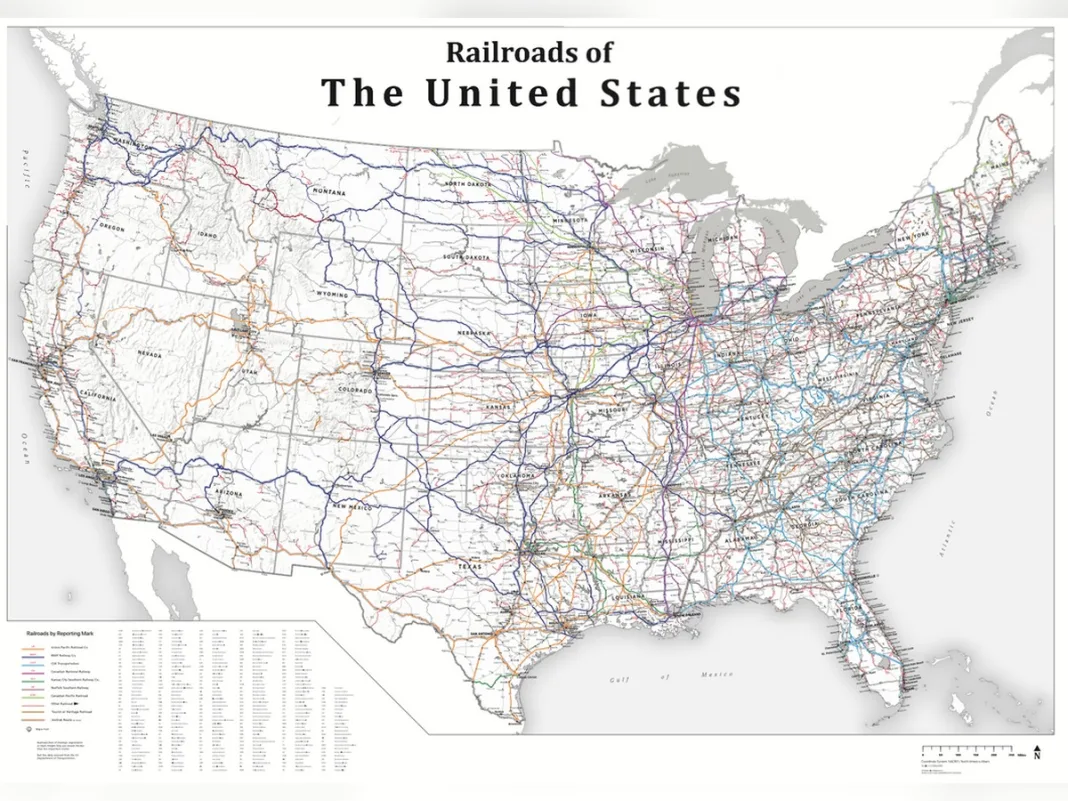
America’s standardized time zones emerged from a practical problem: trains connected communities whose clocks did not agree. A Library of Congress history traces how railroad officials, engineers and scientists helped replace a patchwork of local times with shared regional standards. Before that change, cities set their clocks by observing the sun’s passage across the local meridian. That gave communities a local reference for noon, but it complicated travel between them. As rail networks expanded, passengers encountered different time standards along their journeys, and stations displayed multiple clocks to accommodate different railroads. Railroad companies already maintained precise internal timekeeping systems. The difficulty was getting those systems to agree. A railway might follow the time of its home city or another major city on its route, leaving travelers to reconcile arrival and departure times expressed under different standards. In 1870, Charles F. Dowd published a proposal to divide the country into four time zones, each an hour apart. His plan centered the zones on meridians at 75, 90, 105 and 120 degrees west of Greenwich. He presented the proposal to railroad officials, but securing approval proved difficult. The push for standardization extended beyond passenger travel. In 1879, the American Meteorology Society established a Committee on Standard Time. Supporters saw consistent timekeeping as a way to improve the accuracy of weather forecasts, according to the Library of Congress account. Railroad officials took up the issue in October 1881. William F. Allen, secretary of the General Time Convention, was commissioned to develop a proposal. He drew on earlier ideas while seeking opinions from railroad engineers and officials, making the eventual system a product of negotiation as well as geographic calculation. On October 11, 1883, the convention met at Chicago’s Grand Pacific Hotel. Most railroad officials voted for Allen’s proposal, and railroad clocks were scheduled to adopt the new standard at noon on November 18. The agreement still required cooperation beyond the railway station. Railroad representatives approached city governments to persuade them to participate. The history illustrates why geography alone does not explain standardized time: the need to coordinate journeys helped turn local clock readings into a shared regional framework.
America’s standardized time zones emerged from a practical problem: trains connected communities whose clocks did not agree. A Library of Congress history traces how railroad officials, engineers and scientists helped replace a patchwork of local times with shared regional standards. Before that change, cities set their clocks by observing the sun’s passage across the local meridian. That gave communities a local reference for noon, but it complicated travel between them. As rail networks expanded, passengers encountered different time standards along their journeys, and stations displayed multiple clocks to accommodate different railroads. Railroad companies already maintained precise internal timekeeping systems. The difficulty was getting those systems to agree. A railway might follow the time of its home city or another major city on its route, leaving travelers to reconcile arrival and departure times expressed under different standards. In 1870, Charles F. Dowd published a proposal to divide the country into four time zones, each an hour apart. His plan centered the zones on meridians at 75, 90, 105 and 120 degrees west of Greenwich. He presented the proposal to railroad officials, but securing approval proved difficult. The push for standardization extended beyond passenger travel. In 1879, the American Meteorology Society established a Committee on Standard Time. Supporters saw consistent timekeeping as a way to improve the accuracy of weather forecasts, according to the Library of Congress account. Railroad officials took up the issue in October 1881. William F. Allen, secretary of the General Time Convention, was commissioned to develop a proposal. He drew on earlier ideas while seeking opinions from railroad engineers and officials, making the eventual system a product of negotiation as well as geographic calculation. On October 11, 1883, the convention met at Chicago’s Grand Pacific Hotel. Most railroad officials voted for Allen’s proposal, and railroad clocks were scheduled to adopt the new standard at noon on November 18. The agreement still required cooperation beyond the railway station. Railroad representatives approached city governments to persuade them to participate. The history illustrates why geography alone does not explain standardized time: the need to coordinate journeys helped turn local clock readings into a shared regional framework.
News Desk is the editorial publishing account for Tringlobe Media News, covering breaking news, public affairs, entertainment, community developments and regional stories across Trinidad and Tobago, the Caribbean and internationally.