The key points are temporarily unavailable. You can still read the full Story below.
Main Points
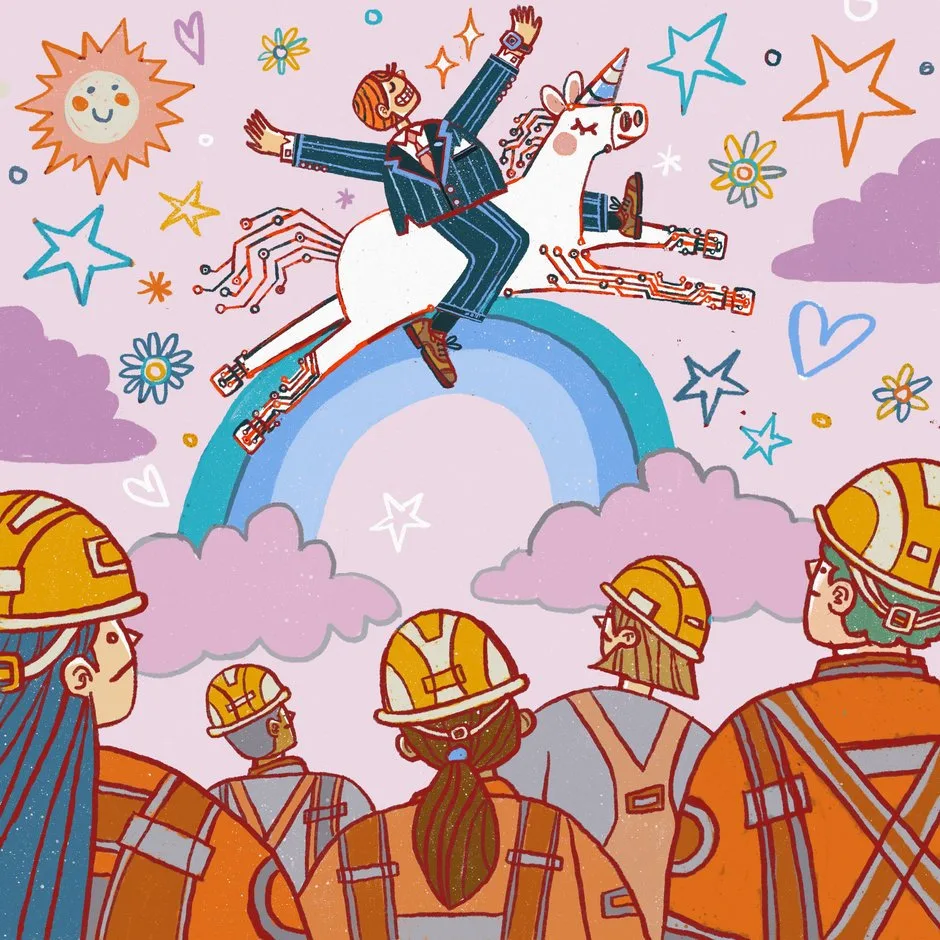
A significant divide has emerged between corporate executives and their workforces regarding the implementation of artificial intelligence, according to recent industry reports. While CEOs frequently cite productivity gains and positive outlooks in earnings calls and public statements, employees express greater concern regarding job security and a lack of transparency from leadership. Data from the Milken Institute-Harris Poll Listening Project highlights a 41-point gap in optimism: more than two-thirds of business leaders expect to be better off financially in five years due to AI, compared with only 27% of the U.S. workforce. Furthermore, a report from the Wharton School released this month found that 73% of leaders believe AI has significantly altered work processes, while only 58% of entry and midlevel employees share that assessment. "We have corner offices and cubicles driving the same economy, but living in completely different realities," said John Gerzema, CEO of the Harris Poll. "There is a gulf in hope between what leaders think AI could bring to companies and what employees feel it is taking away from them." This disconnect is compounded by a lack of perceived transparency. A survey released this month by the management consulting firm BCG found that only 15% of CEOs are concerned that their AI strategies might erode employee trust. Conversely, 40% of workers reported that their CEOs have not been sufficiently transparent regarding the impact of AI on their roles and career paths. Julia Dhar, a leader at BCG and an author of the study, warned that this lack of trust can hinder successful technological integration. "You will not get the people you need to start using it more intensively to do so," Dhar said, noting that companies may face "backsliding or regression" if employees feel alienated. Industry leaders suggest that increased communication is necessary to bridge this gap. Hemant Taneja, head of the venture capital firm General Catalyst, emphasized the need for vulnerability, noting that executives should acknowledge when they do not have all the answers. Similarly, Tim Walsh, chief of consultancy KPMG, stated that he prioritizes direct engagement with employees to understand their concerns, though he acknowledged the difficulty of eliciting candid feedback from rank-and-file staff. Despite these challenges, research from the Edelman Trust Barometer suggests that employees still maintain a higher level of trust in their own CEOs than in other institutions, such as the media, NGOs, or the government. Experts suggest that employees are often receptive to honest, specific communication from leadership, even when the full trajectory of AI implementation remains uncertain. Article source: San Juan Daily Star | Image credit: San Juan Daily Star
A significant divide has emerged between corporate executives and their workforces regarding the implementation of artificial intelligence, according to recent industry reports. While CEOs frequently cite productivity gains and positive outlooks in earnings calls and public statements, employees express greater concern regarding job security and a lack of transparency from leadership. Data from the Milken Institute-Harris Poll Listening Project highlights a 41-point gap in optimism: more than two-thirds of business leaders expect to be better off financially in five years due to AI, compared with only 27% of the U.S. workforce. Furthermore, a report from the Wharton School released this month found that 73% of leaders believe AI has significantly altered work processes, while only 58% of entry and midlevel employees share that assessment. “We have corner offices and cubicles driving the same economy, but living in completely different realities,” said John Gerzema, CEO of the Harris Poll. “There is a gulf in hope between what leaders think AI could bring to companies and what employees feel it is taking away from them.” This disconnect is compounded by a lack of perceived transparency. A survey released this month by the management consulting firm BCG found that only 15% of CEOs are concerned that their AI strategies might erode employee trust. Conversely, 40% of workers reported that their CEOs have not been sufficiently transparent regarding the impact of AI on their roles and career paths. Julia Dhar, a leader at BCG and an author of the study, warned that this lack of trust can hinder successful technological integration. “You will not get the people you need to start using it more intensively to do so,” Dhar said, noting that companies may face “backsliding or regression” if employees feel alienated. Industry leaders suggest that increased communication is necessary to bridge this gap. Hemant Taneja, head of the venture capital firm General Catalyst, emphasized the need for vulnerability, noting that executives should acknowledge when they do not have all the answers. Similarly, Tim Walsh, chief of consultancy KPMG, stated that he prioritizes direct engagement with employees to understand their concerns, though he acknowledged the difficulty of eliciting candid feedback from rank-and-file staff. Despite these challenges, research from the Edelman Trust Barometer suggests that employees still maintain a higher level of trust in their own CEOs than in other institutions, such as the media, NGOs, or the government. Experts suggest that employees are often receptive to honest, specific communication from leadership, even when the full trajectory of AI implementation remains uncertain.
News Desk is the editorial publishing account for Tringlobe Media News, covering breaking news, public affairs, entertainment, community developments and regional stories across Trinidad and Tobago, the Caribbean and internationally.