The key points are temporarily unavailable. You can still read the full Story below.
Main Points
A college degree can offer a substantial earnings advantage while still being a difficult investment for an individual student. An analysis published by the University of Wisconsin–Madison’s undergraduate economics journal, Equilibrium, argues that the decision depends on more than tuition: students must also consider what they give up while studying. The article, by Shubhi Sancheti, cites Bureau of Labor Statistics figures showing that workers with a bachelor’s degree earned approximately 65% more in median weekly income than workers with only a high school diploma in 2024. It also reports lower unemployment among college graduates. Those comparisons support the case for higher education, but they describe outcomes across groups rather than a guaranteed payoff for every enrollee. The other side of the calculation is opportunity cost. Years in college can mean foregoing full-time wages, work experience, an apprenticeship or an entrepreneurial opportunity. A student deciding whether to enroll is therefore comparing two possible paths, each with costs and uncertain benefits. Artificial intelligence adds uncertainty to that comparison. Sancheti describes AI and automation as forces reshaping white-collar work and raising concerns that skills learned today could become outdated. The analysis does not, however, establish how much AI has changed the financial return on a degree. Concern about future employment is different from evidence that the college earnings advantage has disappeared. Alternatives also deserve scrutiny. The article identifies apprenticeships, skilled trades, coding bootcamps and online certifications as routes that can offer faster entry into paid work. It does not provide comparable earnings, completion or placement figures for those options, so it cannot establish that they outperform college. Completion is a particularly important dividing line. Sancheti emphasizes that students who leave college with debt but without a degree can bear substantial costs without receiving the earnings premium associated with graduation. The burden can be greater for students who must borrow heavily or support relatives while studying. The evidence therefore supports a conditional answer. Average graduate earnings remain a reason to consider college, while cost, field of study, time away from work and the prospect of finishing shape the individual decision. AI makes that assessment more uncertain; the supplied analysis does not show that it makes degrees universally worthwhile or universally obsolete.
A college degree can offer a substantial earnings advantage while still being a difficult investment for an individual student. An analysis published by the University of Wisconsin–Madison’s undergraduate economics journal, Equilibrium, argues that the decision depends on more than tuition: students must also consider what they give up while studying.
The article, by Shubhi Sancheti, cites Bureau of Labor Statistics figures showing that workers with a bachelor’s degree earned approximately 65% more in median weekly income than workers with only a high school diploma in 2024. It also reports lower unemployment among college graduates. Those comparisons support the case for higher education, but they describe outcomes across groups rather than a guaranteed payoff for every enrollee.
The other side of the calculation is opportunity cost. Years in college can mean foregoing full-time wages, work experience, an apprenticeship or an entrepreneurial opportunity. A student deciding whether to enroll is therefore comparing two possible paths, each with costs and uncertain benefits.
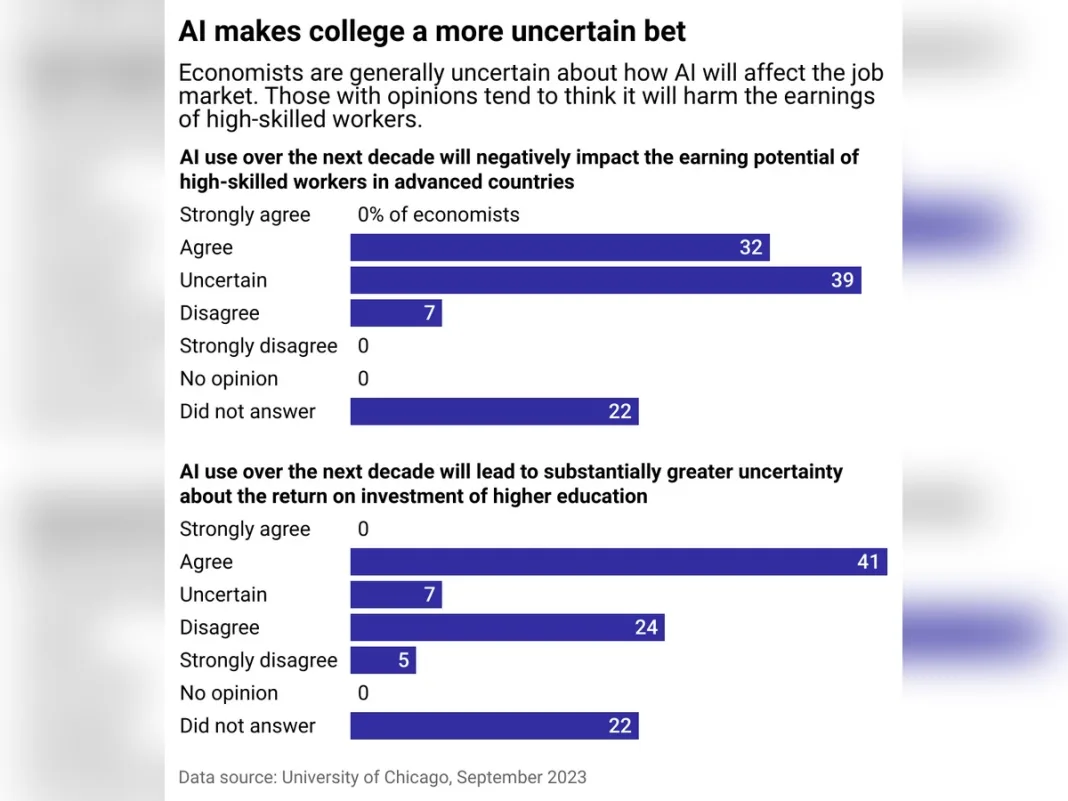
Artificial intelligence adds uncertainty to that comparison. Sancheti describes AI and automation as forces reshaping white-collar work and raising concerns that skills learned today could become outdated. The analysis does not, however, establish how much AI has changed the financial return on a degree. Concern about future employment is different from evidence that the college earnings advantage has disappeared.
Alternatives also deserve scrutiny. The article identifies apprenticeships, skilled trades, coding bootcamps and online certifications as routes that can offer faster entry into paid work. It does not provide comparable earnings, completion or placement figures for those options, so it cannot establish that they outperform college.
Completion is a particularly important dividing line. Sancheti emphasizes that students who leave college with debt but without a degree can bear substantial costs without receiving the earnings premium associated with graduation. The burden can be greater for students who must borrow heavily or support relatives while studying.
The evidence therefore supports a conditional answer. Average graduate earnings remain a reason to consider college, while cost, field of study, time away from work and the prospect of finishing shape the individual decision. AI makes that assessment more uncertain; the supplied analysis does not show that it makes degrees universally worthwhile or universally obsolete.
News Desk is the editorial publishing account for Tringlobe Media News, covering breaking news, public affairs, entertainment, community developments and regional stories across Trinidad and Tobago, the Caribbean and internationally.