The key points are temporarily unavailable. You can still read the full Story below.
Main Points
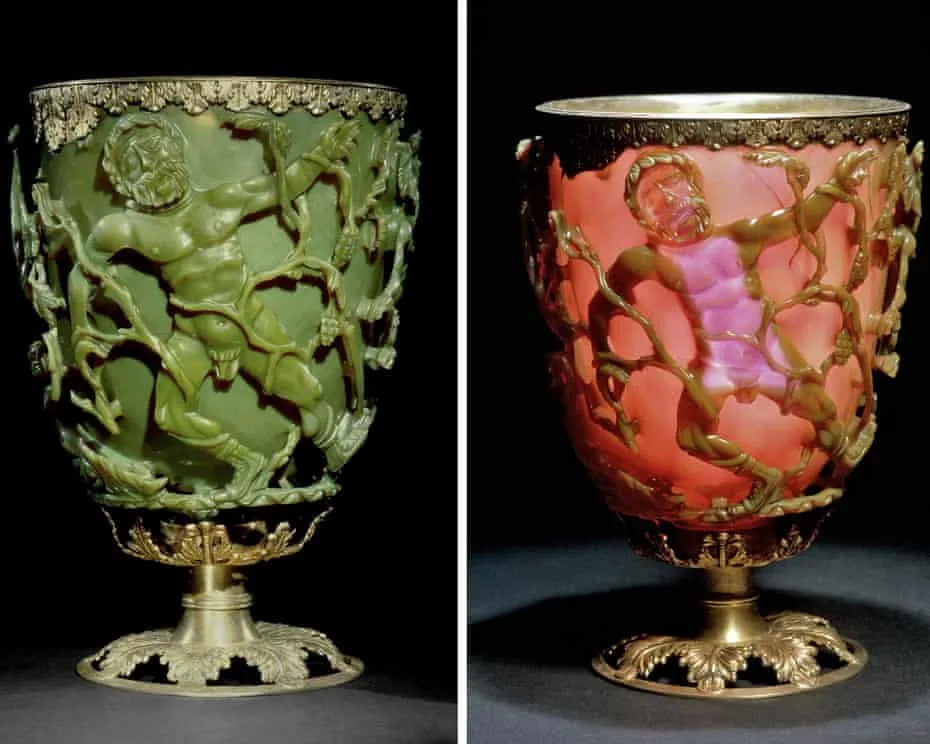
Scientists at the University of Sheffield have successfully replicated the colour‑changing effect of a 1,600‑year‑old Roman glass cup, the Lycurgus Cup, which is now housed in the British Museum. The ancient cup, a 4th‑century masterpiece, displays green jade when illuminated from the front and ruby red when light passes through from the back. In 2022 it was named one of the world’s seven wonders of glass by an international panel. Dr. Lisa Hollands, a technician in the School of Chemical Engineering, Materials and Biology at Sheffield, led the research team. “For me, this is magic,” Hollands said. “Reproducing the glass required extraordinary perseverance, as earlier attempts yielded only limited success.” She worked with Professor Caroline Jackson, a specialist in Roman glass, to incorporate gold and silver nanoparticles into the glass matrix. The particles, roughly a thousand times smaller than a grain of sand, were embedded and the glass was heated to over 1,000 °C. As the material cooled, nanocrystals of gold and silver grew around the particles, enabling the unique optical effect. “The white light we see is made up of many colours, just as a rainbow is,” Hollands explained. “When light passes through the glass, the nanoparticles absorb or scatter specific wavelengths, allowing red and orange to dominate. When light reflects off the surface, the interaction produces a muted green.” She added that if Roman artisans had witnessed the experiment, they might have laughed and asked, “Why didn’t you know how to make this?” Ian Freestone, professor emeritus of material archaeology at University College London, noted that similar colour‑changing glass had been replicated in the 1960s, but the Sheffield team’s version more closely matches the original Lycurgus Cup’s green and red hues. The study demonstrates how ancient glassmakers achieved their effects through precise manipulation of metal nanoparticles, a technique that modern scientists have now decoded and reproduced. Article source: Koran Jakarta | Image credit: Koran Jakarta
Scientists at the University of Sheffield have successfully replicated the colour‑changing effect of a 1,600‑year‑old Roman glass cup, the Lycurgus Cup, which is now housed in the British Museum. The ancient cup, a 4th‑century masterpiece, displays green jade when illuminated from the front and ruby red when light passes through from the back. In 2022 it was named one of the world’s seven wonders of glass by an international panel. Dr. Lisa Hollands, a technician in the School of Chemical Engineering, Materials and Biology at Sheffield, led the research team. “For me, this is magic,” Hollands said. “Reproducing the glass required extraordinary perseverance, as earlier attempts yielded only limited success.” She worked with Professor Caroline Jackson, a specialist in Roman glass, to incorporate gold and silver nanoparticles into the glass matrix. The particles, roughly a thousand times smaller than a grain of sand, were embedded and the glass was heated to over 1,000 °C. As the material cooled, nanocrystals of gold and silver grew around the particles, enabling the unique optical effect. “The white light we see is made up of many colours, just as a rainbow is,” Hollands explained. “When light passes through the glass, the nanoparticles absorb or scatter specific wavelengths, allowing red and orange to dominate. When light reflects off the surface, the interaction produces a muted green.” She added that if Roman artisans had witnessed the experiment, they might have laughed and asked, “Why didn’t you know how to make this?” Ian Freestone, professor emeritus of material archaeology at University College London, noted that similar colour‑changing glass had been replicated in the 1960s, but the Sheffield team’s version more closely matches the original Lycurgus Cup’s green and red hues. The study demonstrates how ancient glassmakers achieved their effects through precise manipulation of metal nanoparticles, a technique that modern scientists have now decoded and reproduced.
News Desk is the editorial publishing account for Tringlobe Media News, covering breaking news, public affairs, entertainment, community developments and regional stories across Trinidad and Tobago, the Caribbean and internationally.