The key points are temporarily unavailable. You can still read the full Story below.
Main Points
One of Trinidad's most unusual conservation sites sits inside an industrial landscape: a freshwater bird sanctuary established within the Pointe-a-Pierre oil refinery. The Pointe-a-Pierre Wild Fowl Trust was founded in 1966 as a non-profit organisation devoted to wetland conservation, education and the breeding of threatened waterbirds. Tourism Trinidad describes the site as a 26-hectare inland wetland with two lakes. Its location makes the Trust distinctive. Visitors pass through a petrochemical complex to reach forest, trails and freshwater habitat used by birds and other wildlife. The National Trust describes it as the only wildlife reserve situated within an oil-refining complex and the world's second-oldest waterfowl reserve. The organisation has worked with species whose numbers declined in the region, raising birds and supporting their reintroduction to suitable habitats. It also protects resident and visiting species that use the lakes and surrounding vegetation. Education is central to the site's purpose. Students, researchers and birdwatchers can learn how wetlands function, why waterbirds need secure habitat and how industrial activity and conservation can exist in close proximity only with deliberate management. That setting also creates an important tension. The sanctuary does not make oil refining environmentally harmless, nor does its presence remove the risks associated with heavy industry. Instead, it shows how a protected space can be maintained inside a landscape built for a very different purpose. The Trust's trails, learning facilities and rehabilitation work have helped generations of visitors see wetland birds at close range. Whistling ducks, herons, macaws and other species make the reserve a living classroom rather than simply a display area. Pointe-a-Pierre demonstrates that conservation in Trinidad is not confined to remote forests or offshore islands. It can also happen in altered environments where people decide to preserve habitat, restore species and make ecological knowledge part of everyday life. The result is a sanctuary defined by contrast: lakes and birds surrounded by one of the country's most recognisable industrial sites.
One of Trinidad’s most unusual conservation sites sits inside an industrial landscape: a freshwater bird sanctuary established within the Pointe-a-Pierre oil refinery.
The Pointe-a-Pierre Wild Fowl Trust was founded in 1966 as a non-profit organisation devoted to wetland conservation, education and the breeding of threatened waterbirds. Tourism Trinidad describes the site as a 26-hectare inland wetland with two lakes.
Its location makes the Trust distinctive. Visitors pass through a petrochemical complex to reach forest, trails and freshwater habitat used by birds and other wildlife. The National Trust describes it as the only wildlife reserve situated within an oil-refining complex and the world’s second-oldest waterfowl reserve.
The organisation has worked with species whose numbers declined in the region, raising birds and supporting their reintroduction to suitable habitats. It also protects resident and visiting species that use the lakes and surrounding vegetation.
Education is central to the site’s purpose. Students, researchers and birdwatchers can learn how wetlands function, why waterbirds need secure habitat and how industrial activity and conservation can exist in close proximity only with deliberate management.
That setting also creates an important tension. The sanctuary does not make oil refining environmentally harmless, nor does its presence remove the risks associated with heavy industry. Instead, it shows how a protected space can be maintained inside a landscape built for a very different purpose.
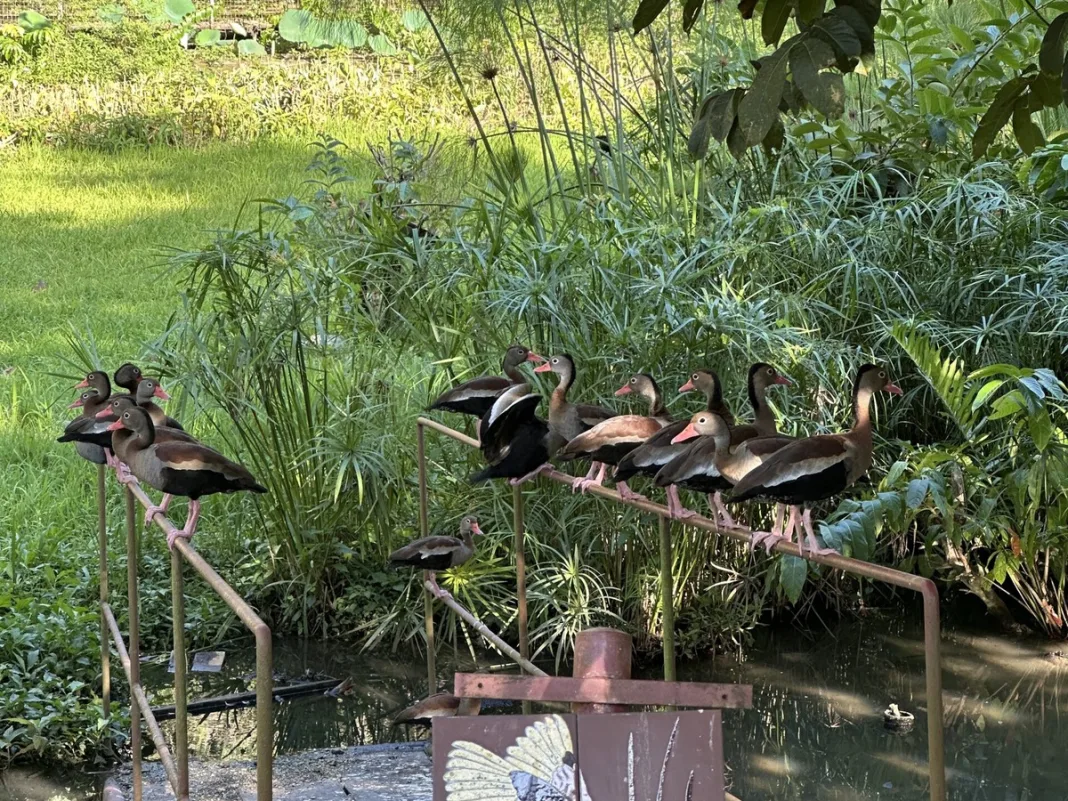
The Trust’s trails, learning facilities and rehabilitation work have helped generations of visitors see wetland birds at close range. Whistling ducks, herons, macaws and other species make the reserve a living classroom rather than simply a display area.
Pointe-a-Pierre demonstrates that conservation in Trinidad is not confined to remote forests or offshore islands. It can also happen in altered environments where people decide to preserve habitat, restore species and make ecological knowledge part of everyday life.
The result is a sanctuary defined by contrast: lakes and birds surrounded by one of the country’s most recognisable industrial sites.
News Desk is the editorial publishing account for Tringlobe Media News, covering breaking news, public affairs, entertainment, community developments and regional stories across Trinidad and Tobago, the Caribbean and internationally.