The key points are temporarily unavailable. You can still read the full Story below.
Main Points
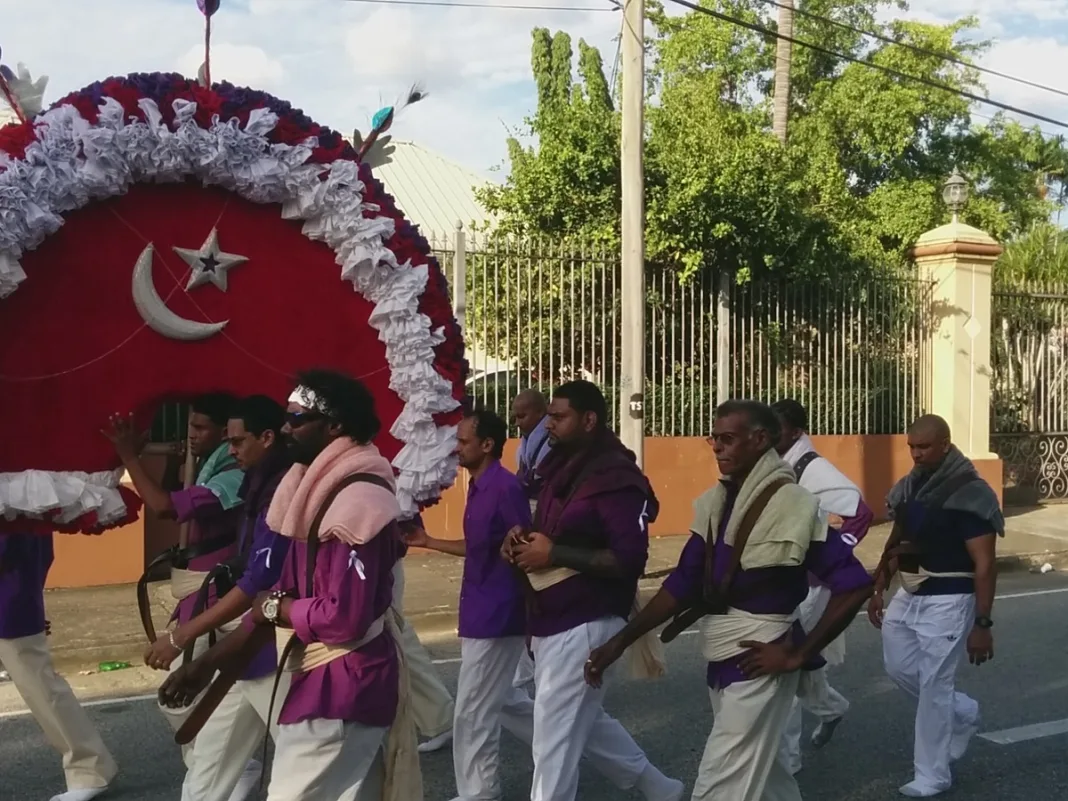
In St James, the sight of towering tadjahs moving through the streets to the pulse of tassa drums is one of Trinidad’s most recognisable cultural scenes. Yet Hosay is more than a colourful procession. It is rooted in Shi’a Muslim mourning traditions associated with Muharram and the remembrance of Husayn, grandson of the Prophet Muhammad, whose death at the Battle of Karbala in 680 became a defining event in Shi’a history.
Hosay reached Trinidad through Indian migration during the colonial period and developed a distinctive local expression. Destination Trinidad and Tobago records the first noted celebration in San Fernando in 1847, with evidence of observances in Chaguanas and St James by 1865. The name Hosay itself is derived from Husayn. Over time, the observance became especially visible in St James, where it remains closely associated with elaborate craftsmanship, community participation and tassa drumming.
The observance traditionally unfolds over ten days. The opening period is devoted to fasting, prayer and the construction of tadjahs. These ornate structures are made from materials including bamboo, coloured paper, tinsel and glass, and some rise between 10 and 15 feet. Public processions begin with Flag Night, followed by the Small Tadjah procession and then the larger procession. On the final day, Ashura, tadjahs from different groups are brought together, prayers are offered and the structures are eventually immersed in the sea or another body of water.
The history of Hosay in Trinidad also carries a painful colonial chapter. In 1884, British authorities issued an ordinance restricting public gatherings and Hosay processions. Despite appeals, processions went ahead in several communities. In San Fernando on 30 October 1884, police opened fire while attempting to disperse participants. Destination Trinidad and Tobago records that 22 people were killed. The event became known as the Muharram Massacre and remains one of the starkest examples of conflict between colonial authority and religious and cultural expression in Trinidad.
What makes Hosay especially significant in Trinidad is the way a sacred observance brought by migrants became part of the wider cultural landscape without losing its religious roots. The St James procession attracts spectators from many backgrounds, and the craftsmanship of the tadjahs and the rhythms of tassa have become familiar far beyond the Shi’a Muslim community.
That wider recognition can sometimes make Hosay appear simply festive, but its central meaning remains remembrance. Behind the colour, music and movement is a story of faith, migration, resistance and continuity. More than 170 years after the first recorded observance in Trinidad, Hosay offers a living connection between the island’s immigrant past and the cultural traditions that communities continue to preserve in public space.