The key points are temporarily unavailable. You can still read the full Story below.
Main Points
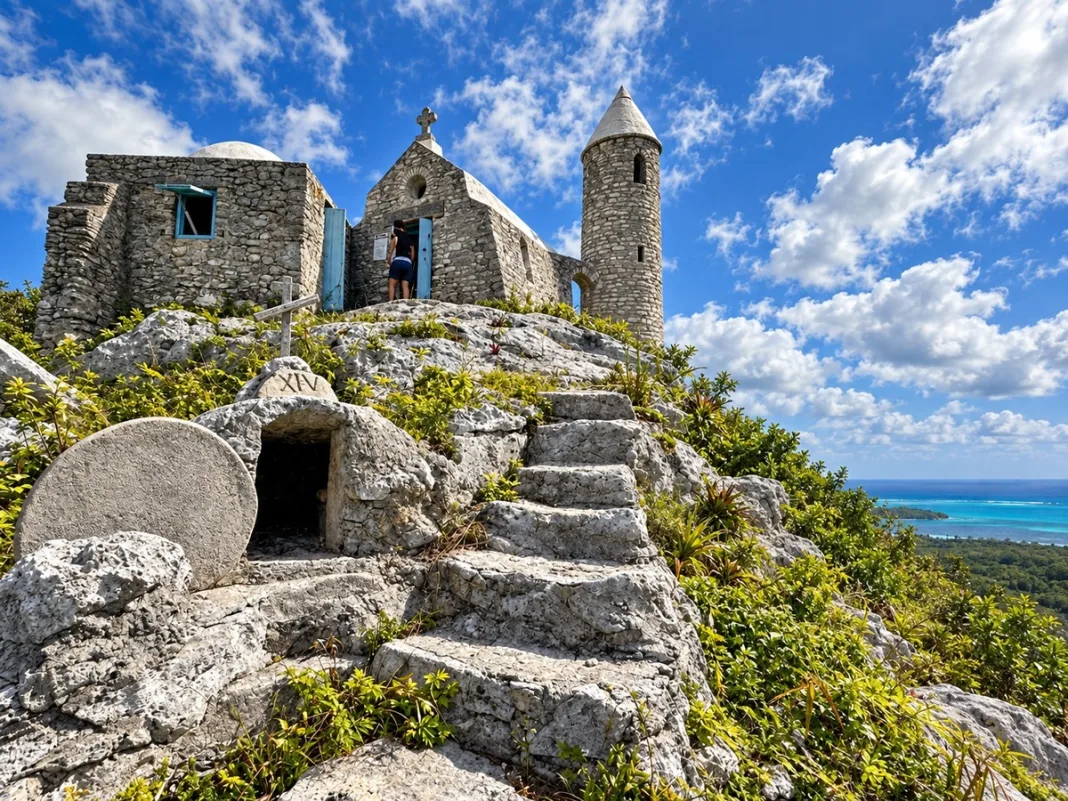
On an island better known for quiet beaches and rolling green landscapes, one of The Bahamas’ most unusual landmarks sits only 206 feet above sea level. That modest elevation is enough to make Mount Alvernia on Cat Island the highest point anywhere in the country, and at its summit stands a small stone monastery built by a priest who wanted a place to withdraw from the world.
Mount Alvernia is also known locally as Como Hill. According to the Bahamas Ministry of Tourism, Monsignor John Hawes, a Roman Catholic priest remembered on Cat Island as Father Jerome, gave the hill its present name. The name was inspired by La Verna in Tuscany, a place associated with St Francis of Assisi and religious contemplation.
Father Jerome was more than a priest. The Ministry of Tourism describes him as a skilled architect and sculptor, as well as a self-described contemplative and admirer of St Francis. In 1939, he used local stone to build The Hermitage at the summit, creating a compact medieval-style monastery where he could live and seek solitude.
The building’s location makes its story particularly striking. The Bahamas consists largely of low-lying islands, so a hill rising just 206 feet, or about 63 metres, becomes the country’s national high point. From the summit, visitors can look across Cat Island in every direction, with the Ministry of Tourism highlighting the 360-degree views available from the top.
Reaching The Hermitage is part of the experience. A stone staircase climbs a steep, rocky incline towards the monastery. Along the route are detailed stone reliefs representing the Stations of the Cross, which the official tourism site says were hand-carved by Father Jerome. The journey therefore functions not only as a climb to the country’s highest elevation, but also as a passage through the priest’s religious artwork.
The Hermitage was not Father Jerome’s only architectural contribution to The Bahamas. He is also credited with work on cathedrals and convents elsewhere in the country, including buildings on Long Island and New Providence. His combination of religious life, architecture and sculpture left a physical legacy scattered across several Bahamian islands.
Father Jerome died in 1956. The Bahamas Ministry of Tourism notes that he is said to be buried somewhere on the grounds of The Hermitage, adding another layer of mystery to the isolated hilltop retreat he created for himself.
Today, Mount Alvernia offers an unusual perspective on Bahamian geography and history. The country’s highest point is not a dramatic mountain peak but a quiet limestone hill, crowned by a hand-built monastery created by one man seeking contemplation. That combination of landscape, craftsmanship and personal history has made The Hermitage one of Cat Island’s most distinctive cultural landmarks.