The key points are temporarily unavailable. You can still read the full Story below.
Main Points
New Research Uncovers Plight of Cork Women Who Fought in Ireland’s Revolutionary Period
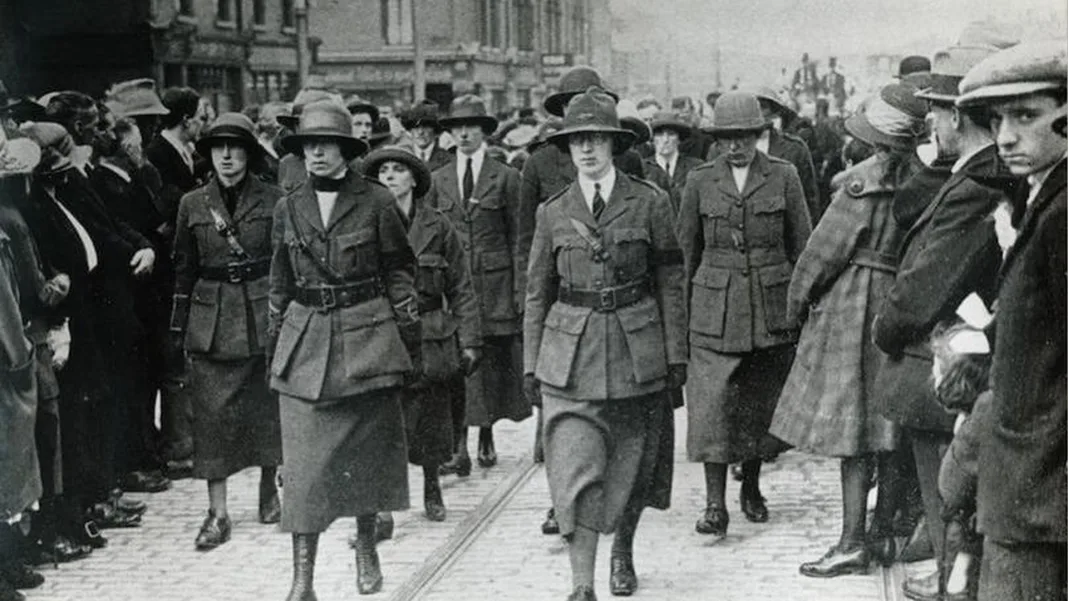
Recent research has shed light on the poverty, neglect, and quiet desperation faced by women from Cork who played a significant role in Ireland’s revolutionary period. The study, conducted by Leeann Lane, associate professor in history at Dublin City University, reveals the struggles of women who fought for Irish independence, only to be left with little to no support or recognition in the years that followed.
One such example is Mary MacCarthy, a former Cumann na mBan member from Bantry, Co Cork, who wrote to the Department of Defence in 1956 to acknowledge her special allowance, stating, “Thank you so much [I’m] very grateful. I was often hungry lately.” This poignant statement highlights the inadequacy of the military pension she received for her service during the War of Independence and Civil War.
MacCarthy’s experience was not unique. Many women who fought for Irish independence, including those who were part of the 3rd Cork Brigade, were left to struggle with poverty and neglect. Mary Doyle, a former member of the brigade, received a minimal pension for her service and was forced to write to the pensions board in 1952, stating that she didn’t want to be a burden on her brother and would consider going to the county home if she didn’t receive adequate support.
The research also highlights the difficulties faced by single women in particular, who were often forced to rely on family members for support. In a letter to the pensions board, Mary Cotter, a member of the Fermoy branch of Cumann na mBan, argued that she had qualified for a pension due to her active role in the revolution, stating, “I qualified when there was work to be done and qualified when arrested at Rathcormac and kept…under a gun for hours and my bicycle taken from me and qualified again when arrested in Watergrasshill.”
The stories of these women, including Sheila and Nora Wallace, who provided vital intelligence work during the revolution, are a testament to the significant contributions made by women during this period. Despite their bravery and dedication, many were left to live in poverty and quiet desperation, with some forced to apply for special allowances due to their dire financial circumstances.
As Leeann Lane notes, “This research seeks to restore their visibility: to identify them, to name them and to rescue them from their status as ‘unproductive’ deadweight existing on the margins of the families created by married siblings or relatives.” The research aims to acknowledge the distinct lived experiences of these women in the post-revolutionary Irish state and to fill in the many blanks in history.
An exhibition based on the research, “Cork Afterlives: Single Women and the New Irish State,” was recently held at the Boole library at University College Cork and is due to be shown at Cork Library. The Military Service Pensions Collection, available online at militaryarchives.ie, provides further insight into the experiences of these women and their struggles for recognition and support.
Article and image source: irishexaminer.com