The key points are temporarily unavailable. You can still read the full Story below.
Main Points
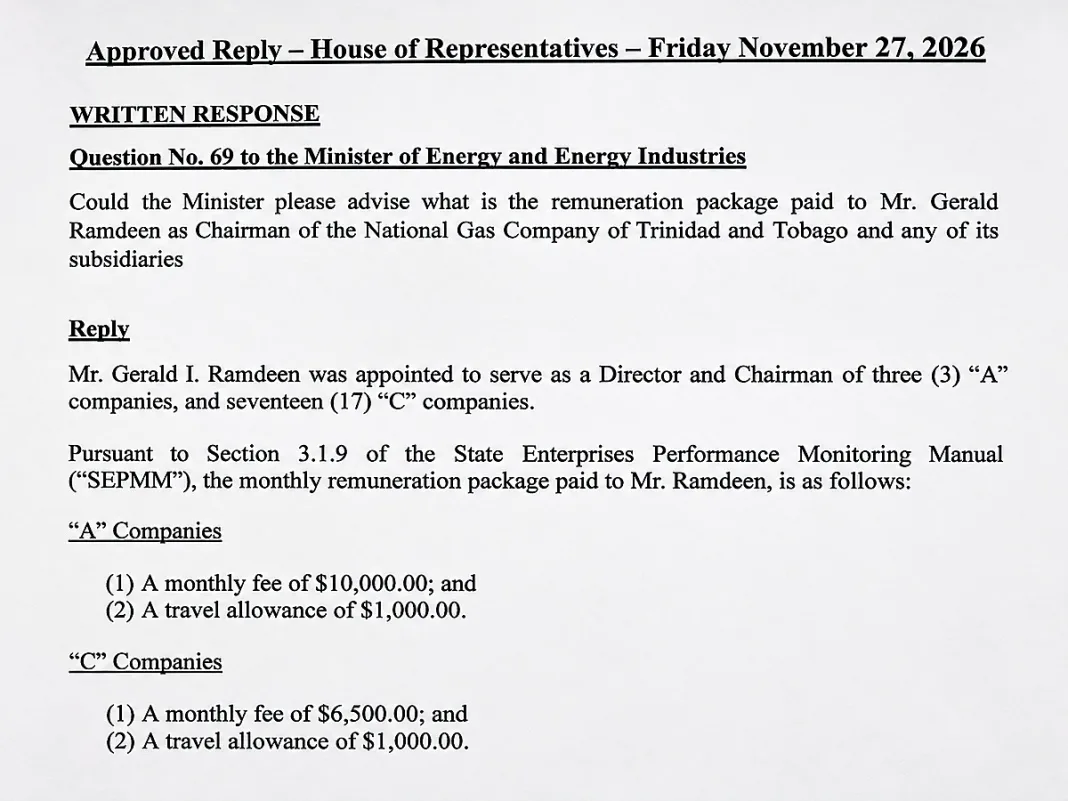
Former prime minister and Opposition MP Stuart Young has ignited a fresh debate over state enterprise remuneration after revealing that National Gas Company (NGC) chairman Gerald Ramdeen reportedly receives a combined TT$160,500 monthly for chairing companies within the NGC Group: the equivalent of TT$1.926 million annually. In a social media post on Saturday, November 28, Young cited a parliamentary response to a question he submitted concerning Ramdeen’s remuneration. He contrasted the package with reported job losses across the public sector, questioning the Government’s spending priorities. However, the practice of compensating NGC chairmen for appointments across multiple companies predates the current UNC administration. In April 2024, Young himself, then energy minister, disclosed in Parliament that former NGC chairman Dr Joseph Ishmael Khan received fees and travel allowances across 16 companies, amounting to TT$130,500 monthly, under the State Enterprises Performance Monitoring Manual. The latest figure cited by Young represents an increase of approximately 23 per cent over that amount. Ramdeen’s remuneration also comes under scrutiny amid a separate controversy surrounding legal fees claimed by attorneys representing the State in the Dominic and Genevieve Hadeed detention case. Meanwhile, under Ramdeen’s chairmanship, the NGC Group reported an after-tax profit of TT$3.46 billion for 2025, its highest in more than a decade. The controversy raises a broader question for Trinidad and Tobago: even where remuneration complies with established policy, should one individual collect multiple chairmanship fees approaching TT$2 million annually — and what benchmarks should determine whether taxpayers are receiving value for money?
Former prime minister and Opposition MP Stuart Young has ignited a fresh debate over state enterprise remuneration after revealing that National Gas Company (NGC) chairman Gerald Ramdeen reportedly receives a combined TT$160,500 monthly for chairing companies within the NGC Group: the equivalent of TT$1.926 million annually.
In a social media post on Saturday, November 28, Young cited a parliamentary response to a question he submitted concerning Ramdeen’s remuneration. He contrasted the package with reported job losses across the public sector, questioning the Government’s spending priorities.
However, the practice of compensating NGC chairmen for appointments across multiple companies predates the current UNC administration.
In April 2024, Young himself, then energy minister, disclosed in Parliament that former NGC chairman Dr Joseph Ishmael Khan received fees and travel allowances across 16 companies, amounting to TT$130,500 monthly, under the State Enterprises Performance Monitoring Manual.
The latest figure cited by Young represents an increase of approximately 23 per cent over that amount.
Ramdeen’s remuneration also comes under scrutiny amid a separate controversy surrounding legal fees claimed by attorneys representing the State in the Dominic and Genevieve Hadeed detention case.
Meanwhile, under Ramdeen’s chairmanship, the NGC Group reported an after-tax profit of TT$3.46 billion for 2025, its highest in more than a decade.
The controversy raises a broader question for Trinidad and Tobago: even where remuneration complies with established policy, should one individual collect multiple chairmanship fees approaching TT$2 million annually — and what benchmarks should determine whether taxpayers are receiving value for money?
News Desk is the editorial publishing account for Tringlobe Media News, covering breaking news, public affairs, entertainment, community developments and regional stories across Trinidad and Tobago, the Caribbean and internationally.