The key points are temporarily unavailable. You can still read the full Story below.
Main Points
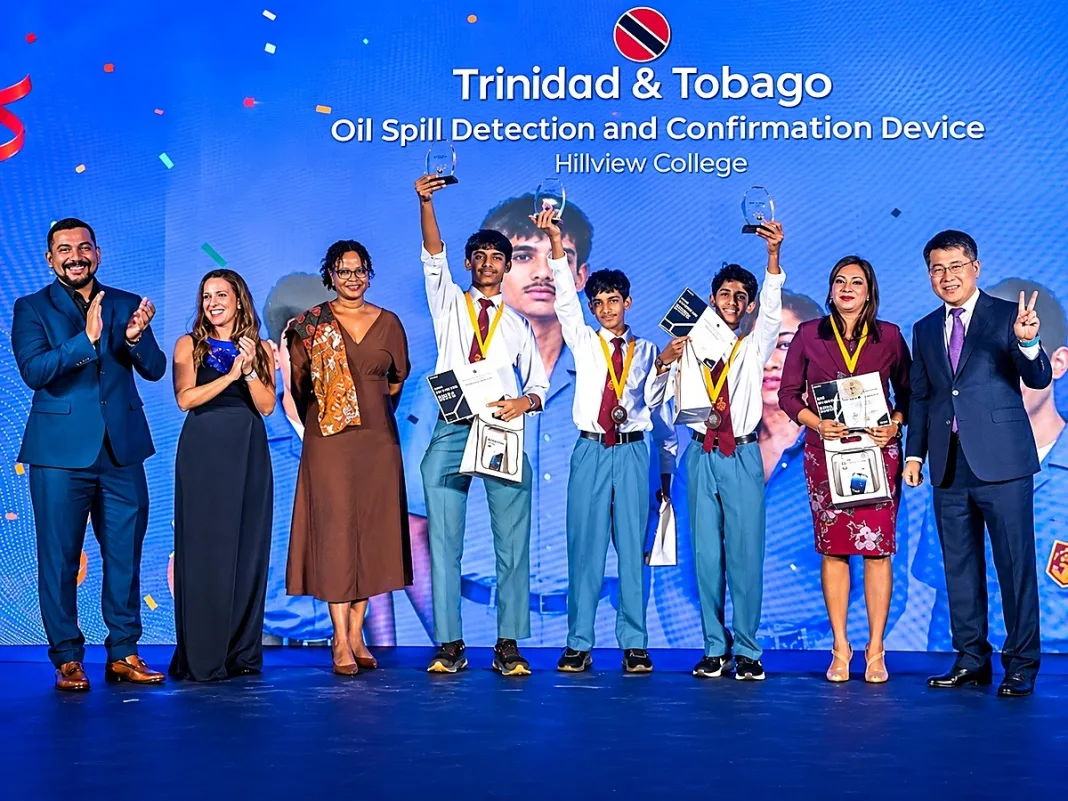
Three brilliant young minds from Trinidad and Tobago have put the nation in the international spotlight, winning Samsung’s 2026 Solve for Tomorrow regional championship with an invention designed to detect oil spills and help protect the Caribbean’s waters. Hillview College students Aaron Mahabir, Xavier Rampersad and Alex Mahabir claimed the prestigious title on November 18 at the Biomuseo in Panama City, defeating finalists from Nicaragua and the Dominican Republic. Guided by their teacher, Allison Rambally-Maharaj, the students developed an Oil Spill Detection and Confirmation Device, an innovative system mounted on an autonomous buoy that uses specialised light filters to distinguish oil from water. The technology could provide a faster, more affordable way to identify marine pollution, complementing satellite monitoring and helping authorities respond before spills cause further environmental damage. The invention is particularly relevant to Trinidad and Tobago, where oil pollution threatens marine ecosystems, fishing livelihoods and coastal communities. The students’ achievement is even more remarkable considering the scale of the competition. Samsung’s 2026 programme attracted 5,153 ideas from across the region, with national champions from 13 countries advancing towards the regional title. Judges praised the team’s scientific approach, environmental impact and potential for real-world application. Their victory is more than another trophy for Hillview College. It is a powerful reminder that world-class innovation can emerge from Caribbean classrooms.
Three brilliant young minds from Trinidad and Tobago have put the nation in the international spotlight, winning Samsung’s 2026 Solve for Tomorrow regional championship with an invention designed to detect oil spills and help protect the Caribbean’s waters.
Hillview College students Aaron Mahabir, Xavier Rampersad and Alex Mahabir claimed the prestigious title on November 18 at the Biomuseo in Panama City, defeating finalists from Nicaragua and the Dominican Republic.
Guided by their teacher, Allison Rambally-Maharaj, the students developed an Oil Spill Detection and Confirmation Device, an innovative system mounted on an autonomous buoy that uses specialised light filters to distinguish oil from water.
The technology could provide a faster, more affordable way to identify marine pollution, complementing satellite monitoring and helping authorities respond before spills cause further environmental damage.
The invention is particularly relevant to Trinidad and Tobago, where oil pollution threatens marine ecosystems, fishing livelihoods and coastal communities.
The students’ achievement is even more remarkable considering the scale of the competition. Samsung’s 2026 programme attracted 5,153 ideas from across the region, with national champions from 13 countries advancing towards the regional title.
Judges praised the team’s scientific approach, environmental impact and potential for real-world application.
Their victory is more than another trophy for Hillview College. It is a powerful reminder that world-class innovation can emerge from Caribbean classrooms.
News Desk is the editorial publishing account for Tringlobe Media News, covering breaking news, public affairs, entertainment, community developments and regional stories across Trinidad and Tobago, the Caribbean and internationally.