The key points are temporarily unavailable. You can still read the full Story below.
Main Points
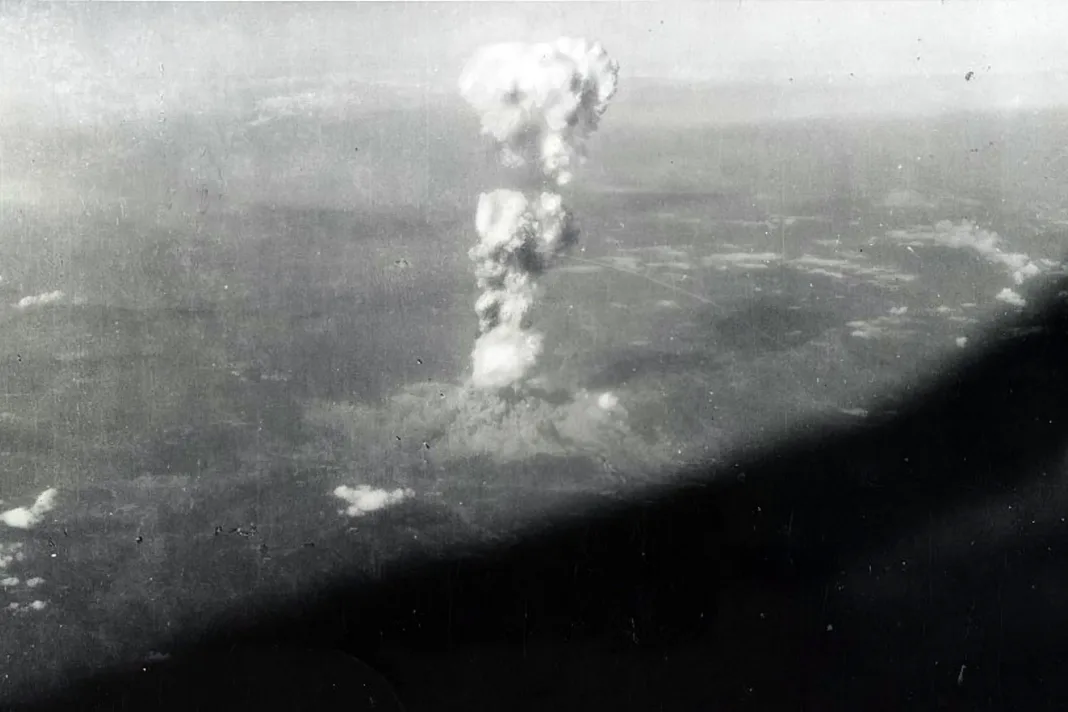
On August 6, 1945, at 8:15 a.m. local time, the United States dropped the Little Boy atomic bomb on Hiroshima. The explosion produced intense heat that ignited widespread fires, which eventually merged into a massive firestorm. As the Enola Gay aircraft departed the area, the resulting smoke and ash column rose higher and higher above the city. Nineteen minutes after the detonation, the aircraft’s navigator, Theodore Van Kirk, recorded only two words in the flight log: “CLOUD GONE.” The brief note received little attention for decades. In 2023, David Romps, a researcher at the University of California, Berkeley, and colleagues revisited the log entry to estimate the height of the firestorm’s smoke plume. Using the Enola Gay’s position, altitude, and the curvature of the Earth, the team examined how far the plume could have been visible. A contemporary military record indicated that visibility at the time was limited by atmospheric moisture and fog rather than the Earth’s curvature, suggesting that the plume had risen above the line of sight but became invisible due to weather conditions. The researchers reconstructed the 1945 atmospheric conditions, accounted for atmospheric refraction of light, and ran hundreds of thousands of simulations. Their results indicate that, with 95 % confidence, the smoke column reached at least 11.3 kilometres (approximately 7.0 miles) above ground level. The significance of this finding lies in the potential for nuclear winter. If large amounts of ash are lofted into the upper atmosphere, they can remain there for months or years, blocking sunlight and cooling the planet. Such a scenario could have severe impacts on agriculture and food supply. While Hiroshima alone did not trigger a nuclear winter, the study shows that a single nuclear detonation can produce a firestorm capable of lofting ash to altitudes that could influence global climate, according to the research reported by ScienceAlert. Article source: Magyar Hirlap | Image credit: Magyar Hirlap
On August 6, 1945, at 8:15 a.m. local time, the United States dropped the Little Boy atomic bomb on Hiroshima. The explosion produced intense heat that ignited widespread fires, which eventually merged into a massive firestorm. As the Enola Gay aircraft departed the area, the resulting smoke and ash column rose higher and higher above the city. Nineteen minutes after the detonation, the aircraft’s navigator, Theodore Van Kirk, recorded only two words in the flight log: “CLOUD GONE.” The brief note received little attention for decades. In 2023, David Romps, a researcher at the University of California, Berkeley, and colleagues revisited the log entry to estimate the height of the firestorm’s smoke plume. Using the Enola Gay’s position, altitude, and the curvature of the Earth, the team examined how far the plume could have been visible. A contemporary military record indicated that visibility at the time was limited by atmospheric moisture and fog rather than the Earth’s curvature, suggesting that the plume had risen above the line of sight but became invisible due to weather conditions. The researchers reconstructed the 1945 atmospheric conditions, accounted for atmospheric refraction of light, and ran hundreds of thousands of simulations. Their results indicate that, with 95 % confidence, the smoke column reached at least 11.3 kilometres (approximately 7.0 miles) above ground level. The significance of this finding lies in the potential for nuclear winter. If large amounts of ash are lofted into the upper atmosphere, they can remain there for months or years, blocking sunlight and cooling the planet. Such a scenario could have severe impacts on agriculture and food supply. While Hiroshima alone did not trigger a nuclear winter, the study shows that a single nuclear detonation can produce a firestorm capable of lofting ash to altitudes that could influence global climate, according to the research reported by ScienceAlert.
News Desk is the editorial publishing account for Tringlobe Media News, covering breaking news, public affairs, entertainment, community developments and regional stories across Trinidad and Tobago, the Caribbean and internationally.