The key points are temporarily unavailable. You can still read the full Story below.
Main Points
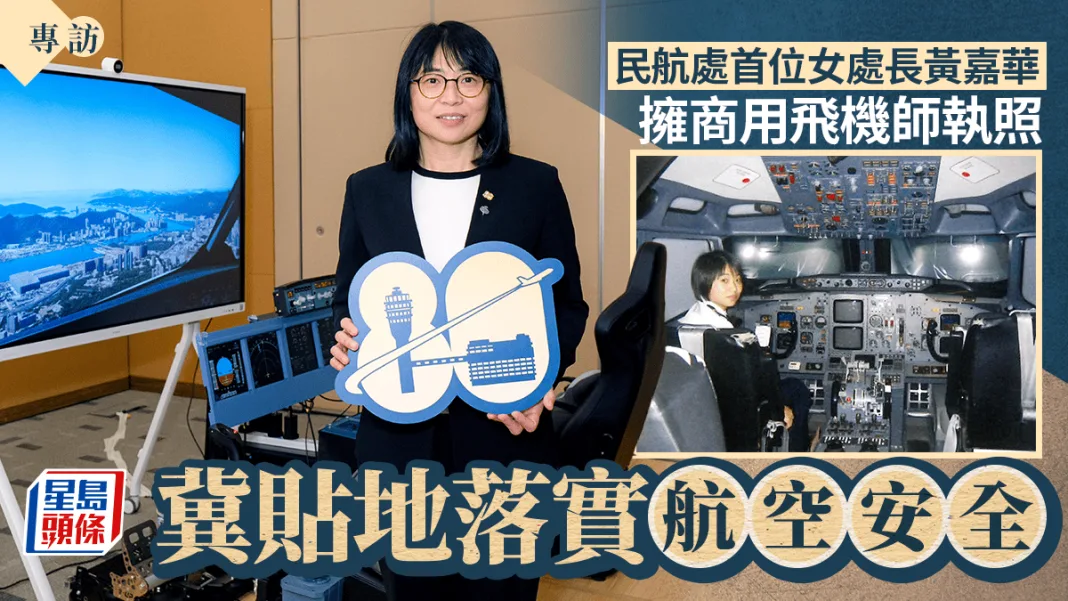
Hong Kong Civil Aviation Department (CAD) appointed its first female director, Huang Jiahua, in August 2026. Huang, who has served the CAD for 29 years, is also the department’s first director to hold a commercial pilot licence. Huang joined the CAD in 1997 and has worked in a variety of roles. In 2002 she was sent to Australia for a 14‑month flight training programme, after which she earned her commercial pilot licence. She was then seconded to a cargo airline, where she flew night cargo flights. “Flying in adverse weather and adapting to different airport requirements gave me a practical understanding of the industry,” she said. The experience, Huang says, has helped her in her current role. “Knowing how the industry operates allows me to implement safety measures and development initiatives that are grounded in real‑world practice,” she explained. Huang has witnessed the evolution of Hong Kong’s aviation sector, from the relocation of Kai Tak Airport to Chek Lap Kok and the expansion from one to three runways. She notes that the CAD’s regulatory focus has broadened from high‑altitude operations to include low‑altitude economic activities. “We must adapt to societal and industry needs and develop appropriate measures that safeguard safety while promoting growth,” she said. In her first year as director, Huang’s priority is to maintain the CAD’s professional standards in air traffic control, flight standards, airworthiness, licensing and other safety‑related functions. With new aircraft models and increasing traffic, she stresses the need for efficient airspace use and adherence to international standards. Huang also highlighted the CAD’s role as a facilitator, not just a regulator. “We sometimes step beyond enforcement to advise the industry on making plans feasible,” she said. She cited the 55‑year plan and the first five‑year plan, which aim to strengthen Hong Kong’s position as an international aviation hub. Future initiatives include expanding the air traffic network, developing low‑altitude economy, improving aircraft component handling and fostering a new aviation industry ecosystem. Talent development is another focus. Huang pointed out that beyond pilots and cabin crew, the industry relies on ground staff, maintenance crews, airline planners, discipline units, air traffic controllers, safety officers and engineering teams. “Collaboration across the sector is essential for safe operations,” she said. She hopes to encourage more experience sharing and professional succession to raise the overall capability of the CAD and its partners. Article source: Sing Tao Electronic Daily | Image credit: Sing Tao Electronic Daily
Hong Kong Civil Aviation Department (CAD) appointed its first female director, Huang Jiahua, in August 2026. Huang, who has served the CAD for 29 years, is also the department’s first director to hold a commercial pilot licence. Huang joined the CAD in 1997 and has worked in a variety of roles. In 2002 she was sent to Australia for a 14‑month flight training programme, after which she earned her commercial pilot licence. She was then seconded to a cargo airline, where she flew night cargo flights. “Flying in adverse weather and adapting to different airport requirements gave me a practical understanding of the industry,” she said. The experience, Huang says, has helped her in her current role. “Knowing how the industry operates allows me to implement safety measures and development initiatives that are grounded in real‑world practice,” she explained. Huang has witnessed the evolution of Hong Kong’s aviation sector, from the relocation of Kai Tak Airport to Chek Lap Kok and the expansion from one to three runways. She notes that the CAD’s regulatory focus has broadened from high‑altitude operations to include low‑altitude economic activities. “We must adapt to societal and industry needs and develop appropriate measures that safeguard safety while promoting growth,” she said. In her first year as director, Huang’s priority is to maintain the CAD’s professional standards in air traffic control, flight standards, airworthiness, licensing and other safety‑related functions. With new aircraft models and increasing traffic, she stresses the need for efficient airspace use and adherence to international standards. Huang also highlighted the CAD’s role as a facilitator, not just a regulator. “We sometimes step beyond enforcement to advise the industry on making plans feasible,” she said. She cited the 55‑year plan and the first five‑year plan, which aim to strengthen Hong Kong’s position as an international aviation hub. Future initiatives include expanding the air traffic network, developing low‑altitude economy, improving aircraft component handling and fostering a new aviation industry ecosystem. Talent development is another focus. Huang pointed out that beyond pilots and cabin crew, the industry relies on ground staff, maintenance crews, airline planners, discipline units, air traffic controllers, safety officers and engineering teams. “Collaboration across the sector is essential for safe operations,” she said. She hopes to encourage more experience sharing and professional succession to raise the overall capability of the CAD and its partners.
News Desk is the editorial publishing account for Tringlobe Media News, covering breaking news, public affairs, entertainment, community developments and regional stories across Trinidad and Tobago, the Caribbean and internationally.