The key points are temporarily unavailable. You can still read the full Story below.
Main Points
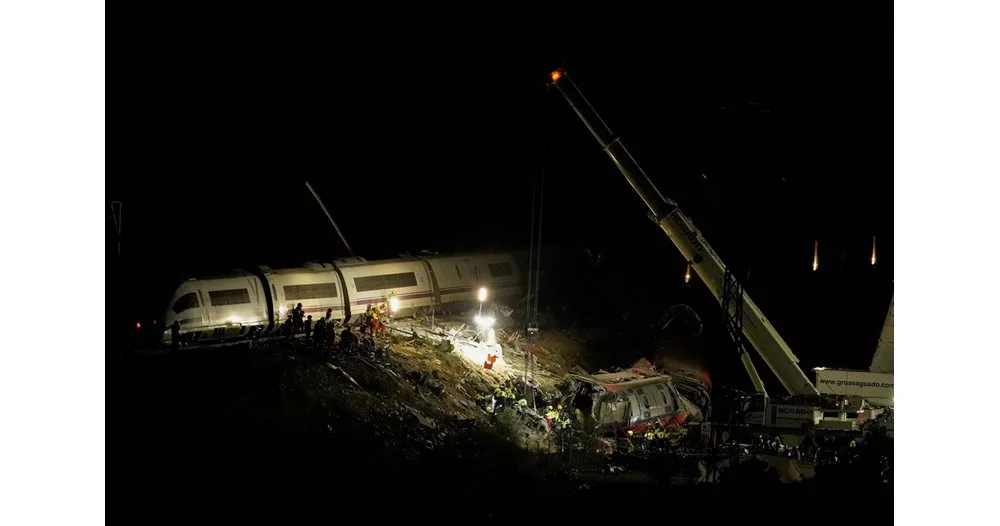
Three‑day national mourning was declared by Prime Minister Pedro Sánchez, beginning today, to honour the victims of the train collision that occurred near Toledo yesterday. The accident, which involved a head‑on collision between two trains, killed at least 68 people, according to France‑Press. It is the worst rail disaster in Spain since the 2013 incident in Santiago de Compostela, where 80 people died on 24 July, Reuters reported. Earlier this year, two separate train accidents in Spain claimed 46 lives. According to the head of the regional government of Castile‑La Mancha, Emilio García‑Pache, 108 people were injured in the Urda station crash, 58 of whom were hospitalized. The incident has raised questions about the safety of Spain’s rail network. Transport Minister Oscar Puente described the event as a “mistake” caused by “unexplained circumstances.” He said a high‑speed train operated by the state company Renfe collided with a stationary train operated by the private high‑speed operator Iryo, which is controlled by the Italian company Ferrovie dello Stato Italiane (FS). Spain’s high‑speed rail network spans 3,993 kilometres, of which 3,225 kilometres are designed for speeds above 250 km/h, making it the longest in Europe, AFP noted. Puente said the signalling system failed, triggering an automatic stop of six trains in the area, including the two involved. Minutes later, dispatchers ordered the Renfe train to depart again—a decision Puente called “wrong” and “unexplained.” The Renfe train travelled 25 kilometres before striking the stationary Iryo train at an unknown speed, BTA reported. Puente added that the dispatch centre had “enough time to detect the error but did not correct it,” as quoted by France‑Press. In a televised address near the crash site south of Madrid, Prime Minister Sánchez announced that the tragedy would be investigated and pledged to address any identified shortcomings, Reuters reported. The incident is likely to intensify criticism of Sánchez’s socialist government’s management of the rail network, AFP added. Both the Spanish Socialist Workers’ Party (PSOE) and the opposition People's Party (PP) have cancelled all planned public events from today until at least Saturday. Spain’s snap parliamentary elections are scheduled for 29 November. Emergency services continued to search the site overnight. Derailled carriages from both trains were lifted with cranes. Lanes, funeral agency minibuses, and helicopters gathered at one of the trains on a raised section of the line. Scattered metal and debris were found on the slope of the embankment, where at least three carriages had disappeared, Reuters described. A spokesperson for the Castile‑La Mancha regional government, quoted by Reuters, said that 147 passengers were aboard the Iryo train and 397 on the Renfe train at the time of the crash, around 9:00 a.m. local time yesterday (10:00 a.m. Bulgarian time). Article source: 24 Chasa | Image credit: 24 Chasa
Three‑day national mourning was declared by Prime Minister Pedro Sánchez, beginning today, to honour the victims of the train collision that occurred near Toledo yesterday. The accident, which involved a head‑on collision between two trains, killed at least 68 people, according to France‑Press. It is the worst rail disaster in Spain since the 2013 incident in Santiago de Compostela, where 80 people died on 24 July, Reuters reported. Earlier this year, two separate train accidents in Spain claimed 46 lives. According to the head of the regional government of Castile‑La Mancha, Emilio García‑Pache, 108 people were injured in the Urda station crash, 58 of whom were hospitalized. The incident has raised questions about the safety of Spain’s rail network. Transport Minister Oscar Puente described the event as a “mistake” caused by “unexplained circumstances.” He said a high‑speed train operated by the state company Renfe collided with a stationary train operated by the private high‑speed operator Iryo, which is controlled by the Italian company Ferrovie dello Stato Italiane (FS). Spain’s high‑speed rail network spans 3,993 kilometres, of which 3,225 kilometres are designed for speeds above 250 km/h, making it the longest in Europe, AFP noted. Puente said the signalling system failed, triggering an automatic stop of six trains in the area, including the two involved. Minutes later, dispatchers ordered the Renfe train to depart again—a decision Puente called “wrong” and “unexplained.” The Renfe train travelled 25 kilometres before striking the stationary Iryo train at an unknown speed, BTA reported. Puente added that the dispatch centre had “enough time to detect the error but did not correct it,” as quoted by France‑Press. In a televised address near the crash site south of Madrid, Prime Minister Sánchez announced that the tragedy would be investigated and pledged to address any identified shortcomings, Reuters reported. The incident is likely to intensify criticism of Sánchez’s socialist government’s management of the rail network, AFP added. Both the Spanish Socialist Workers’ Party (PSOE) and the opposition People’s Party (PP) have cancelled all planned public events from today until at least Saturday. Spain’s snap parliamentary elections are scheduled for 29 November. Emergency services continued to search the site overnight. Derailled carriages from both trains were lifted with cranes. Lanes, funeral agency minibuses, and helicopters gathered at one of the trains on a raised section of the line. Scattered metal and debris were found on the slope of the embankment, where at least three carriages had disappeared, Reuters described. A spokesperson for the Castile‑La Mancha regional government, quoted by Reuters, said that 147 passengers were aboard the Iryo train and 397 on the Renfe train at the time of the crash, around 9:00 a.m. local time yesterday (10:00 a.m. Bulgarian time).
News Desk is the editorial publishing account for Tringlobe Media News, covering breaking news, public affairs, entertainment, community developments and regional stories across Trinidad and Tobago, the Caribbean and internationally.