The key points are temporarily unavailable. You can still read the full Story below.
Main Points
A country’s wealth figures can improve without every household experiencing the same progress. Research using the United States’ 2022 Survey of Consumer Finances offers a revealing example: wealth became less concentrated at the very top than it had been in 2016, even as income inequality increased. In a 2025 working paper disseminated by the National Bureau of Economic Research, economists Moritz Kuhn and José-Víctor Ríos-Rull report that the wealthiest 1% held 35% of total wealth in 2022. That was down from a peak of 39% in 2016, but still represented a highly concentrated distribution. The researchers attribute the decline in concentration to strong housing price appreciation that disproportionately benefited middle-class households. Their finding complicates the assumption that every rise in asset values necessarily widens the wealth gap: which assets rise, and who owns them, matters. It also illustrates why income and wealth should be examined separately. The paper finds rising income inequality alongside falling wealth concentration over this comparison. A household’s position in the distribution of accumulated wealth can therefore move differently from its position in the distribution of income. Generational comparisons reveal another uneven pattern. According to the researchers, younger generations accumulated less wealth than their predecessors had at comparable ages. Comparing people at similar ages is important here: the finding concerns differences between generations, rather than simply observing that young adults have had less time to accumulate assets than older adults. Family circumstances also matter. The paper highlights the financial vulnerability of single-parent households and examines labor market differences that contribute to wealth disparities beyond standard employment categories. Even the reasons households save differ across the distribution. Precautionary saving dominates among lower-wealth households, the researchers report, while retirement planning and leaving bequests become more prominent at the top. Those differences show that financial resources serve different priorities across households. The study does not measure whether Americans feel poor, nor does its excerpt compare consumer prices, public services or current household purchasing power. It cannot settle that broader question. What it does establish is that a national wealth headline can conceal divergent experiences: housing gains can reduce overall concentration while younger generations lag behind and financially vulnerable families face different pressures.
A country’s wealth figures can improve without every household experiencing the same progress. Research using the United States’ 2022 Survey of Consumer Finances offers a revealing example: wealth became less concentrated at the very top than it had been in 2016, even as income inequality increased.
In a 2025 working paper disseminated by the National Bureau of Economic Research, economists Moritz Kuhn and José-Víctor Ríos-Rull report that the wealthiest 1% held 35% of total wealth in 2022. That was down from a peak of 39% in 2016, but still represented a highly concentrated distribution.
The researchers attribute the decline in concentration to strong housing price appreciation that disproportionately benefited middle-class households. Their finding complicates the assumption that every rise in asset values necessarily widens the wealth gap: which assets rise, and who owns them, matters.
It also illustrates why income and wealth should be examined separately. The paper finds rising income inequality alongside falling wealth concentration over this comparison. A household’s position in the distribution of accumulated wealth can therefore move differently from its position in the distribution of income.
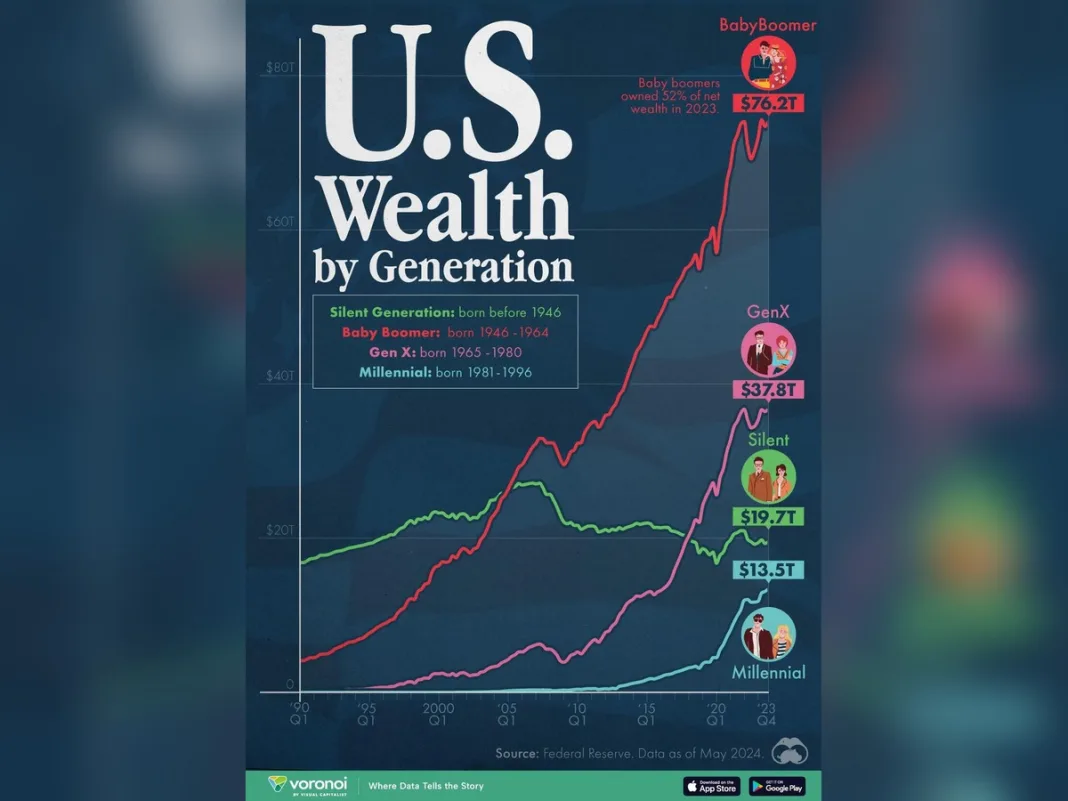
Generational comparisons reveal another uneven pattern. According to the researchers, younger generations accumulated less wealth than their predecessors had at comparable ages. Comparing people at similar ages is important here: the finding concerns differences between generations, rather than simply observing that young adults have had less time to accumulate assets than older adults.
Family circumstances also matter. The paper highlights the financial vulnerability of single-parent households and examines labor market differences that contribute to wealth disparities beyond standard employment categories.
Even the reasons households save differ across the distribution. Precautionary saving dominates among lower-wealth households, the researchers report, while retirement planning and leaving bequests become more prominent at the top. Those differences show that financial resources serve different priorities across households.
The study does not measure whether Americans feel poor, nor does its excerpt compare consumer prices, public services or current household purchasing power. It cannot settle that broader question. What it does establish is that a national wealth headline can conceal divergent experiences: housing gains can reduce overall concentration while younger generations lag behind and financially vulnerable families face different pressures.
News Desk is the editorial publishing account for Tringlobe Media News, covering breaking news, public affairs, entertainment, community developments and regional stories across Trinidad and Tobago, the Caribbean and internationally.